Religion


  • Pope Francis Promotes Collaborative Structure

    The least collaborative organization is changing its structure.

    Which organization? Well, here are some of its characteristics. This global enterprise pays a few people to make decisions while everybody else follows orders. The CEO’s direct reports act like a royal court and compete for face time. Senior leaders often live lavishly and consume conspicuously. Headquarters micromanages satellite offices. Bureaucracy and formality reduce efficiency.  Internal competition runs rampant. The command-and-control organizational structure quashes dissent.

    Sound familiar? This description fits many global corporations and government entities. This particular multinational spent $170 billion in the United States in 2010, according to The Economist. The organization is the Catholic Church and, more specifically, the Roman Curia, the church’s centralized administrative operation.

    Like many corporations, the Catholic Church suffers from an obsolete organizational structure that is compromising value. And like many corporations, reform-minded leaders have tried introducing a new approach. But entrenched interests and a centralized bureaucracy rife with intrigue, fiefdoms, and Machiavellian motivations has frequently derailed change.

    Enter Pope Francis setting the stage for change by wearing a simple white robe and black shoes rather than the regal vestments and ruby shoes of his predecessor. He has washed the feet of inmates and has Pope Francis smallopted to live in a guest quarters rather than the Vatican’s deluxe papal apartments in the Apostolic Palace. There are signs the Pope’s frugal tone is rippling across the Church. In March, the Pope accepted the resignation of Bishop Franz-Peter Tebartz-van Elst of Limburg, Germany who spent the equivalent of $43 million on a new house and office complex.  In April, the Atlanta Archdiocese announced that it would sell Archbishop Wilton Gregory’s $2.2 million mansion.
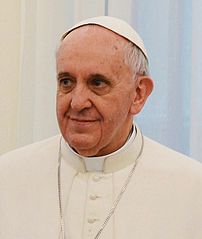
    Beyond Pope Francis’ rejection of the trappings of office, he is taking steps to adopt a more collaborative structure in the Roman Curia and in the global Catholic Church. The Pope has chosen a “working group” of eight cardinals from outside the Curia to collaborate with him on changing the structure.

    Cardinal Francesco Coccopalmerio heads the Vatican department that writes the church laws that will codify reforms. The Religion News Service quotes Cardinal Coccopalmerio as saying “The big change is the emphasis on collegiality, on collaboration.” Now Pope Francis, Cardinal Cocopalmerio and other new church leaders are focused on breaking down barriers among silos so that information flows around the organization rather than from top to bottom. Cardinal Cocopalmerio has proposed naming a “moderator of the Curia” to identify inefficiencies and cut through red tape.

    Pope Francis participates in meetings without dominating them and embraces broad input. Cardinal Donald Wuerl of Washington, D.C. recently attended one such meeting at the Vatican about appointing new bishops. Typically, popes never attend such meetings. Pope Francis reportedly stayed for three hours. “We’re all sitting around the table, and he comes in and pulls up a chair,” Cardinal Wuerl told Fox News.  At another similar meeting, a senior cardinal asked the Pope what he thought about the topic. “If I told you what I think, you would all agree,” Pope Francis responded according to Cardinal Wuerl. “I want to hear from you what you think.”

    Perhaps most significantly, according to Cardinal Wuerl, the Pope has repeatedly advocated a collaborative process through which “the Holy Spirit can be heard.”  And the Holy Spirit isn’t going to be heard if just one person speaks. “He wants all of us to be speaking with him so at the end of the day he can say this truly was the fruit of the work of the Spirit.”

    Hallelujah. Many corporations in multiple industries including United States government agencies can learn from the Pope’s example. It takes more than window dressing and a desire for change to create value through collaboration.  The only viable approach is changing the organizational structure which, in turn, shifts the culture. My research on collaboration indicates that changing the structure requires seven steps—plan, people, principles, practices, processes, planet and payoff. Pope Francis has demonstrated that making progress through these steps requires that a leader set the stage for change so that others feel comfortable participating.

    In essence, The Bounty Effect has hit the Catholic Church. The Bounty Effect happens when exigent circumstances compel companies, governments and organizations to change their structures from command-and-control to collaborative. For the Catholic Church, exigent circumstances range from sexual abuse scandals to corruption and cronyism at the Vatican. And it’s The Bounty Effect that led to the election of Pope Francis and the structural change now underway.


  • U.S. Embassy Vatican Gains Influence by Sharing

    After delivering a keynote speech for the Tagetik User Conference 2010 in Lucca, Italy late last month, I wanted to experience first-hand the collaborative movement in the United States Department of State.

    So, I visited the United States Embassy to the Holy See. With only six diplomats plus local staff, the embassy is undoubtedly one of America’s smallest. Unlike every other U.S. embassy, Embassy Vatican represents the U.S. government not just to a sovereign nation, but also to the largest single organization on Earth. That organization is the Catholic Church and its 1.2 billion Catholics globally.

    With a geographically-dispersed constituency, Embassy Vatican requires more than a physical location to accomplish U.S. policy objectives. That’s where virtual or eDiplomacy plays a role. Sure, there are often reasons for U.S. diplomats to press the flesh with Church officials, but Embassy Vatican need not be physically located in the Vatican. And, in fact, it’s not. The embassy is across the Tiber River in Rome, Italy.

    To reach the embassy, I made my way to Aventine Hill, an upscale neighborhood of Rome. What distinguishes the villa housing Embassy Vatican from the other mansions on the tree-lined block is the soldiers and small artillery across the street, security at the gate plus metal detectors at the entrance to the building. I waited in a converted living room decorated with portraits of former U.S. ambassadors and pictures of popes with U.S. presidents ranging from Reagan to Obama.

    Vatican Embassy - Julieta Valls Noyes In time, I was shown into an elegant office with a view of the embassy’s lush garden. Julieta Valls Noyes, Deputy Chief of Mission, extended her hand. She then introduced Mark Bakermans, Embassy Vatican’s point person on collaborative tools. After brief pleasantries, Julieta was ready to embrace the informality so necessary to collaboration. “I’ve already greeted you, so I can remove my jacket,” she smiled.

    Our conversation focused on the challenges of representing the United States to a global constituency. “We’re a small embassy, but what happens here has universal interest,” according to Julieta. To encourage information exchange and collaboration, Julieta had advocated building a Microsoft SharePoint portal for the embassy. However, according to Julieta, the tiny embassy lacked the necessary bandwidth. So, the State Department’s eDiplomacy team sent people to Rome. In May of 2009, a Diplopedia wiki-based internal site went live. For more on Diplopedia, see my September 14, 2010 post on “Taking Collaborative Risk at the State Department.”

    Clearly, Embassy Vatican’s use of Diplopedia is raising the embassy’s profile within the State Department. On an average month, the site gets 300 to 400 visitors. But that number spikes considerably when issues involving the Catholic Church hit the news. As the Catholic Church sex scandal bubbled up to banner headlines last February, Embassy Vatican’s Diplopedia site became a State Department clearinghouse for information on the scandal and the Church’s reaction to it. Most of the staff at Embassy Vatican contributes to the Diplopedia site, but Mark noted that the challenge is getting people across the State Department to comment on posts and share knowledge. For Diplopedia to enhance collaboration, consumers of information must also become contributors to information.

    I asked Julieta whether she would provide an inside view of the State Department’s internal ideation tool called Secretary Clinton’s Sounding Board, which is based on a blogging platform. For more on Secretary Clinton’s Sounding Board, see my September 14, 2010 post. Julieta invited me to sit on the edge of her desk (more informality!) as we viewed spirited debate from employees on topics ranging from recruitment of Hispanics to paying interns. Notably, one of the State Department’s most senior officials participated in the discussion and helped shape the ideas.

    The State Department has used Secretary Clinton’s Sounding Board to create workplace improvements. These range from installing showers for team members who ride bicycles to installing donation boxes so that employees can deposit left-over foreign currency from trips. The State Department then uses the money to aid families of Department people such as those who were Haiti earthquake victims. Ultimately, the State Department may use the ideation tool to craft diplomacy. Julieta insists that a separate ideation tool for diplomacy hosted on the Department’s classified site makes more sense than integrating diplomacy with workplace issues.

    Like so many organizations, the State Department still faces cultural issues that impede collaboration. These include rank-consciousness, unnecessary manifestations of hierarchy and silos among levels, teams and regions. Nevertheless, collaborative culture is starting to take hold—and tools like Diplopedia and Secretary Clinton’s Sounding Board are extending and enhancing that culture.


  • Visual Collaboration and a Prosecution Dream Team

    I had lunch the other day with J. Christopher Anderson, part of the prosecution “dream team” recently honored with a “home run hitters award” from the National District Attorney’s Association. The award stems from the efforts of Chris and his colleagues in the Lucas County Prosecutor’s Office in Ohio to solve a cold murder case.

    The case involved the stabbing death in 1980 of a Toledo nun. Prosecutors persuaded a jury last year to convict Toledo priest Gerald Robinson of the murder. During the trial, witnesses testified that Sister Margaret Ann Pahl was stabbed 31 times, including nine wounds shaped like an inverted cross and made through an altar cloth.

    Chris mentioned how he and his colleagues are using the SMART Board interactive whiteboard from SMART Technologies in Calgary, Alberta, Canada. SMART is particularly helpful in presenting scientific evidence-oriented cases such as the Gerald Robinson trial, because prosecutors can mix images, video and other digital files on the board and annotate the content to help juries understand their arguments. In one case, Chris says he used the SMART board to demonstrate through an animation how a bullet pierced a door.

    Using interactive whiteboards helps collaborators achieve common goals. For prosecutors, the goal is a conviction. While using an interactive whiteboard at a trial is more presentation-oriented, prosecutors can also use such tools more collaboratively while developing trial strategy. And many other occupations can enhance goal achievement and collaboration through interactive whiteboards. For engineers, the goal might be designing a world-class skyscraper or developing a more effective integrated circuit. For businesspeople, the goal might be penetrating a new market.

    When we talk about collaboration tools, we’re usually referring to tools that collaborators in different locations use. In The Culture of Collaboration book, I point out that as distance collaboration tools get better, our challenge is to collaborate as effectively in the same room as we do remotely. Interactive whiteboards address this issue. We can push content from our laptops to the boards, group write documents, work together on graphic design or presentations, and even edit videos together in the same room. The take-away is that collaboration should be as effective when we’re sharing the same physical space as it is when we’re geographically-dispersed.