California Academy of Sciences


  • Star Culture Trips Up Venice

    It’s called Ponte della Costituzione, the fourth footbridge over Venice’s Grand Canal. The glass and steel structure has caused nothing but headaches—and some muscle aches—for  tourists, Venetians and the officials who run their city.

    When Venice commissioned an architect to build the new bridge in the late 1990s, the job went to Santiago Calatrava. Named by Time magazine to the Time 100, one of the hundred most influential people in 2005, Calatrava has chalked up dozens of awards and honorary doctorates. His celebrated projects range from the World Trade Center Transportation Hub in New York City to the Museum of Tomorrow in Rio de Janeiro, Brazil. And the New York Times calls Calatrava a “star architect.”
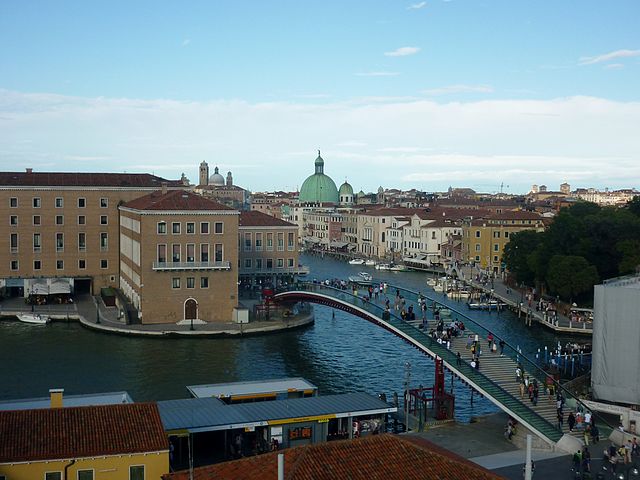
    Ponte della Costituzione
    Venice’s Ponte della Constituzione. Photo by Christoph Radtke. Licensed under CC BY 3.0. No changes made.

    The problem is that the Zurich, Switzerland based architect apparently failed to adequately consider practicalities impacting Venetians who cross the bridge regularly and tourists who cross when visiting one of Italy’s most visited cities. For starters, the bridge lacks disabled access. Also, the glass floor has caused many people to slip and fall. According to a story in Architectural Digest, some Venetians have cracked their chins and foreheads and others have reportedly broken bones. City officials have told media outlets that injuries occur almost daily.

    Because too many injured pedestrians have sued the City of Venice over the multimillion dollar bridge, the city has decided to allocate more than half a million dollars to replace the glass with trachyte stone. This expense comes after a failed 1.5 million Euro modification to install a cable car so that people could cross the bridge without injury.

    What has caused heartache, bone ache, lawsuits and wasted taxpayer dollars is star culture. Rather than designing a bridge for the practical needs of tourists and others who regularly cross the canal, Calatrava was apparently too focused on capturing and representing Venice’s “embrace of modernity” as the New York Times puts it. Rome’s Court of Auditors found that Calatrava was negligent in failing to account for the number of tourists dragging their bags across the bridge. Calatrava argued that bag dragging constitutes “incorrect use.”

    Stars tend to get swept up by things like symbolism, messaging and virtue signaling. Collaborative architects seek input from people who will use the structure they’re designing. In The Bounty Effect: 7 Steps to The Culture of Collaboration®, I describe how architect Renzo Piano made no sales presentation but rather pulled ideas from his clients in collaboratively conceptualizing and designing the California Academy of Sciences in San Francisco.

    Undoubtedly, Calatrava has chalked up major accomplishments, but accomplished professionals run the risk of buying their own hype. When people are made to believe they can do no wrong, they often make decisions in a vacuum and may work without adequate input from others. This feeds star culture for which the media has an insatiable appetite. Yet we must resist the temptation, because star culture sucks value out of companies, governments and communities.


  • California Academy of Sciences Collaborates to Discover Mammals

    Collaboration requires long-term thinking. That’s where universities, libraries, museums, and research organizations often eclipse for-profit companies. Pressure to generate quarterly returns can compromise long-term value, particularly at publicly-held companies. With less pressure to deliver immediate results, research-driven, non-profit organizations can focus more on creating long-term value. Maybe it’s a new take on history or a scientific discovery. Regardless, the work product may remain relevant hundreds of years from now.


    That said, competition internally and within fields of study can prove more ferocious in the research arena than in corporations—whether it’s competing for limited grant dollars or for publishing articles in academic journals. Like corporations, the best research organizations mitigate unhealthful competition by thinking and acting towards creating long-term value. In this realm, long-term value can extend into eternity.


    Knowing the collaborative mindset of the California Academy of Sciences, I accepted an invitation to attend a briefing and preview tour last Thursday of the Academy’s new Extreme Mammals exhibit, which runs through September 12, 2010. For background on architectural collaboration in the Academy’s building design, see my February 17, 2009 post.


    San Francisco is the Extreme Mammals exhibit’s second stop after opening at the American Museum of Natural History in New York.  Over tea and cupcakes, I had a compelling pre-tour conversation with Greg Farrington, the self-proclaimed “chief penguin” or executive director of the Academy. Farrington, a chemist, is the former president of Lehigh University. “You might think everything in the world has been discovered at least twice, but it hasn’t,” Farrington noted. Touring the exhibit confirmed Farrington’s point.

      
    Elephant-shrew
      
    The exhibit features extinct, living and recently-discovered mammals including the striped rabbit identified as a new species in 1999 and the gray faced sengi or giant elephant shrew discovered in 2008. Galen Rathbun,  
    a behavioral biologist at the Academy and Francesco Rovero of the Trento Museum of Sciences in Italy and other collaborators discovered the gray-faced sengi in the Ndundulu Forest in Tanzania’s Udzungwa Mountains. It was the first new species of giant elephant shrew discovered in 126 years.


    Rathbun accompanied us on the tour and later took a small group behind several locked doors to view a collection of shrew specimens shelved inside fireproof cabinets in the Academy’s research collections. The collections include 26 million specimens of animals, insects, reptiles, birds, plants, fish and gems. Rathbun noted that several collaborating research institutions had loaned shrew specimens to the Academy for research.


    One participant asked birds and mammals curator Jack Dumbacher if we could look inside the special cabinet that contains extinct animals and so-called “type specimens” of newly-discovered mammals. Dumbacher obliged, and we walked down the aisle past many rows of cabinets until we reached a shorter cabinet set apart from the others. As Jack unlocked the cabinet, he unleashed a ripe odor along with a feast for the eyes of preserved birds, rodents, and bats. The treasures also include the largest egg in the world from the elephant bird of Madagascar. A model of the egg is on display in the Academy’s public area.


    Back to the public galleries and the Extreme Mammals exhibit. Scientists and administrators from global institutions have collaborated on the show, which the American Museum of Natural History organized. Collaborators shared knowledge, pieced together skeletons and gathered skulls, fossils and taxidermy specimens for Extreme Mammals. The result is a compelling experience for visitors who gain insight into the extreme variety of mammals and the awesome biodiversity of our planet.