Collaborative Leadership


  • How Bean Counting Compromised Value at General Motors

    Too often companies emphasize numbers over products and forecasting over customers. Such firms typically focus on short-term results over long-term value. This creates greater internal competition and encourages shorter-term supplier relationships rather than enhancing collaboration internally among functions and externally with business partners.

    The relentless focus on numbers at the expense of domain expertise figures prominently in the book, Car Guys vs. Bean Counters (Portfolio, 2011) by Bob Lutz, former vice chairman of General Motors. Fifty years ago, GM products were the epitome of design. Over the last half century, though, the company’s products have steadily lost traction with customers. This decline culminated in the company’s reorganization under Chapter 11 in June of 2009. While many factors contributed to GM’s bankruptcy, short-sighted bean counting was undoubtedly one of them.

    “It’s time to stop the dominance of the number crunchers, living in their perfect, predictable, financially projected world,” writes Bob, who specializes in getting people’s attention. I first encountered Bob early in my career when I was reporting on the auto industry and attending the introduction of the Jeep Grand Cherokee at the 1992 North American International Auto Show in Detroit. Bob exuded machismo as he drove the SUV through a plate-glass window into the hall, shocking me and other journalists awaiting the usual dull presentations. At the time, Bob was president of Chrysler.

    Bob’s detractors consider him an old-school, shoot-from-the-hip executive who makes decisions based on his gut with little analysis. In reality, Bob understands the need for left brain and right brain driven people to collaborate regardless of their titles or functions. And he encourages more junior people to challenge him. In short, he values constructive confrontation, one of the ten cultural elements of collaboration I introduce in my book, The Culture of Collaboration

    The former Marine Corps pilot insists that “car guys” should run auto companies, “supermarket guys” should run supermarkets, and “software guys” should run software companies. He concedes that these “guys” can be of either sex. Too often, as I noted in The Culture of Collaboration book, boards of directors and senior leaders believe that if they hire “star players” these supposed stars can and will achieve results regardless of their domain knowledge or industry experience. Some prominent management consulting firms reinforce this skewed logic. The so-called star players are typically numbers-driven MBA’s interested more in units rather than in products and in forecasting rather than in customers. The organization promotes these internally-competitive numbers crunchers and sidelines others who focus on improving products and interacting with customers.

    Of course, quantitative analysis is critical to any business. The problem arises when quantitative analysis dominates and pervades every aspect of a business while designing awesome products and creating market stickiness take a back seat. As Lutz chronicles in his entertaining and informative Chevrolet 1957 book, once upon a time design dominated the auto industry. Think of the tail fin era of the late 1950’s which gave rise to cars including the 1957 Chevrolet and the 1959 Cadillac (see images, Chevy image courtesy Trekphiler). Designers originated products. By the 1970’s, General Motors had reigned in designers, made design “part of the system,” and assigned product origination to a department called Product Planning staffed by former finance people.

    Neither the old design-driven General Motors nor the newer numbers-driven organization is a model of collaboration. In the 1960’s, when design and the designers were at their pinnacle, Lutz writes thatCadillac 1959  chief designers in well-tailored suits graced magazine covers. Essentially, designers had become stars and expected star status and treatment within GM and in society. Chief designers often silenced and sidelined people in other functions.

    When GM reduced the role of designers, the organization empowered product planning to originate products in a vacuum. Handing plans off to designers with the instruction “go design this” hardly enhances collaboration. Ideally, designers would lead a design process with input from, engineering, manufacturing, marketing, sales and dealers. In a collaborative organization, people come together across departmental and functional barriers to share ideas and develop products and services in concert.

    At least among senior leaders, GM more recently came closer to this ideal when it hatched the Chevrolet Volt, a hybrid electric/gas car introduced in December, 2010. Lutz, who had advocated an all-electric vehicle, describes how he sat across from Jon Lauckner, former GM vice president of product planning, as Lauckner sketched out the first drawing depicting the “sequential” hybrid technology of the Volt. This differs from the “parallel” hybrid technology of the Toyota Prius (The Volt is designed to go forty miles without using gasoline unlike the Prius which alternates between electric and gas). And almost immediately people Lutz dubs “unconventional thinkers” in design and product planning began collaborating.

    Whether it’s skimping on ingredients in restaurant kitchens or using inferior paint in automobile assembly plants, focusing on numbers over products and forecasting over customers reinforces the wrong organizational values. In time, team members become comfortable sacrificing products and shortchanging customers. Ultimately, value evaporates.  More collaborative organizations use quantitative analysis as a tool rather than as the primary organizational focus.



  • MIT Technology Review Featuring The Culture of Collaboration

    Technology journalist and former Wall Street Journal reporter Lee Gomes and I had a thought-provoking chat earlier this week about collaboration. Lee was interviewing me for a question-and-answer style profile in the MIT Technology Review. The Review was capping off a series of stories about collaboration with the interview on The Culture of Collaboration book. I’m glad that the editor accurately summed up my perspective in the headline: "Collaborating Takes More than Technology."

    You can read the article here.

    Lee did a good job playing devil’s advocate. Among the issues and questions he raised: “Command and control might not be pretty, but it gets things done. Couldn’t an overemphasis on collaboration paralyze an organization?" I responded this way:

    "What paralyzes an organization is when management compromises value by failing to tap ideas, expertise, and assets. What also paralyzes an organization is when requests for decisions languish in in-boxes rather than hashing out issues spontaneously. Paying a few people to think and paying everybody else to carry out orders creates far less value than breaking down barriers among silos and enabling people to engage each other spontaneously."


  • U.S. Embassy Vatican Gains Influence by Sharing

    After delivering a keynote speech for the Tagetik User Conference 2010 in Lucca, Italy late last month, I wanted to experience first-hand the collaborative movement in the United States Department of State.

    So, I visited the United States Embassy to the Holy See. With only six diplomats plus local staff, the embassy is undoubtedly one of America’s smallest. Unlike every other U.S. embassy, Embassy Vatican represents the U.S. government not just to a sovereign nation, but also to the largest single organization on Earth. That organization is the Catholic Church and its 1.2 billion Catholics globally.

    With a geographically-dispersed constituency, Embassy Vatican requires more than a physical location to accomplish U.S. policy objectives. That’s where virtual or eDiplomacy plays a role. Sure, there are often reasons for U.S. diplomats to press the flesh with Church officials, but Embassy Vatican need not be physically located in the Vatican. And, in fact, it’s not. The embassy is across the Tiber River in Rome, Italy.

    To reach the embassy, I made my way to Aventine Hill, an upscale neighborhood of Rome. What distinguishes the villa housing Embassy Vatican from the other mansions on the tree-lined block is the soldiers and small artillery across the street, security at the gate plus metal detectors at the entrance to the building. I waited in a converted living room decorated with portraits of former U.S. ambassadors and pictures of popes with U.S. presidents ranging from Reagan to Obama.

    Vatican Embassy - Julieta Valls Noyes In time, I was shown into an elegant office with a view of the embassy’s lush garden. Julieta Valls Noyes, Deputy Chief of Mission, extended her hand. She then introduced Mark Bakermans, Embassy Vatican’s point person on collaborative tools. After brief pleasantries, Julieta was ready to embrace the informality so necessary to collaboration. “I’ve already greeted you, so I can remove my jacket,” she smiled.

    Our conversation focused on the challenges of representing the United States to a global constituency. “We’re a small embassy, but what happens here has universal interest,” according to Julieta. To encourage information exchange and collaboration, Julieta had advocated building a Microsoft SharePoint portal for the embassy. However, according to Julieta, the tiny embassy lacked the necessary bandwidth. So, the State Department’s eDiplomacy team sent people to Rome. In May of 2009, a Diplopedia wiki-based internal site went live. For more on Diplopedia, see my September 14, 2010 post on “Taking Collaborative Risk at the State Department.”

    Clearly, Embassy Vatican’s use of Diplopedia is raising the embassy’s profile within the State Department. On an average month, the site gets 300 to 400 visitors. But that number spikes considerably when issues involving the Catholic Church hit the news. As the Catholic Church sex scandal bubbled up to banner headlines last February, Embassy Vatican’s Diplopedia site became a State Department clearinghouse for information on the scandal and the Church’s reaction to it. Most of the staff at Embassy Vatican contributes to the Diplopedia site, but Mark noted that the challenge is getting people across the State Department to comment on posts and share knowledge. For Diplopedia to enhance collaboration, consumers of information must also become contributors to information.

    I asked Julieta whether she would provide an inside view of the State Department’s internal ideation tool called Secretary Clinton’s Sounding Board, which is based on a blogging platform. For more on Secretary Clinton’s Sounding Board, see my September 14, 2010 post. Julieta invited me to sit on the edge of her desk (more informality!) as we viewed spirited debate from employees on topics ranging from recruitment of Hispanics to paying interns. Notably, one of the State Department’s most senior officials participated in the discussion and helped shape the ideas.

    The State Department has used Secretary Clinton’s Sounding Board to create workplace improvements. These range from installing showers for team members who ride bicycles to installing donation boxes so that employees can deposit left-over foreign currency from trips. The State Department then uses the money to aid families of Department people such as those who were Haiti earthquake victims. Ultimately, the State Department may use the ideation tool to craft diplomacy. Julieta insists that a separate ideation tool for diplomacy hosted on the Department’s classified site makes more sense than integrating diplomacy with workplace issues.

    Like so many organizations, the State Department still faces cultural issues that impede collaboration. These include rank-consciousness, unnecessary manifestations of hierarchy and silos among levels, teams and regions. Nevertheless, collaborative culture is starting to take hold—and tools like Diplopedia and Secretary Clinton’s Sounding Board are extending and enhancing that culture.


  • Taking Collaborative Risk at The State Department

    Shifting from command-and-control to collaborative culture involves what might be termed collaborative risk, but some organizations are realizing that there’s greater risk in clinging to old ways of working.


    State Department Logo One organization that is recognizing the need for taking collaborative risk is the United States Department of State. “We’re a very risk-averse culture,” notes Duncan MacInnes, principal deputy coordinator for the Bureau of International Information Programs. State Department professionals fear that misstating policy or saying the wrong thing could become a diplomatic crisis. This parallels the fear in companies that trade secrets or market-moving information could leak. Nevertheless, the State Department has determined that the benefits of collaborating internally and externally outweigh the risks of resisting work style change.


    Change agents across the State Department are guiding the culture towards embracing collaboration. These change agents have wisely realized that eliminating disincentives to collaboration is as important as creating incentives. Therefore, the Department has updated its policies to eliminate disincentives to taking collaborative risk. “People will make mistakes, and those who have made too many mistakes have not been dinged for it,” according to MacInnes. This approach is critical to shifting the culture, because people must feel that the organization values collaborative risk and will provide the cover for them to try new ways of working.


    Externally, the State Department enables embassies to broadcast their own events including speeches by ambassadors on the Web with input from the public. The State Department uses ConnectSolutions Podium high-definition webcasting, which lets users ask live text questions, text chat with each other about the event, and leave video comments. The ConnectSolutions Real-Time Collaboration Platform enhances and extends Adobe Connect web conferencing. Embassies are also using the tool to collaborate internally. At first, embassy staff resisted the shift. “We’re showing them a new way to work, and we’re meeting in the middle,” says Tim Receveur, a foreign affairs officer coordinating global use of the tool.


    Aside from real-time collaboration, the State Department is also chalking up results in collaborating asynchronously. Over 3500 State Department team members have contributed some 12,000 articles to Diplopedia, an internal online encyclopedia based on Wikipedia. You can view an amusing video on Diplopedia here. The Department has also seen compelling growth in the use of an ideation tool. Ideation means developing and refining ideas so that people can make their organization better. The tool, dubbed Secretary Clinton’s Sounding Board, is based on a blogging platform. The tool lets people across embassies, bureaus, regions and levels of leadership brainstorm, make process improvements and create value collaboratively.


    In the last eighteen months, people have contributed 1800 ideas. “What in the past would have been water-cooler conversation that went nowhere is now [getting results], because the person who can make it happen is part of the conversation,” explains Richard Boly, director of e-Diplomacy. The ideation tool lets a person hired locally who’s working in a small West African consulate to collaborate, brainstorm and develop communities of interest with counterparts globally.


    One success factor for Richard and his team as they guide the work style shift is focusing on “the how rather than the what” for starters and saving the “thorniest issues” for last. By thorniest issues, Richard means U.S. policy and diplomacy. Meantime, he and his colleagues are encouraging culture shift and emphasizing use of collaborative tools for brainstorming improvements in “how” policy can be crafted. As the culture warms to the new way of working, the change agents believe diplomats will more collaboratively create policy itself.  


    Private industry is now looking to the State Department for clues regarding how to engage people effectively through corporate ideation tools. Increasingly, companies collaborate through ideation tools with their customers, but lag in collaborating internally. A big factor is fear. Companies often fail to give people cover so that they take collaborative risks. In this case, the Federal government may clear a path for business.


  • Incenting the Intelligence Community to Collaborate

    Instilling collaborative organizational culture often requires changing the recognition and reward system. But internally-competitive entrenched interests will undoubtedly resist changes to how the organization pays and promotes people. Also expect resistance from people who believe there’s no reason to incent people, because they should do as they’re told.


    James Clapper Tuesday, during James Clapper’s confirmation hearing as director of national intelligence, Senator Carl Levin (D-Michigan) asked Clapper why it’s necessary to incent the intelligence community to collaborate. Levin was referring to Clapper’s pre-hearing questionnaire in which he apparently wrote that, if confirmed, he would achieve progress in information sharing by the “disciplined application” of incentives—both rewards and consequences. “Why do we need incentives,” Levin asked “Why don’t we just need a directive from the President by executive order, for instance? Otherwise, why do we need incentives, rewards and consequences?”


    Clapper responded, “One way of inducing change in culture is to provide rewards for those who collaborate and, I suppose, penalties for those who don’t.” He added, “And obviously directives are effective too.” You can watch Levin’s questions and Clapper’s testimony before the Senate Intelligence Community on C-SPAN here (counter 1:37:06). Incidentally, collaborative organizations achieve more with the carrot than the stick. Penalties for failure to collaborate are anti-collaborative in that they spread fear. Instead, reward and recognize collaborators; then others will get the message and start changing their behavior.


    Since the 9/11 terrorist attacks, the intelligence community has struggled to shift from a culture of competition and information hoarding among agencies to a collaborative culture in which people share data and information. For background on this, see my December 30, 2009 post. I have advised senior leaders of the intelligence community about the transition. On the sixth anniversary of the terrorist attacks, I gave a speech to the community sponsored by the Office of the Director of National Intelligence (ODNI).


    In the speech, I highlighted four areas. One was aligning recognition and reward systems to encourage collaboration. ODNI, the entity formed after September 11, has been driving collaboration among the sixteen agencies that comprise the intelligence community. Some agencies have balked, ostensibly for security reasons, about sharing their data across the community. While security concerns are valid, perceived loss of control and inter-agency rivalry also play a role.


    The leaders whom I’ve advised implicitly understand the value of collaboration in developing better intelligence and thwarting terrorists. They also understand institutional resistance. James Clapper currently serves as Under Secretary of Defense for Intelligence and formerly served as the director of the National Geospatial-Intelligence Agency (NGA) and the Defense Intelligence Agency (DIA). This multi-agency intelligence background gives Clapper an advantage in guiding the shift in the intelligence community’s culture in that an insider committed to change has more credibility than an outsider does. Clapper must draw on his alliances and relationships across the community to help break down barriers among agencies and adopt collaborative culture.  


  • Creating Collaboration Takes More than Technology

    Decision makers often think collaborative tools will create collaboration, and they're perplexed when results elude the organization. Technology extends and enhances–but rarely creates–collaboration. My current column for BusinessWeek.com describes what organizations need besides technology to make collaboration happen. You can read the column here.


  • Collaborating with Salespeople Provides Unfiltered Information

    Hierarchy dies hard in many organizations, so breaking down barriers among levels can prove particularly challenging.


    Team members must feel it’s culturally acceptable to engage senior leaders on the fly, and likewise senior leaders must feel culturally comfortable reaching out across the organization to connect with front-line managers, factory workers and salespeople. This gives leaders access to real-time, unfiltered information. In The Culture of Collaboration book, I write about the Dow Chemical Company’s collaborative culture and the collaborative leadership approach of Dow CEO Andrew Liveris. In a compelling interview by Susan Daker  in the Monday, January 25 edition of the Wall Street Journal, Andrew describes how Dow taps its salespeople for real-time intelligence about customer needs.


    Wisely, Dow recognizes that the role of salespeople goes beyond addressing customer needs and closing deals.  Dow salespeople collaborate with Research & Development and senior leaders to ensure that products meet customer needs. This may sound like a no brainer, but countless salespeople from many companies have told me that marketing, R&D and senior leaders have little interest in their customer insights. In such organizations, an “us and them” attitude develops between salespeople and management. And therefore the organization loses opportunities to gain real-time intelligence that would otherwise create value.


    For years, salespeople have been underutilized. After all, they’re the eyes and ears of an organization. They can also be an early warning system for market shifts and product issues. Good salespeople understand their customers’ businesses, challenges, and industry trends. Isn’t that information important to R&D and senior leadership? Absolutely! In fact, companies pay dearly for similar intelligence and information from consultants and researchers.


    In a collaborative organization, senior leaders reach out to salespeople for unfiltered, real-time information and input into decisions.  Salespeople, in turn, engage and collaborate across leadership levels and across functions, business units and regions. Presence-enabled tools enhance this by letting people find each other and collaborate in real-time, enabling salespeople to share intelligence with senior leaders, R&D and others. But tools can only enhance and extend collaboration. For salespeople to contribute to product development and strategy, the organizational culture must support informal, spontaneous interactions regardless of level or title.


  • BusinessWeek.com Launches Collaboration Column

    Internal competition wreaks havoc in organizations, compromising collaboration and reducing value. The cost is often hidden, but it can be significant. That’s why my first column on collaboration for BusinessWeek.com focuses on internal competition. The column is part of the site’s Management section, which offers actionable business information. So my column offers 5 ways that leaders can reduce internal competition.

    Check out “The Hidden Cost of Internal Competition” on the BusinessWeek.com site.


  • Collaboration Curing Multiple Sclerosis

    It was definitely unorthodox. Many said it was impossible. But it looks like The Myelin Repair Foundation has done it. MRF, which is working on curing multiple sclerosis, is about to meet its ambitious goal of licensing a discovery for commercial drug development within five years. Through a collaborative research model, the Silicon Valley-based foundation has reduced drug development time from 15 years to 5 years. MRF is negotiating with a biotech company and believes a license agreement is in the works.


    Intuit Founder Scott Cook, a foundation supporter, suggested I research MRF when I was writing The Culture of Collaboration book.  In the book, I tell the story of how Scott Johnson, who has MS, learned that a cure was taking three or four times as long because of competition among researchers. This prompted Johnson to rethink the culture of medical research and begin changing that culture. Scientists often refuse to share data and information, because they compete for limited grant money and for publishing articles in top medical journals. The answer was to get experts in different disciplines to collaborate. So Johnson raised money, ultimately plowed $20 million into drug discovery work, and built a collaborative medical research foundation.


    Johnson brought in fellow tech start-up veteran Russell Bromley as chief operating officer. And Johnson and Bromley recruited five principal investigators who head labs.  They proposed a level of collaboration for curing disease that none of the scientists had ever experienced. Their focus was to repair myelin, the sheath that surrounds the nerves, which MS damages. Johnson and Bromley with input from the researchers developed a Collaborative Research Process, which addresses everything from tools to incentives.


    Since its founding in 2004, MRF has advanced work towards a cure for MS beyond anything anybody else had imagined within this timeframe. “Because of our work, we have a much clearer understanding of how to drive neural stem cells to the site of myelin damage in the central nervous system and instruct the myelin-producing cells to remyelinate,” Johnson writes in his recent president’s message.


    The Myelin Repair Foundation’s game-changing collaborative approach sets a new standard for medical research. The broader medical research community should sit up and take notice that collaboration among researchers creates greater value than competition.


  • Constructive Confrontation at the Clinton Library and Museum

    When I’m on the road, I keep my eyes open for collaboration insights.


    This week I was in Memphis and made a detour to Little Rock. In Memphis, I stayed at the Peabody Hotel, the grand old hotel of the south famous for the daily parade of ducks from the hotel roof to the fountain.  The site of several ducks marching in formation through the hotel lobby certainly requires coordination and arguably collaboration.


    Here in Little Rock…I’m staying at the Capital Hotel, which has an elevator big enough to supposedly have accommodated Ulysses Grant and his horse. Also, the Capital serves one of the best hotel breakfasts I’ve ever eaten. Everything is made from scratch! All of this in a gorgeous, old-world dining room.


    Back to collaboration. Regardless of politics and how you may feel about Bill Clinton, any leader would do well to take note of Little Rock’s favorite son and his thoughts about hiring, culture, and decision-making:


    “I don’t care how smart you are…” Bill Clinton’s voice boomed into my audio tour headset at the William J. Clinton Presidential Library and Museum. “Success and failure depends on how well the staff and cabinet debate honestly and openly and then unite once you’ve made a decision. “


    I was standing in the replica of the White House cabinet room, and President Clinton was setting the scene for the debates that occurred in that room on his watch as the 42nd President of the United States. “You never can tell when somebody who’s in an unrelated agency will have a really keen insight…thinking people, caring people who came from all different backgrounds from all over America.” Amen! Cross-functional collaboration!


    President Clinton was essentially talking about constructive confrontation, one of the Ten Cultural Elements of Collaboration that I identify in my book, The Culture of Collaboration. To effectively collaborate, the culture of any organization—whether it’s the federal government, a large enterprise, a non-profit, or a small business—must encourage debate and constructive confrontation regardless of level, role or region. 


    Constructive means that the confrontation is about making a better decision rather than personality conflicts or posturing. At some point, debate ends and an organization coalesces behind a united position.  Smart organizations encourage debate as President Clinton did among his staff and cabinet rather than blind agreement with the boss.

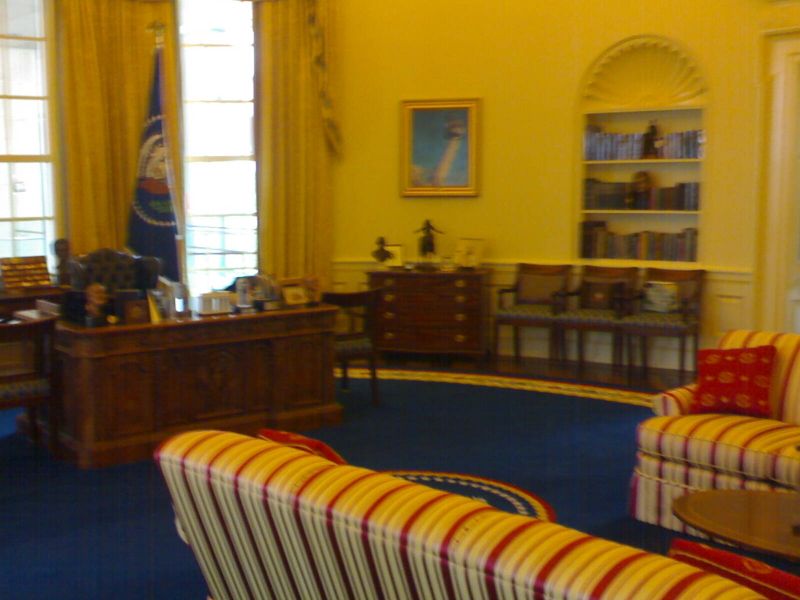
    Oval Office Replica

    The Clinton Library and Museum includes a replica of the Oval Office as it was when President Clinton occupied it. According to the staff, the former President often moves objects around or borrows them during his monthly or bi-monthly visits to the Library (he has an apartment upstairs with room for his secret service agents). 


    The docents tell me that President Clinton knows them all by name and is closely involved in almost everything that happens at the Library. I spoke at length with one docent, Jane Cazort, whose father-in-law was lieutenant governor of Arkansas and whose granddaughter went to school with Chelsea Clinton.


    Coincidentally, next week I’ll be attending the Fortune Brainstorm: Green 2009 conference in Laguna Niguel, California at which President Clinton is speaking.  More on that later.