Concepts


  • Saying Goodbye to the Brigade System

    Recently-resurfaced abuse allegations against chef René Redzepi at Copenhagen’s Noma restaurant, now closed, have called into question the so-called Brigade System. The French chef Georges Auguste Escoffier developed the hierarchical structure in the late 19th Century to instill discipline and efficiency. Yet many restaurants still use the Brigade. Le Cordon Bleu, the French culinary education organization, conflates the Brigade System with collaboration. While collaboration may exist in Brigade System kitchens, it exists in spite of the system rather than because of it.

    With the executive chef at the top of the kitchen org chart, the Brigade System not only instills hierarchy. The system also gives rise to star culture with the chef as the star. It’s not just kitchens where star culture flourishes. As I describe in the Introduction to the expanded and updated edition of The Culture of Collaboration book, we turn artists, athletes, chefs, politicians, surgeons, influencers, television hosts, entrepreneurs, corporate leaders and many others into stars. This tendency creates the impression that we accomplish great feats by ourselves. Yet we know better. Hierarchy and star culture are two of the Ten Anti-Collaborative Cultural Artifacts I identify in the book.

    Escoffier’s goal, as Pete Wells points out in his well-researched New York Times story, was to mold disorderly kitchen staffs into a profession. Yet as many organizations have discovered, instilling “order” can also discourage dissent, spontaneity, and creativity. No wonder expensive tasting menus seem formulaic, and customers perceive plunging value in fine dining.

    In contrast, Chez Panisse has never used the Brigade System. Rather, the Berkeley, California restaurant embraces a collaborative ecosystem of stakeholders which includes farmers, team members and customers. Team members often rotate roles and enjoy greater autonomy than at other restaurants. Chefs, servers, bussers and managers enjoy a daily meal together with wine—and it’s often the same meal the staff serves to customers.

    Evan Rosen and Alice Waters in the Chez Panisse kitchen

    A Chez Panisse principle revolves around food education—how food should be raised and prepared. Accordingly, the restaurant has a word-of-mouth, open-door kitchen policy. On a recent visit, I walked into the kitchen. Team members were focused but seemed relaxed and willing to answer questions. Chez Panisse founder Alice Waters was sitting at the prep counter enjoying a glass of rose and waiting for her dinner which is obviously more civilized than Rene Redzepi’s reported approach. We chatted a bit. I then walked back to the production kitchen where a prep cook was cutting the ends off of just out-of-the-ground sugar snap peas. Had Noma customers wandered back to the production kitchens, they might have observed the alleged abuses that reportedly occurred there. In any industry, command-and-control and star culture may appear to work. Yet in time, these Anti-Collaborative Cultural Artifacts backfire and compromise value. Instead, a collaborative ecosystem creates lasting value.
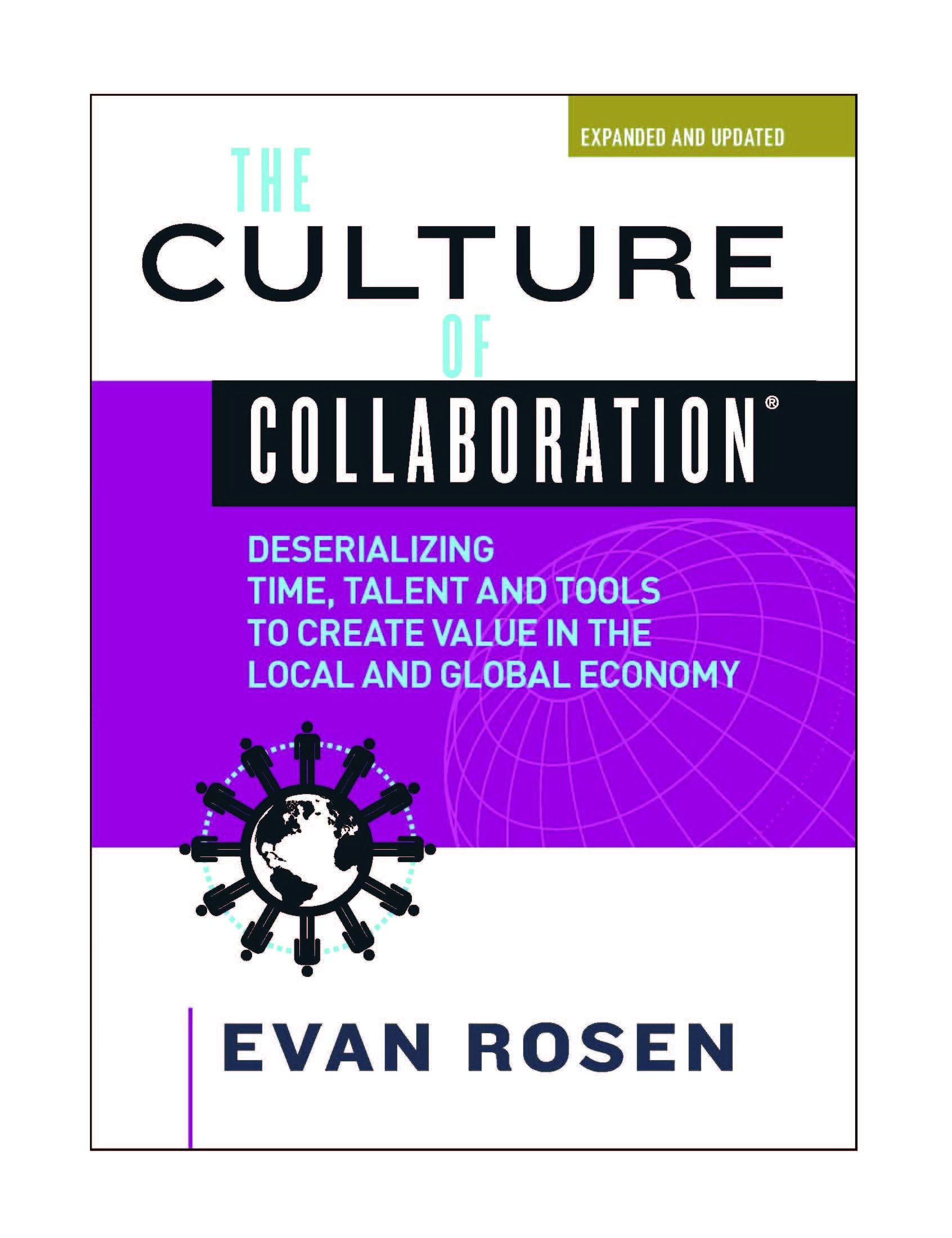


  • New Expanded and Updated Edition of The Culture of Collaboration® Book

    How has collaboration evolved? What is the current state of collaboration at Toyota, Mayo Clinic, Industrial Light & Magic, Boeing and other companies profiled in the first edition of The Culture of Collaboration® book? What are the keys to long-term value creation through collaboration?

    These are questions I sought to answer as I went back inside collaborative companies to research and write the new, expanded and updated edition of The Culture of Collaboration® book.

    Jacket with border CofC EU


    The expanded and updated edition has just been released, and I’m proud of the finished work. The 363-page business book includes 54 images and illustrations and a beefy index. By the way, 54 images and illustrations is no easy feat in 2024. Ever wonder why most business books lack pictures? It’s time-consuming to license even a single image from a large organization.

    One thing I’ve learned is that deserialization and collaboration go together like peanut butter and jelly. Deserialization means removing sequences from the lifecycle of products and services. The idea is to collapse outmoded sequential approaches and replace them with spontaneous, real-time processes.

    Deserialization also involves removing sequences from interaction. This means killing what’s left of the in-box culture. In short, deserialization is the key to long-term value creation through collaboration. That’s why the subtitle of the expanded and updated edition of The Culture of Collaboration® is: Deserializing Time, Talent and Tools to create Value in the Local and Global Economy.

    I’ve also learned that despite best efforts, collaboration can stall within highly-collaborative organizations. Paradoxically, collaboration happens in companies in which the dominant culture is command and control. Likewise, internal competition and command and control exist in mostly-collaborative organizations. Many factors, as I explain in the expanded and updated edition, influence both the evolution and regression of The Culture of Collaboration.

    More broadly… as I write in the preface, in some ways we’re less collaborative than we were in the early 2000s. Social media lets us broadcast opinions without refining ideas through real-time interaction. We join groups that make rules for how we should think. Videoconferencing enables interaction at a distance, but too often we’re wasting time in scheduled virtual meetings rather than creating value together spontaneously. While in the same room, we meet rather than collaborate. We leave meetings to work and then schedule follow-up meetings to review work. This serial process zaps value.

    My objective in revisiting this topic is to consider whether we have evolved or veered off track and to provide a new framework for unblocking collaboration and unlocking value.

    Let me know your thoughts about the new, expanded and updated edition of The Culture of Collaboration® book.


  • Goodbye Meetings. Hello Collaborative Group Sessions.

    COVID-19 has taught us that the only thing worse than a meeting is a virtual meeting. And the buzz lately is about the relative merits of video calls vs. in-person work gatherings. I had dinner recently with a former colleague, now a communications professor, who has concluded that videoconferencing is best for meetings people want to avoid while in-person gatherings work better for meetings people want to attend. No question it’s easier to multitask and disengage during virtual meetings.

    Because of my work in this arena—including a book on videoconferencing in the 90s and two subsequent books on collaboration—outlets have been asking me for my take post-COVID on how to improve meetings in the “hybrid” work environment. Since my focus is on completing a new book for release next year, I have been quiet here and elsewhere. Yet I feel compelled to inform those who have yet to read my books about my view of meetings.

    Meetings are a waste of time. That’s true whether we’re talking about same-room or virtual meetings. When I wrote the book Personal Videoconferencing in the mid-90s, I concluded that the benefit of then emerging PC-based videoconferencing was that we could work together screen-to-screen while seeing one another. We could jointly create a work product. In many scenarios, this involved minimizing the video while we shared applications and together produced something.

    Virtual meetings were by no means the killer app for personal videoconferencing. The killer app was co-creation. That’s still true. Yet during COVID, many of us grew to hate videoconferencing because we misused the tool for something we dislike: meetings.

    So how do we fix meetings? We don’t. Instead, we replace them with collaborative group sessions. I write about this in my book The Bounty Effect: 7 Steps to The Culture of Collaboration®. In a nutshell, meetings—whether physical or virtual—are a remnant of command-and-control culture. Often, the highest-ranking or highest-status person sets the agenda and conducts the proceedings. Meetings involve presentation and discussion. Then participants leave to do follow up work, often in isolation. Then this work is reviewed or discussed at yet another meeting. Meetings produce no work product and therefore create no value.

    In contrast, a collaborative group (CGS) session produces a work product. Participants co-create documents, drawings, slideshows, animation, 3D models, spreadsheets—you name it. A CGS creates value and is infinitely more collaborative than a meeting. Goodbye meetings. Hello collaborative group sessions.


  • COVID-19 Triggers The Bounty Effect

    We are living in a time of exigent circumstances. What do I mean by exigent circumstances? I mean a do-or-die challenge that raises the stakes for survival.

    Exigent circumstances ignite the structural change necessary to collaborate for governments, companies, non-profits, universities and just about every organization. This is The Bounty Effect which I describe in my book The Bounty Effect: 7 Steps to The Culture of Collaboration®. I call this The Bounty Effect using the metaphor of the mutiny that occurred on the H.M.S. Bounty more than two centuries ago. For Captain Bligh and his loyalists who were cast adrift on a small boat in stormy seas, surviving meant changing the structure and culture from command-and-control to collaborative.

    COVID-19 is an exigent circumstance. COVID-19 is The Bounty Effect.

    The pandemic is kick starting collaboration in myriad ways as command-and-control practices recede. Companies that weeks ago shunned telecommuting now embrace working from home. Organizations that paid a few people to think and paid everybody else to carry out orders want everybody thinking and contributing. It’s all hands on deck!

    Deficit hawks have voted for the largest stimulus in history as legislators of both parties collaborate in ways not seen for at least a decade. Companies are mobilizing and retooling to manufacture medical supplies. Toyota says it’s ready to produce face shields, face masks and respirators.

    Companies that preferred email and messaging are integrating rich, real-time collaboration tools such as videoconferencing into work processes and they’re rediscovering an age-old synchronous tool called the telephone. Companies with centralized decision making at “headquarters” are spreading decision making around the organization.

    Is this actually lasting structural change or just a temporary reaction to an imminent threat? COVID-19 is a watershed event in the modern history of the world, and many shifts in practices and processes will become permanent.

    We’ve seen The Bounty Effect before with pandemics. AIDS changed the structure of vaccine development from competing isolated labs to collaborating across organizational boundaries. Likewise, we will experience not only lasting structural change in organizations of all kinds but also more institutionalized cross-organizational and cross-sector collaboration.


  • Trust, Transparency and Collaborating with Partners (or App Users)

            My college housemate, an early and frequent Facebook user, recently announced that he’s pulling the plug on his Facebook account. This decision is apparently based on the perception that Facebook has deceived users about how it shares and profits from personal data. Facebook users are essentially its business partners.

            Meantime, the City and County of Los Angeles is suing the business unit of IBM that includes the Weather Channel app. According to the complaint filed in Los Angeles County Superior Court, the IBM unit has “deceptively used its users’ private, personal geolocation data.” The app reportedly has 45 million users monthly.

            The tide is turning against social media services and various apps that fail to adequately protect user’s data and privacy. Both Facebook and the IBM weather unit also serve business customers. “We want to be the place where work happens,” Facebook VP of Workplace Julien Cordorniou has reportedly told ZDNet. In an interview on Weather.com, Michael Rodriguez, head of mobile apps for The Weather Company, an IBM Business, says “the app has your back.”

             These pronouncements sound great but fall flat. The problem is deterioration of trust. Trust is one of the Ten Cultural Elements of Collaboration that are critical to collaboration. I identify these in The Culture of Collaboration book. Both Facebook and the Weather Company are essentially asking us to trust them with our data so that we can collaborate with other users and with the companies themselves.

              Sneaky language, allegedly deceptive practices and hidden agendas destroy trust and therefore inhibit collaboration. Say a firm wants to collaborate with a business partner. Before partnering companies can effectively collaborate, they must establish the rules of engagement which, among other things, spell out the ownership and use of jointly-created intellectual property. If one partner has a hidden agenda, what are the chances trust will flourish and the collaboration will create value? Practically zero.

              Similarly, when we input data into social media and other apps, we are essentially partnering with the app owner. When the word gets out about allegedly deceptive practices and sneaky language in the terms of service, which is the contract between vendor and user, hidden agendas are no longer hidden. Trust vanishes and with it collaboration. Instead of creating value through collaboration, the deception costs a company plenty in reputation, litigation and revenue.

               Because only the vendor writes the rules of engagement or terms of service, there can be no real collaboration or partnering with the user. While negotiating the terms with each user is impossible, companies would do well to seek input into privacy guidelines and other terms from, say, a panel of user representatives. Then something closer to collaboration with user/partners could occur.

               If Facebook had not lost the trust of many users, my college housemate would undoubtedly continue to partner with Facebook by inputting his data. Companies seeking to truly collaborate with customers and business partners seek clarity and transparency.


  • Getting High on Collaboration

            Is collaboration or competition in our DNA?

            The answer is both, but we enter this world collaborative. We are naturally inclined to work together to create value. But competitive organizational cultures short circuit our collaborative instincts.

            Lux Narayan, CEO of the data analytics company Unmetric, analyzed two thousand New York Times non-paid obituaries. In a TED talk, he describes how he used natural language processing on the first paragraphs of these obituaries and found that the word help appeared more than almost any other word.

            The lesson is that people want to help. Our instincts are to work towards common goals. Psychologists including Sander van der Linden write about intrinsic and extrinsic motivation. When we are intrinsically motivated, we take action because we want to help or because it’s the right thing to do. In contrast, competition involves extrinsic motivation which is derived externally rather than internally. An incentive system that rewards sharp elbows in an organization is extrinsic motivation.

            The more educated people are, the more competitive they are. Our educational system has traditionally used extrinsic motivation to beat collaboration out of us. In high school, we compete to get into college. In college, we compete for admission to graduate school. In graduate school, we compete for grants and fellowships. We enter professions, careers and corporations conditioned to compete.

            In smaller communities where many people get jobs right out of high school, people are driven more by intrinsic motivation—and they’re used to working together. They organize fundraisers and cook together at the VFW, fire stations and churches. They help neighbors repair tornado or hurricane damage.

            It’s this type of attitude that we need to nourish in companies, higher education, government and in our communities. Aetna CEO Mark Bertolini lit a spark that is taking hold at Aetna. In a "corner office" interview in Sunday’s New York Times, Bertolini describes how drugs and Western medicine failed him after a serious ski accident. His success with alternative therapies propelled him to introduce yoga, meditation and an enlightened approach at Aetna. According to Bertolini, the CFO’s initial reaction was “We’re a profit-making entity. This isn’t about compassion and collaboration.”

            Nevertheless, leaders became more enlightened and began paying attention to the struggles of front-line team members some of whom were on Medicaid and food stamps. Aetna raised the minimum wage to $16 an hour and improved benefits. Next the company stopped giving quarterly guidance to investors and focused more on collaboratively creating long-term value.

            Studies show we feel good physically and psychologically when we help people. Psychologists calls this the “helper’s high.” There’s no research I know of yet, but I suspect there is also a “Collaborator’s high.”


  • Fidelity’s Amazing, Disappearing Star Fund Manager?

    The era of the star fund manager is waning.

    Fidelity Investments may replace a star-oriented fund management system with a collaborative approach after a consultant's report. As is so often the case when organizations suddenly consider—and often embrace— a more collaborative structure and culture, exigent circumstances precipitated the potential move. I call this phenomenon The Bounty Effect, and I’ve written extensively about it in the book by the same name. The Bounty Effect occurs when an event or circumstance creates a fundamental shift, changes the game and accelerates collaboration.

    The Bounty Effect for Fidelity occurred because of two exigent circumstances:

    Last year Fidelity reportedly fired Gavin Baker, manager of Fidelity OTC Portfolio, for allegedly sexually harassing a junior female staff member though Baker denies the allegations. This happened against the backdrop of the #MeToo movement. The apparent firing prompted Fidelity to conduct a “cultural review” of its stock picking unit.

    The other exigent circumstance is the reported outflow of $40 billion from Fidelity’s actively-managed funds in 2017, according to Morningstar, as investors have increasingly embraced exchange-traded funds (ETFs) and passively managed index mutual funds meaning those linked to the performance of a particular index such as the S&P 500. Active fund management essentially means one star manager with a supporting cast of analysts attempts to beat a particular index. Fidelity built its reputation in the 1980s around successful active managers including Peter Lynch who managed the Fidelity Magellan Fund.

    The decline of the “star” fund manager mirrors trends in other industries and throughout workplaces. Before the rise of human resources as a valued discipline, swashbuckling managers made hiring and tactical decisions based on gut and sometimes whim. Executives often made strategy decisions in a vacuum.  As HR has become more data driven, the era of the swashbuckling manager has ebbed. Leaders make few decisions without input or at least without consulting HR, finance, IT, communications or some other function. Companies measure everything and everybody which, incidentally, can short circuit collaboration.

    Fidelity would likely argue that “star” managers never made decisions in a vacuum but rather consulted Fidelity’s extensive research team and worked with analysts assigned to each fund. Nevertheless the funds industry—including Fidelity—has historically embraced star culture. And so have such industries as sports, food and beverage, medicine, journalism, the film industry and so many others. The media still goes to bizarre lengths to reinforce star culture, because media decision makers believe that personalities sell newspapers and drive viewership and eyeballs translating into advertising dollars. I’ve even read stories on “star” butchers. And while I appreciate the skill involved in selecting and cutting meat, putting certain butchers on a pedestal feeds a misleading perception that the vast majority of butchers fail to measure up to the so-called stars.

    When we turn athletes, chefs, doctors, television hosts, movie producers and others into stars, these so-called “stars” start believing the rules that apply to everybody else never apply to them. This breeds bad behavior. Star culture has also diminished the contributions of people who work with “stars” which makes these people feel sidelined and less likely to provide valuable input. In short, star culture costs organizations dearly. In contrast, embracing a collaborative culture and structure creates value.

    If Fidelity abandons its “star” manager system, the question is whether the move is window dressing or real structural change. We may learn that one person never really “managed” Fidelity’s actively-managed funds and that fund management was always an inherently-collaborative process among colleagues despite Fidelity’s marketing so-called “star” managers.


  • Fake Data and the Death of Star Culture

    The recent rash of sexual misconduct accusations against prominent men provide a lens through which we can view the death of star culture. For generations, we have bestowed God-like status on so-called stars whether they’re politicians, chefs, entertainers, executives, athletes or show hosts. This exalted status makes “stars” believe they are special.

    The #metoo movement is a proxy for rejecting star culture. And now this cultural shift is manifesting in other ways. Viewership for last Sunday’s Grammy Awards dropped 24 percent compared with viewership for last year’s Grammy Awards. We’re tired of stars.

    If “stars” like Bill Cosby, Harvey Weinstein, Matt Lauer, Mario Batali, Kevin Spacey, Charlie Rose, Steve Wynn and so many others get a pass on just about everything for being stars, our star culture is responsible for their transgressions. We elevate them to status so rarified that they may believe laws and standards of fairness and decency do not apply to them.

    Star culture reinforces the false notion that we achieve great feats by ourselves. Whether the so-called star is a movie producer, chef, tv host, actor or executive, the reality is that he or she succeeds because of others. Nobody achieves great feats entirely on their own. Behind the scenes, many people work to make the movie, the meal, the talk show, the team, the business a success regardless of the “star.”

    In The Culture of Collaboration book, I describe the Myth of the Single Cowboy. This is the notion that one self-suf­ficient, rugged individual can achieve smashing success without help from anybody. When we perpetuate this myth, we make so-called stars feel that they’re a breed apart and can conduct themselves without consequences.

    Star culture reinforced by the media and society at large also infects organizations. The result is that contributors who are not considered A-listers get sidelined. Their input and ideas are lost, and value creation suffers. Plus internal competition to become a star increases bad behavior such as sabotaging others and hoarding information.

    Our excuse for star culture and for tolerating transgressions is that stars supposedly create more revenue. There is evidence, though, that the financial performance of stars is often overstated. NBC’s Today Show picked up more viewers after the network fired Matt Lauer.

    Rejecting star culture is nothing short of a fundamental shift in our society. This shift will impact companies, universities, government agencies and organizations of all types. Smart organizations will get ahead of the curve and take the necessary steps to replace star culture with a collaborative culture

    People who become stars often cheat to achieve or keep their rarefied status. Social media is a case in point. One way we measure star power is to count the number of followers on social media. Did we really think that stars are so popular that millions of people read their posts and tweets? It turns out that “stars” and wannabe “stars” pay for fake followers which create fake data on which companies base advertising and endorsement decisions.

    A reporting team at the New York Times recently investigated a company named Devumi that sells Twitter followers and retweets. The company reportedly has at least 3.5 million automated accounts for rent. Customers include reality television “stars.”

    So it turns out that star culture is related to another unfortunate phenomenon that compromises collaboration: measurement mania and the tyranny of data. Fake data is by no means limited to social media. In command-and-control organizational cultures that foster internal competition and information hoarding, team members get the message that the goal is winning at all costs. In this type of culture, numbers get fudged and corners get cut.

    Fake data scandals cost these companies plenty. A recent glaring example is the fake bank account scandal at Wells Fargo. Companies that embrace fake data are often the same companies that promote “stars” and minimize the contributions of others.

    Many companies have yet to catch up with our evolving society. Successful organizations use real data and replace star culture with collaborative culture.


  • Does Remote Work Reduce Collaboration?

    Some companies are eliminating remote work or “telecommuting” because they believe their people must share the same physical space to collaborate.

    I define collaboration as “working together to create value while sharing virtual or physical space.” But apparently some organizations want to get more physical rather than virtual.

    According to a recent Wall Street Journal story, companies including IBM, Aetna, Bank of America, Best Buy and Reddit have ended or reduced remote-work arrangements as managers “demand more collaboration, closer contact with customers—and more control over the workday.”

    Companies facing challenges are often the first to scrap or reduce remote work programs. In 2013, as Yahoo was struggling, then CEO Marissa Mayer defended her decision to eliminate work from home. Speaking at the Great Place to Work conference in Los Angeles, Mayer reportedly said “People are more productive when they’re alone, but they’re more collaborative and innovative when they’re together.”

    No question people are more collaborative and innovative when they’re together, but the point is people can be together virtually as well as physically. Many tools and technologies support high-impact virtual collaboration. Forcing people to endure a daily commute and interfering with their life/work balance reinforces command and control and disrupts collaboration and innovation. Also, remote work lets companies tap expertise regardless of geography. And teams are often comprised of people in multiple regions, so forcing people to work from a company location is unlikely to enhance collaboration within a team. It does make sense to encourage remote workers to spend some time at company locations to spark chance encounters in cafeterias, corridors and break rooms with people outside their teams.

    Command and control culture is the opposite of collaborative culture so an organization trying to control team members by keeping them at the workplace short circuits collaboration. Ironically, my research interest in collaboration began in the mid-1990s when I was writing a book on personal videoconferencing. Early telecommuting programs experimented with PC-based videoconferencing so that remote workers could look each other in the eye and talk with colleagues while they were collaboratively working on spreadsheets, documents, design plans and other work. The issue then was whether we could collaborate as effectively at a distance as we could in the same room.

    By the time I wrote The Culture of Collaboration book, the tools and technologies supporting remote work had become pervasive and the culture supporting virtual collaboration had become widespread. People at many organizations were becoming accustomed to collaborating spontaneously from almost anywhere. So the challenge was changing. I wrote:

    “Today we struggle to collaborate as effectively at a distance as we do in the same room. Tomorrow the challenge becomes the reverse.”

    This is because same-room collaboration tools were lagging behind those used at a distance and people were becoming more accustomed to collaborating from applications on their notebook and laptop computers. Also, “presence” technology provided the capability to find colleagues, check their availability and begin collaborating with them on the fly from anywhere.

    Spontaneity and organizational culture supporting ad hoc encounters is critical to creating value collaboratively. In some cultures, this means it’s okay to grab people out of meetings or interrupt their work for on-the-fly collaboration. But in mature companies walking back remote work, often this level of spontaneity is a cultural faux pas. So the most effective way to spontaneously connect in these cultures is often through online chat which can escalate into a collaborative group session (CGS). Organizations create far greater value by moving away from command and control and instead enabling team members to connect and collaborate spontaneously regardless of physical location.

    As I demonstrate in my book The Bounty Effect, exigent circumstances including disruptive market forces, new competitors, or a regional slowdown are opportunities to accelerate collaboration and emerge stronger from the challenge. Eliminating remote work because of a difficult environment rarely enhances collaboration and instead increases command and control. The more effective approach is to seize the opportunity exigent circumstances provide and adopt a more collaborative organizational structure and culture which transcend physical location.


  • 7 Success Factors for Collaboration Hackathons

    The hackathon has gone mainstream.

    Once a method used primarily by coders, the hackathon has moved beyond the boundaries of software development. From government agencies and universities to start-ups and Fortune 500 companies, organizations are embracing collaboration hackathons or what we might call collabathons to spark innovation, develop products and services, and improve processes for everything from quality control to recognition and reward.

    Collaboration hackathons inspire team members to step away from their day-to-day roles and solve a big problem or brainstorm a new direction with a tangible take-away.  The structure of a successful collaboration hackathon mirrors that of a collaborative organization. We’re talking about an ad hoc team that forms for a specific purpose, collaborates, and then disbands. The 7 Success Factors for Collaboration Hackathons mirror the 7 steps in my book The Bounty Effect: 7 Steps to The Culture of Collaboration. These are:

    1) Plan

    2) People

    3) Principles

    4) Practices

    5) Processes

    6) Planet

    7) Payoff

    In the context of collaboration hackathons:

    Plan is a problem to be solved, product/service to be developed, process to be created or improved or key question to be answered

    People means broad participation in cross-functional collaboration hackathons regardless of level, role or region

    Principles are the collaboration hackathon’s value system, the guidelines in solving the problem

    Practices put principles into action through everything from a physical environment that fosters brainstorming to tools for capturing and refining ideas and putting them into action. Practices ensure that the hackathon is a collaborative group session (CGS) rather than a meeting.

    Processes let hackers rapidly prototype and test ideas.

    Planet puts communities in the center of the hackathons and inspires hackers to address how their ideas impact the communities in which the organization does business. The Planet step may consider everything from carbon footprint to privacy.

    Payoff is the work product of the hackathon which must create value

    These 7 steps prevent collaboration hackathons or collabathons from degenerating into meandering “bull sessions” at one extreme or turning into formal meetings at the opposite extreme. With The Bounty Effect’s 7 Steps, collaboration hackathons or collabathons succeed in solving big problems, answering key questions, developing products and services, improving processes, refining ideas and putting concepts into action.

    Collabathons can help shift the structure of the entire organization from competitive, command-and-control to collaborative. The possibilities are endless.