Community


  • Star Culture Trips Up Venice

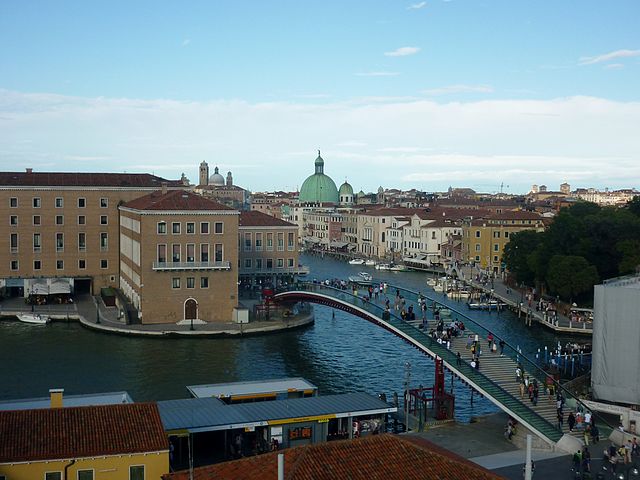
    It’s called Ponte della Costituzione, the fourth footbridge over Venice’s Grand Canal. The glass and steel structure has caused nothing but headaches—and some muscle aches—for  tourists, Venetians and the officials who run their city.

    When Venice commissioned an architect to build the new bridge in the late 1990s, the job went to Santiago Calatrava. Named by Time magazine to the Time 100, one of the hundred most influential people in 2005, Calatrava has chalked up dozens of awards and honorary doctorates. His celebrated projects range from the World Trade Center Transportation Hub in New York City to the Museum of Tomorrow in Rio de Janeiro, Brazil. And the New York Times calls Calatrava a “star architect.”
    Ponte della Costituzione
    Venice’s Ponte della Constituzione. Photo by Christoph Radtke. Licensed under CC BY 3.0. No changes made.

    The problem is that the Zurich, Switzerland based architect apparently failed to adequately consider practicalities impacting Venetians who cross the bridge regularly and tourists who cross when visiting one of Italy’s most visited cities. For starters, the bridge lacks disabled access. Also, the glass floor has caused many people to slip and fall. According to a story in Architectural Digest, some Venetians have cracked their chins and foreheads and others have reportedly broken bones. City officials have told media outlets that injuries occur almost daily.

    Because too many injured pedestrians have sued the City of Venice over the multimillion dollar bridge, the city has decided to allocate more than half a million dollars to replace the glass with trachyte stone. This expense comes after a failed 1.5 million Euro modification to install a cable car so that people could cross the bridge without injury.

    What has caused heartache, bone ache, lawsuits and wasted taxpayer dollars is star culture. Rather than designing a bridge for the practical needs of tourists and others who regularly cross the canal, Calatrava was apparently too focused on capturing and representing Venice’s “embrace of modernity” as the New York Times puts it. Rome’s Court of Auditors found that Calatrava was negligent in failing to account for the number of tourists dragging their bags across the bridge. Calatrava argued that bag dragging constitutes “incorrect use.”

    Stars tend to get swept up by things like symbolism, messaging and virtue signaling. Collaborative architects seek input from people who will use the structure they’re designing. In The Bounty Effect: 7 Steps to The Culture of Collaboration®, I describe how architect Renzo Piano made no sales presentation but rather pulled ideas from his clients in collaboratively conceptualizing and designing the California Academy of Sciences in San Francisco.

    Undoubtedly, Calatrava has chalked up major accomplishments, but accomplished professionals run the risk of buying their own hype. When people are made to believe they can do no wrong, they often make decisions in a vacuum and may work without adequate input from others. This feeds star culture for which the media has an insatiable appetite. Yet we must resist the temptation, because star culture sucks value out of companies, governments and communities.




  • Getting High on Collaboration

            Is collaboration or competition in our DNA?

            The answer is both, but we enter this world collaborative. We are naturally inclined to work together to create value. But competitive organizational cultures short circuit our collaborative instincts.

            Lux Narayan, CEO of the data analytics company Unmetric, analyzed two thousand New York Times non-paid obituaries. In a TED talk, he describes how he used natural language processing on the first paragraphs of these obituaries and found that the word help appeared more than almost any other word.

            The lesson is that people want to help. Our instincts are to work towards common goals. Psychologists including Sander van der Linden write about intrinsic and extrinsic motivation. When we are intrinsically motivated, we take action because we want to help or because it’s the right thing to do. In contrast, competition involves extrinsic motivation which is derived externally rather than internally. An incentive system that rewards sharp elbows in an organization is extrinsic motivation.

            The more educated people are, the more competitive they are. Our educational system has traditionally used extrinsic motivation to beat collaboration out of us. In high school, we compete to get into college. In college, we compete for admission to graduate school. In graduate school, we compete for grants and fellowships. We enter professions, careers and corporations conditioned to compete.

            In smaller communities where many people get jobs right out of high school, people are driven more by intrinsic motivation—and they’re used to working together. They organize fundraisers and cook together at the VFW, fire stations and churches. They help neighbors repair tornado or hurricane damage.

            It’s this type of attitude that we need to nourish in companies, higher education, government and in our communities. Aetna CEO Mark Bertolini lit a spark that is taking hold at Aetna. In a "corner office" interview in Sunday’s New York Times, Bertolini describes how drugs and Western medicine failed him after a serious ski accident. His success with alternative therapies propelled him to introduce yoga, meditation and an enlightened approach at Aetna. According to Bertolini, the CFO’s initial reaction was “We’re a profit-making entity. This isn’t about compassion and collaboration.”

            Nevertheless, leaders became more enlightened and began paying attention to the struggles of front-line team members some of whom were on Medicaid and food stamps. Aetna raised the minimum wage to $16 an hour and improved benefits. Next the company stopped giving quarterly guidance to investors and focused more on collaboratively creating long-term value.

            Studies show we feel good physically and psychologically when we help people. Psychologists calls this the “helper’s high.” There’s no research I know of yet, but I suspect there is also a “Collaborator’s high.”


  • Daimler Collaborates to Reinvent Trucks

    Karl Benz is often credited with inventing the first true car. In 1885, Benz built the Benz Patent-Motorwagen powered by an internal combustion gasoline engine.

    Did he act alone? Of course not. We collaborators know that nobody achieves great feats by themselves. Karl Benz had help. One collaborator was his wife, Bertha, who funded the project and took a later version of the Benz on its first long-distance journey. Benz’s company eventually merged with Daimler Motoren Gesselschaft.

    Now the company that invented the automobile is collaborating to reinvent the truck.  At the Tokyo Auto Show last Wednesday, Daimler announced a purely electric truck and bus brand called E-FUSO and pledged to electrify all vehicles produced by Daimler’s Mitsubishi Fuso Truck and Bus Corporation subsidiary. 

    Some hours later at the Mercedes-Benz Research and Development Center in Silicon Valley, journalists gathered for a briefing.  Before the event, Daimler leaders and I had a far-reaching discussion about how Daimler collaborates internally and with partners and governments. We also discussed how electric trucks and buses will change life particularly for those of us who live in cities.

    Daimler Fuso’s e-Canter all-electric light truck. Image copyright Daimler. All rights reserved.

    Daimler’s Fuso is currently selling the eCanter light truck which it assembles in Portugal for the North American market. 7-Eleven in Japan and UPS in Atlanta are using the eCanter which has a range of 60 miles between battery charges. The optimal use of the eCanter is for deliveries within cities.

    “We want to make the cities a better place to live. We want the world to change to the next level,” explained an energetic Marc Llistosella, president and CEO of Daimler’s Mitsubishi Fuso Truck and Bus Corporation. Marc, who is anything but a staid leader, was animated and clearly comfortable climbing aboard the concept E-Fuso Vision One truck and giving us a live tour via real-time, interactive video.  The concept truck, which is several years from production, has a 220-mile range between battery charges and carries a payload of eleven tons. This would enable metro and regional delivery routes.

    Benoit Tallec, head of design for Mitsubishi Fuso, noted that a central touch display replaces dials and switches on the Vision One so that the driver focuses on the road. He compared the evolution of Fuso trucks to the evolution of boats from sail to steam power in the early 19th Century. Fuso’s technological advances are “the result of a team effort across three continents,” he said.

    Daimler FUSO’s Vision One concept all-electric truck. Image copyright Daimler. All rights reserved.

    After the discussion and presentation, I hopped aboard the eCanter and drove the quietly-purring vehicle by some of Sunnyvale’s

    technology company parking lots as some curious engineers took notice.

    Daimler’s E-FUSO unit faces two big challenges: infrastructure for charging trucks and increasing battery range. Overcoming these challenges could one day make electric trucks economically viable for longer routes. While consumers may buy electric cars as much for novelty as economics, truck customers demand a business case that proves electric vehicles create value.  Making that case through technology advances and cost reduction will require continued collaboration within Daimler, with business partners and with governments.


  • 7 Success Factors for Collaboration Hackathons

    The hackathon has gone mainstream.

    Once a method used primarily by coders, the hackathon has moved beyond the boundaries of software development. From government agencies and universities to start-ups and Fortune 500 companies, organizations are embracing collaboration hackathons or what we might call collabathons to spark innovation, develop products and services, and improve processes for everything from quality control to recognition and reward.

    Collaboration hackathons inspire team members to step away from their day-to-day roles and solve a big problem or brainstorm a new direction with a tangible take-away.  The structure of a successful collaboration hackathon mirrors that of a collaborative organization. We’re talking about an ad hoc team that forms for a specific purpose, collaborates, and then disbands. The 7 Success Factors for Collaboration Hackathons mirror the 7 steps in my book The Bounty Effect: 7 Steps to The Culture of Collaboration. These are:

    1) Plan

    2) People

    3) Principles

    4) Practices

    5) Processes

    6) Planet

    7) Payoff

    In the context of collaboration hackathons:

    Plan is a problem to be solved, product/service to be developed, process to be created or improved or key question to be answered

    People means broad participation in cross-functional collaboration hackathons regardless of level, role or region

    Principles are the collaboration hackathon’s value system, the guidelines in solving the problem

    Practices put principles into action through everything from a physical environment that fosters brainstorming to tools for capturing and refining ideas and putting them into action. Practices ensure that the hackathon is a collaborative group session (CGS) rather than a meeting.

    Processes let hackers rapidly prototype and test ideas.

    Planet puts communities in the center of the hackathons and inspires hackers to address how their ideas impact the communities in which the organization does business. The Planet step may consider everything from carbon footprint to privacy.

    Payoff is the work product of the hackathon which must create value

    These 7 steps prevent collaboration hackathons or collabathons from degenerating into meandering “bull sessions” at one extreme or turning into formal meetings at the opposite extreme. With The Bounty Effect’s 7 Steps, collaboration hackathons or collabathons succeed in solving big problems, answering key questions, developing products and services, improving processes, refining ideas and putting concepts into action.

    Collabathons can help shift the structure of the entire organization from competitive, command-and-control to collaborative. The possibilities are endless.


  • Collaboration to Change Product Use and Brand Perception

    The Apple iPod began as a music player and became a video player in part because consumers discovered a new use for the device. The brand perception then shifted.  Lego Mindstorms began as company-provided software and hardware to create small robots. Then consumers hacked the code, changed the products together and Lego ultimately began providing the source code and collaborating with its customers on new products. In time, consumers began perceiving Mindstorms as a collaborative activity.

    As in these cases, sometimes consumers collaborate to alter a product or its use and this ultimately changes the brand perception. In other cases, companies can collaborate with partners to discover new uses for products and change how consumers perceive the brand.

    Gin has traditionally involved martinis or gin and tonic—and at least one gin producer is collaborating with partners to change this use and brand perception. When Bombay Sapphire East

    Bombay Custom Tonic Bar
    The LUCKYRICE festival’s “custom tonic bar”: bartenders mix flavor extracts with Bombay Sapphire East gin and club soda

    emerged in test markets as the first product line extension of Bombay Sapphire gin in 2011, reviews described the gin as spicy. That’s because Bombay Sapphire East adds two new botanicals to Bombay Sapphire: lemongrass and black pepper. This “flavor profile” may seem a bit assertive to accompany typical cocktail fare like cheese and crackers. Therefore, it’s necessary for this brand to gain traction in a different culinary arena, namely Asian food.

    This past Friday evening, Bombay Sapphire East sponsored the 6th Annual LUCKYRICE feast at the Bently Reserve venue in San Francisco’s financial district. As I entered the event, an Asian woman handed me one of many varieties of exotic drinks bartenders were mixing with Bombay Sapphire East. A who’s who roster of upscale Asian restaurants with tables scattered around the event were cranking out specialties to accompany Bombay Sapphire East. The brand was clearly collaborating with chefs to create the perception that the gin goes well with Asian food. This is by no means a stretch.

    I sampled a drink called Piman which includes Bombay Sapphire East, yellow pepper puree and Kalamansi (an orange/kumquat hybrid) syrup.  I also checked out the Bombay Sapphire East “custom tonic” bar at which bartenders combined such flavor extracts as bergamot and elderflower with club soda and gin (see above image). These drinks complimented available dishes including Dosa restaurant’s Hyderabad chicken biryani, M.Y. China’s black pepper beef with mushrooms and Brussels sprouts, and Asian Box’s lamb meatballs in coconut curry.

    Collaborating with Asian chefs, the people behind Bombay Sapphire East are not only changing consumer perceptions about their gin. They’re also working with Asian restaurants to co-create and sell cocktails using a gin accented with botanicals that compliment Asian food.  This creates value for the restaurants and for Bacardi Limited, which owns Bombay Sapphire East.

    Whether the product is booze, blenders, toothpaste or technology, collaborating with partners to change brand use and perception can transform a sleeper product into a sales leader.


  • Coffee and Collaboration

    In San Francisco, where I live, coffee plays a major role in lifestyles and work styles. People stand in long lines at artisanal coffee businesses for coffee that’s sourced, roasted and prepared with care. CoffeeIt has become de rigueur for leading technology and social media companies to make artisanal coffee available to team members. Google stocks beans from the better San Francisco purveyors in snack areas throughout its “Googleplex” in Mountain View, California. Team members can grind the beans, brew a cup, or pull a shot of espresso on demand.

    As the artisanal movement in coffee, often called “Third Wave Coffee,” sweeps the U.S. and infiltrates workplaces, people are becoming particular about what’s in their mug. Commercial brew just won’t do. Yet coffee consumption remains primarily a solitary activity. People fiddle with their smart phones or work on notebook computers as they sip that Yirgacheffe or Antigua drip-by-the-cup in cafes and in workplaces.

    In contrast, workplace coffee consumption in Sweden is primarily a social activity. Swedes embrace the ritual consumption of coffee rather than the coffee itself. So Swedes care less about sourcing, roasting and preparation and more about gathering around a table with colleagues to consume the beverage.

    I recently returned from Gothenburg, Sweden where I gave a keynote speech on collaboration to a group of government leaders, healthcare professionals and pharmaceutical executives. While in Sweden, I engaged in Fika which is an institution in the Swedish workplace. Fika is scheduled twice a day, typically at 9 a.m. and 3 p.m. Work groups sit around tables in break areas. They drink coffee, eat cake sometimes baked by a team member, and they discuss issues pertinent to their work. Fika helps achieve the consensus that is integral to Swedish business culture (consensus is not integral to collaboration, but that’s a different post). Fika’s limitation is that people share coffee and cake with the same team members every day.

    Both U.S. and Swedish workplaces can enhance collaboration by changing how they consume coffee—but the challenges are different for each culture. In the U.S., the challenge is to put down the devices and engage others while enjoying that artisanal cup of joe.

    In Sweden, the challenge is to include people from other levels, roles and regions so that fika is less insular. Collaborative tools such as telepresence could bridge the distance gap and offer the opportunity for a video fika. Because fika is so engrained in the Swedish business culture, it is a critical channel Swedes can use to enhance organizational collaboration.


  • Collaboration Keeps Martini Thriving for 150 Years

    Winemaking, at its best, involves collaboration. Making vermouth adds a layer of complexity to winemaking and therefore requires an extra dose of collaboration along with added alcohol, sugar and botanicals. Martini, also known as Martini and Rossi, is the top-selling vermouth producer globally.

    In the building known as Department 54 at Martini near Turin, Italy, winemakers and herbalists

    Martini botanicals
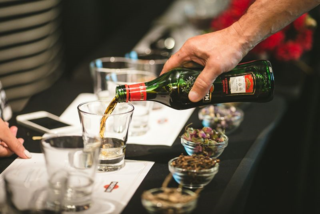
    Making vermouth involves blending wine and botanicals. (Photo: Gary Sexton)

    collaborate to blend wine with botanicals. These include such herbs as dittany from Crete, a purported aphrodisiac, and the bitter artemesia. Also in the mix are flowers including roses and violets plus such fruits as raspberry and lemon. Martini winemakers and herbalists also include woods including quassia from Jamaica and cascarilla bark from the Bahamas plus many roots and spices.

    Many of these ingredients lined tables at San Francisco’s Dirty Habit restaurant a couple of weeks ago where I joined Martini Master Blender Giuseppe Musso, Operations Director Giorgio Castagnotti and Head Wine Maker Franco Brezza as they explained the intricacies of vermouth blending and production. The Martini team was in San Francisco to introduce Gran Lusso, a new vermouth celebrating the company’s 150 years.

    As Giuseppe described the woods, herbs and other botanicals, twenty or so writers and guests sipped

    Martini vermouth
    Botanicals line the tables at Martini’s vermouth tasting. (Photo: Gary Sexton)

    vermouths. Giuseppe has spent his entire 30-year career with Martini. His emotion bubbled to the surface as he described how Martini people treat each another as family and how the company emphasizes sharing skills and techniques from one generation to the next. Since 1992, Martini has been part of Bacardi Limited, the largest privately-held, family-owned spirits company.

    Most vermouths use white wine. For the new Gran Lusso vermouth, Martini blends red wine from Barbera grapes with white wine from          Trebbiano grapes.  To extract the botanicals, the winemakers and herbalists have created a new method for Gran Lusso. They combine grape must from Moscato di Canelli grapes with a natural spirit, and then they age the mixture for a year before adding botanicals. They then add a “secret ingredient” called “extract 94” which originates from a Martini recipe reportedly from 1904. The result is a bitter sweet vermouth with aromatic complexity.

    What struck me about the Martini team’s formal presentations and informal discussions with guests is the lack of marketing bravado and genuine love for their products and company which they constantly referred to as “family.” At dog-and-pony shows staged by less collaborative companies, people pepper presentations and conversations with empty superlatives such as “Our products are best-of-breed” or “Nobody can do what we do.”

    In The Culture of Collaboration book, I call this Superlative Syndrome. It’s a manifestation of what the Greeks called hubris or excessive pride. Superlative Syndrome often masks defects and can ruin a business as trust evaporates. Customers, financial analysts and the media become conditioned to doubt the company’s messages. Team members learn to cut corners and lie. In contrast, Martini delivers its message with sincerity and cultivates long relationships with business partners, customers and team members.


  • Multicultural Collaboration Produces Unique Spa

    Bridging cultures, particularly regional cultures, produces a broader perspective that gives collaborators an edge. In disciplines like aerospace engineering, team members trained in one country’s engineering tradition may view a creative challenge differently than their colleagues who were trained in a different country’s system. Drawing from their collective global knowledge, cross-cultural collaborators can spark synergies and create greater value. In The Culture of Collaboration book, I call this the Dynamic Dimension of Cross-Cultural Collaboration.

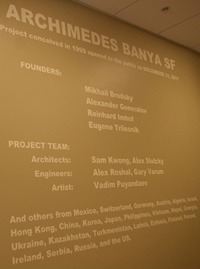
    This dimension is alive and well at Archimedes Banya, a spa complex that opened in San Francisco last New Year’s Eve after twelve years of development and construction. People from twenty different countries collaborated on the project. Managing partner Mikhail Brodsky of Russia had the original idea. Reinhard Imhof of Switzerland led the indoor construction. Architect Sam Kwong of China developed the plans. Other partners are from countries including Korea, Israel, Germany, Japan, and Mexico.

    The concept began when Brodsky, a mathematician, arrived in San Francisco from Moscow in 1989. A lBanya2over of Russian bath complexes or banyas, Brodsky was disappointed to find no such facilities in his adopted city. He longed to start a banya. In the summer of 1998, Brodsky, then a professor at the University of California at Berkeley, applied for a job as chair of the mathematics department at San Francisco State University. SFSU’s rejection sparked Brodsky’s interest in doing something significant in San Francisco while delivering on his banya dream.

    Brodsky, Imhof and two other partners formed a company, and in 1999 bought a lot in India Basin near San Francisco’s former Hunters Point Shipyard. Though in an obscure neighborhood, the lot provided sweeping views of San Francisco Bay. To construct the building, Brodsky and his partners would need to recruit more partners. Like many ethnic groups living in the United States, many Russians do business only within their community. Therefore, logic would dictate engaging Russians to finance, design and build the project. But some Russians who Brodsky approached had difficulty seeing past the many roadblocks to the project ranging from building permits and location to construction costs and customer base. So, Brodsky decided to broaden his reach, involving people from as many countries as possible. The common thread was a passion for the Banya project plus mutual trust and common goals, two of the Ten Cultural Elements of Collaboration I identify in The Culture of Collaboration book.

    In a departure from the command-and-control approach to business in which “stars” grab the credit, Archimedes Banya recognizes multiple contributions in much the same way Adobe Systems includes a Banya Wallcredit role in its software products. When I visited Archimedes Banya recently, the first thing I noticed was a wall near the entrance listing the names of the multicultural collaborators who turned the concept into reality. Also apparent was the amazing art ranging from mosaics depicting bathing traditions to murals and inlaid ceiling tiles. Including art in public bathing facilities is a tradition dating back to the Roman Empire.

    Artist Vadim Puyandaev of Kazakhstan collaborated with Brodsky to evoke the right atmosphere. “I
    wanted very simple, clear images of emotion,” says Brodsky. And the images also reflect action. “In a Russian banya, people move. It’s an active place. It’s not just sitting and sweating.” The complex is geared to socializing and offers facilities ranging from a rooftop sun deck with a San Francisco Bay view to private reception rooms replete with bars and kitchens.

    The Banya offers a spa experience reflecting the cultural melting pot. I checked out two Russian saunas, the Finish dry sauna, the steam room, warm soaking pools, cold plunge and relaxation room. After loosening up in the various saunas, I experienced a Russian venika platza treatment that involved a tall Moldovan fellow clad in a towel and sweat-soaked Banya hat brushing and lashing bunches of Latvian birch leaves on me to increase circulation.

    Following this, I laid on a table as an attendant scrubbed me with an exfoliating soap and then rinsed me with buckets of warm water. Then my muscles were relaxed enough for a massage from a masseuse from the United States. Afterwards, I headed to the café upstairs for pelmini or Russian dumplings, stuffed cabbage, hearty Russian beef soup, fresh-sqeezed juices spiked with kombucha, which is fermented tea and housemade kvass, a non-alcoholic beer made from fermented rye bread.

    An ambitious spa project that began as one person’s vision ultimately reflects the combined vision and execution of multiple people from many cultures. Collaboration involves marrying talents that are worth far more collectively than individually. Brodsky describes himself as a “starter.” But to make the project a reality, he collaborated with Imhof, a “finisher.” Because of the Swiss tradition of quality workmanship, Imhof shared Brodsky’s values of using the best materials and constructing a banya for the long term. The concept of “starters” and “finishers” has broad ramifications. A starter may have an incredible idea, but creating a company that produces substantial value may require collaborating with a finisher.

    As we collaborate, we can create awesome value by engaging and involving people with multiple talents and backrounds and, yes, from multiple cultures. The Dynamic Dimension of Cross-Cultural Collaboration delivers results otherwise unattainable.


  • Cross-Sector Collaboration for Sustainable Development

    Accomplishing massive goals requires massive collaboration—far beyond collaborating within an organization or within an industry or among government agencies.

    Making meaningful progress on issues including eradicating global poverty and protecting the global ecosystem requires collaboration among governments, non-governmental organizations (NGO’s), private industry, farmers, indigenous peoples and unaffiliated individuals with ideas. This cross-sector collaboration is driving the agenda for the United Nations Conference on Sustainable Development which happens this June 20-22 in Rio de Janeiro, Brazil. The conference, dubbed Rio+20, marks the twentieth anniversary of the United Nations Conference on Environment and Development. The 1992 conference established the Rio Declaration, which includes 27 principles mostly addressing sustainable economic development.

    Last Friday, at the invitation of the United States Department of State, I attended a planning meeting for Rio+20 at the Center for Social Innovation at the Stanford Graduate School of Business. The purpose was to distill ideas from cross-sector collaborators on how to bridge connection technologies with sustainable development. In a brainstorming session on “sustainable economic growth,” we tackled wasted talent and connectivity.  Think of the many people in developing countries with talent and ideas who have no outlet to connect and collaborate. This is our collective loss as global citizens until we tap that talent.

    The world’s wasting of talent in developing countries is analogous to the command-and-control organization that pays “knowledge workers” to think and pays everybody else to carry out orders. See my January 11, 2011 column for BusinessWeek.com on this topic. Such an organization squanders talent. This is because people throughout the organization—from the loading dock to the call center—have knowledge to contribute.

    One participant noted that wasted connectivity involves using the Internet frivolously, perhaps for pirating movies and other content, rather than for working together to eradicate poverty, create new markets and protect the environment. Similarly, wasted connectivity within organizations involves using networks and tools for chatter rather than for developing and producing products and services.

    Since the 1992 Rio Declaration, the Internet has grown from less than 16 million users to over 2 billion users, according to internetworldstats.com. Mobile phone users have grown from less than 23 million in 1992 to more than 6 billion in 2011, according to nationmaster.com. The current level of connectivity creates an opportunity for a more distributed, peer-to-peer (read inclusive) approach in collaborating for sustainable development. 

    Old models of cross-sector collaboration were minimally effective, because they involved “decision makers” or “thought leaders” shaping ideas and developing solutions which they would hand down to people impacted by the decisions. Now people in developing countries without affiliations can shape ideas with ministers and private sector leaders globally. Well, at least this is technically possible.

    As important to cross-sector collaboration as global connectivity and enabling technologies is a cultural shift in which governments, NGO’s and private industry embrace input from people regardless of affiliation or location. This is analogous to organizations adopting more collaborative cultures and tools so that people far from the home office or from executive corridors can participate in making decisions. The State Department has chalked up success with an emerging collaborative culture and tools including Secretary Clinton’s Sounding Board. For more on this, see my September 14, 2010 post.

    One of the people hashing out ideas in the sustainable development brainstorming session was Rio+20 Secretary General Sha Zukang, who is also the UN Under Secretary General for Economic and Social Affairs. Zukang, who demonstrated particular talent at defining and outlining sustainable development issues, brushed against a live wire as the workshop concluded: intellectual property. The brainstorm was exactly three weeks after the collapse of U.S. House of Representatives support for the Stop Online Privacy Act and Senate support for the PROTECT IP Act backed by media and entertainment companies and opposed by Google and Wikipedia among other online interests.

    Zukang described the need to “find a balance” between protecting intellectual property and disseminating information. This balance impacts cross-sector collaboration in that people in developing countries often lack access to the same information accessible to their collaborators in developed countries. Providing affordable access will help level the playing field. Contrary to some viewpoints, collaboration—cross-sector or otherwise—by no means requires eliminating or dismantling intellectual property protection. IP protection creates incentives for people and organizations to collaboratively develop and produce products and services.

    Cross-sector collaboration takes collaboration beyond organizational and sector boundaries to create value on a global scale.


  • Slow Money Collaboration

    In a cavernous, nearly empty room above the Readers Café & Bookstore in Building C of San Francisco’s Fort Mason Center, Woody Tasch sits at a corner table by a lone window looking out on the Bay. It’s the eve of the Slow Money National Gathering, and the organization’s chairman is putting the finishing touches on his opening remarks. He must fend off criticism that his model is “fantasy economics” and impress on the three hundred investors and five hundred or so other attendees that our industrialized food system has become as imbalanced as the financial system was during the depths of the 2008 crisis.

    Woody, a former New York venture capitalist who now lives off the grid near Taos, New Mexico, wants to change how we finance food businesses as dramatically as he has changed his own life and career. In the 1980’s, Woody worked as a self-proclaimed “small-time VC” making healthcare investments for Prince Ventures, owned by the Prince family of Chicago.  Ultimately, he transformed himself from a mathematics-driven investor to one with a social conscience with stops along the way as treasurer for a foundation and chairman of an angel investor network called Investors Circle.

    “It’s no longer about how much we can take off the table for ourselves,” Woody insists. After getting involved with the global Slow Food movement, the antithesis of fast food in its promotion of sustainability, Woody and his collaborators sought to address the difficulty many sustainable food businesses have getting financing. “It hit me that patient capital plus slow food equals slow money,” he explains.

    Woody and his colleagues are enabling microfinance for the food industry and, since 2009, have sparked $6 million in micro loans. Slow Money links growers, restaurants, organic farm suppliers and other food entrepreneurs with consumers willing to lend businesses a few thousand—or even a few hundred—dollars.

    “This is not a typical fiduciary model,” Woody explains. “What we are going to be proving over the next decade is that collective intelligence and local knowledge of groups of individuals effectively collaborating will produce positive outcomes both in arithmetic and impact on the community.” In other words, investors can do good and simultaneously get a modest return on investment. At the moment, 3 percent a year in interest is typical.

    Slow Money is evolving from advocating individual investments to promoting investment clubs. Compared to angel investing, for which investors must have assets of at least a million dollars or a yearly salary of at least $200,000, the investment club barrier to entry is much lower. As a model, Slow Food organizers point to the No Small Potatoes Investment Club, which provides low-interest loans to Maine farmers and food producers. So far, fifteen investors have each put up five thousand dollars.

    After talking with Woody, I stop by the rehearsal for the entrepreneur pitches. These five-minute presentations are not unlike those for technology companies at venture capital conferences. But there is something perhaps more wholesome and genuine and, yes, rougher around the edges, about these pitches.  Some of these food businesspeople have never before spoken at an event. George Weld, owner of both Egg restaurant in Brooklyn and a farm in Oak Hill, New York, speaks of the need to curb the “recurring alienation between rural and urban that plagues the food economy.”

    One of the better-received pitches comes from Dr. Hubert Karreman, a veterinarian and founder of Bovinity Health. Hubert’s company manufactures natural alternatives to antibiotics for livestock. He clicks through financials including $250,000 in sales in 2011, provides market share projections and leaves the rehearsal audience whispering "he's gonna get funded."

    Slow Food’s goal is for a million Americans to be investing one percent of their money in local food systems within a decade. Meantime, Woody Tasch offers his prescription for the economy. “What we need is rebalancing. Right now we’re lurching towards the global race to the bottom. It’s buy low, sell high, GMO [genetically modified organism], CDO [collateralized debt obligation] capitalism. We have to compete for cheap labor around the planet subsidized by cheap oil and ignoring the medium and long-term social and environmental impact.” Collaborating requires a longer-term focus, and Slow Money is helping enable that evolution.