
Decision makers often think collaborative tools will create collaboration, and they're perplexed when results elude the organization. Technology extends and enhances–but rarely creates–collaboration. My current column for BusinessWeek.com describes what organizations need besides technology to make collaboration happen. You can read the column here.
-
Collaborating with Salespeople Provides Unfiltered Information
Hierarchy dies hard in many organizations, so breaking down barriers among levels can prove particularly challenging.
Team members must feel it’s culturally acceptable to engage senior leaders on the fly, and likewise senior leaders must feel culturally comfortable reaching out across the organization to connect with front-line managers, factory workers and salespeople. This gives leaders access to real-time, unfiltered information. In The Culture of Collaboration book, I write about the Dow Chemical Company’s collaborative culture and the collaborative leadership approach of Dow CEO Andrew Liveris. In a compelling interview by Susan Daker in the Monday, January 25 edition of the Wall Street Journal, Andrew describes how Dow taps its salespeople for real-time intelligence about customer needs.
Wisely, Dow recognizes that the role of salespeople goes beyond addressing customer needs and closing deals. Dow salespeople collaborate with Research & Development and senior leaders to ensure that products meet customer needs. This may sound like a no brainer, but countless salespeople from many companies have told me that marketing, R&D and senior leaders have little interest in their customer insights. In such organizations, an “us and them” attitude develops between salespeople and management. And therefore the organization loses opportunities to gain real-time intelligence that would otherwise create value.
For years, salespeople have been underutilized. After all, they’re the eyes and ears of an organization. They can also be an early warning system for market shifts and product issues. Good salespeople understand their customers’ businesses, challenges, and industry trends. Isn’t that information important to R&D and senior leadership? Absolutely! In fact, companies pay dearly for similar intelligence and information from consultants and researchers.
In a collaborative organization, senior leaders reach out to salespeople for unfiltered, real-time information and input into decisions. Salespeople, in turn, engage and collaborate across leadership levels and across functions, business units and regions. Presence-enabled tools enhance this by letting people find each other and collaborate in real-time, enabling salespeople to share intelligence with senior leaders, R&D and others. But tools can only enhance and extend collaboration. For salespeople to contribute to product development and strategy, the organizational culture must support informal, spontaneous interactions regardless of level or title.
-
It Takes More Than Sharing Information to Prevent Terrorist Attacks
More than eight years after lack of collaboration among intelligence agencies contributed to the September 11, 2001 terrorist attacks on the United States, the Central Intelligence Agency is facing new allegations that it failed to share vital information that could have thwarted last week’s attempted bomb attack on Northwest flight 253.
 President Obama yesterday scolded the United States Intelligence Community for “a systemic failure” because intelligence agencies apparently never shared all of their information about the suspect before he boarded the plane and was ultimately subdued by passengers. The National Security Agency reportedly had information that Al Qaeda operatives in Yemen were preparing a Nigerian to commit a terrorist attack against the United States. And the Central Intelligence Agency had reportedly met with the father of Umar Farouk Abdulmutallab , the suspect, at the U.S. Embassy in Nigeria. The suspect’s father apparently informed the CIA of his son’s radicalization. Had there been greater collaboration among agencies, President Obama has said that the suspect’s name would have appeared on the so-called No Fly List, which likely would have prevented him from boarding the Northwest plane.
According to the lead story in today’s Wall Street Journal, officials of the National Counterterrorism Center which acts as a clearinghouse for terrorism data, have indicated that the CIA failed to share all of its information with other agencies.
The problem is that terrorists are often highly collaborative, but the Intelligence Community has lagged behind in embracing collaboration. The 911 Commission Report recommended a reorganization of the 16-agency Intelligence Community under a Director of National Intelligence. The report also recommended increased information sharing among agencies to thwart future attacks. Subsequently, President Bush signed the Intelligence Reform and Terrorism Prevention Act of 2004 which established the Office of the Director of National Intelligence (ODNI), the National Counterterrorism Center, and called for “open-source intelligence.” In 2007, ODNI implemented a 100-day plan and a 500-day plan for Integration and Collaboration among agencies.
As part of the new commitment to collaboration, the Intelligence Community adopted A-Space, modeled after MySpace and Facebook, so that analysts could share information across agencies. The community has also adopted Intellipedia, a cross-agency wiki.
On the sixth anniversary of the terrorist attacks, I gave a speech to the Intelligence Community. The speech was sponsored and hosted by ODNI. In the speech and during subsequent meetings with senior intelligence officials, I insisted that it would take much more than tools and a top-down collaboration initiative for the Intelligence Community to actually collaborate. Our research at The Culture of Collaboration® Institute indicates that in any organization, people may buy into collaboration as a concept, but in practice it’s a totally different story. Therefore, reducing fear of collaboration and changing behavior are crucial to cultural shift.
Clearly, intelligence requires protecting classified information just as corporations must protect trade secrets. But aside from keeping outsiders from obtaining information, many career intelligence officers have been conditioned to embrace secrecy within their community. This fosters information hoarding, intra-agency rivalry and intelligence failures. It takes more than new tools and technologies and more than even an act of Congress to abandon this deeply-engrained conditioning.
Sharing information among agencies is undoubtedly necessary, but thwarting attacks requires much more. Even if agencies make information available to one another, people need to know how to act on that information. Therefore, I will reiterate here two major points on which I’ve counseled senior intelligence officials:
1) Favor on-the-fly decisions over chain-of-command decisions.
2) Encourage spontaneous interaction over scheduled encounters and meetings
The White House and intelligence officials can talk ad nauseam about sharing information. If, however, analysts and other intelligence personnel are expected to run decisions “up the flagpole” and are inclined to schedule meetings rather than connect with colleagues and hash out issues on the fly, it will remain difficult to thwart attacks.
As I noted in The Culture of Collaboration book, "the in-box culture is dead." And if asynchronous information sharing persists without the necessary real-time cultural components, intelligence failures will continue. The cultural shift necessary to prevent security lapses like the one aboard Northwest flight 253 involves moving beyond information and data sharing—and embracing real-time collaboration.
Tags: A-Space, Central Intelligence Agency, CIA, collaboration, director of national intelligence, in-box culture, information sharing, intelligence community, Intellipedia, National Security Agency, Northwest flight 253, NSA, odni, President Barack Obama, real-time collaboration, Setpember 11, terrorism, the culture of collaboration, Umar Farouk Abdulmutallab -
BusinessWeek.com Launches Collaboration Column
Internal competition wreaks havoc in organizations, compromising collaboration and reducing value. The cost is often hidden, but it can be significant. That’s why my first column on collaboration for BusinessWeek.com focuses on internal competition. The column is part of the site’s Management section, which offers actionable business information. So my column offers 5 ways that leaders can reduce internal competition.
Check out “The Hidden Cost of Internal Competition” on the BusinessWeek.com site.
-
Empathy and Collaboration: What’s the Link?
Are empathic people more likely to collaborate? Or are collaborators more likely to empathize?
 Dev Patnaik, author of Wired to Care, and I tossed around these and other questions during an engaging discussion this afternoon. “Collaboration allows for empathy and creativity to occur” is Dev’s view. We can argue this chicken-or-egg question either way, but the point is that empathy and collaboration are fellow travelers. While I argue in The Culture of Collaboration book that collaborating creates value, Dev argues that empathy makes money for companies.
 Almost everything in business has become data-driven. The thinking is…if you can’t measure it, it doesn’t matter. Even traditionally less data driven disciplines such as public relations have become more numbers-oriented. Data certainly provides valuable insight, but it doesn’t tell the whole story. After all, the road is littered with businesses that have used numbers—real or manufactured—to hide destructive practices. Bernie Madoff, who’s not exactly a poster boy for empathy, comes to mind.
I’ve been noticing recently some cracks developing in this data-obsessed foundation on which we build and grow businesses. Clearly, Dev’s antenna is up, and he’s noticing something similar. Dev likens the shift to the change in painting (canvases, not houses) that occurred after the adoption of the camera. Expressionism replaced realism.
According to Dev, we’re moving into the “abstract expressionist phase of management.” It’s no longer enough to be a great numbers person. We’re now expecting more of our leaders, and empathy and collaboration are among those qualities. Because a collaborative organization creates greater value, there’s an increasing role for collaborative leaders. And the same is true for empathy.
Understanding the feelings of others is good behavior, but empathy particularly pays off when companies—that is the people who work for companies– understand what their customers are feeling. And in Wired to Care, Dev deftly weaves into his narrative numerous examples—ranging from Harley-Davidson to Nike—of companies that have achieved impressive results through empathy.
Dev asked me about the relationship between empathy and collaboration, and I’ve been thinking more about it since we talked. The strongest link is that both qualities involve focusing less on self and more on others. The opposite of collaborative behavior is internally-competitive, command-and-control behavior. This is a form of self absorption. Another form of self absorption is lack of understanding how others feel.
While reading Dev’s book, I wondered whether its author is empathetic. So I asked him. “I’m not a very empathic person,” Dev insisted. That struggle with empathy, though drives Dev’s interest in the topic. He points to the reputation of Apple CEO Steve Jobs as technologically-challenged. Jobs and Apple are ideally suited to sort out usability, Dev argues, because of this struggle. It’s not exactly analogous, but I take Dev’s point. And at the risk of treading into blurb-like territory, Wired to Care will make you think and act differently.
-
Kaiser’s Garfield Center Enhances Innovation, Collaboration
With the growing use of tools enabling collaboration at a distance, it’s easy to forget the value of same-room collaboration and the role of the physical workplace environment. Environment—both physical and virtual– is one of the Ten Cultural Elements of Collaboration that I identify in The Culture of Collaboration book.
It’s essential to bring collaborative capabilities to people so that collaboration becomes integrated with work styles. Forcing people to walk down the hall or go someplace to collaborate falls short. Therefore, it may seem counter-intuitive that dedicated collaborative spaces not only enhance collaboration, but also are crucial components of collaborative organizations.
Our research at The Culture of Collaboration® Institute shows that the most collaborative organizations integrate dedicated collaborative spaces into work flow. The distinction is that these physical spaces are by no means the primary means of organizational collaboration. In some cases, dedicated collaborative spaces bridge physical and virtual environments by including geographically-dispersed team members through telepresence or videoconferencing.
 Yesterday, I had the opportunity to explore one such dedicated collaborative space. From the outside, Kaiser Permanente’s Sidney R. Garfield Health Care Innovation Center looks like a warehouse. In fact, it’s a former check processing center in an industrial park in San Leandro, California. On the inside, the Garfield Center is anything but ordinary. The future of healthcare delivery is unfolding in this 37-thousand square foot laboratory. The Garfield Center includes multiple environments ranging from patient room prototypes to homes outfitted with monitoring and telemedicine technologies.
 There are lots of gee-whiz technologies and environments including a concept operating room in which researchers are testing tools including augmented virtual reality. But what’s most significant about the Garfield Center is that people from across Kaiser regardless of level, role or region come together to brainstorm, innovate and collaborate. Doctors and nurses partner with architects and technologists to create prototypes for patient care in this “touchdown location for innovation work” as Sherry Fry, operations specialist for the Center, describes it. Anybody at Kaiser can use the facility as long as the activity is interdisciplinary. “The Garfield Center has become synonymous with innovation at Kaiser,” notes Dr. Yan Chow, associate director of innovation and advanced technology for Kaiser Permanente.
In developing the 3-year-old Garfield Center, Kaiser researchers studied models outside healthcare, notably the McDonald’s Innovation Center near Chicago. Kaiser also studied Mayo Clinic's S.P.A.R.C. unit, which I describe in my book. S.P.A.R.C. stands for See Plan Act Refine Communicate. Through S.P.A.R.C., Mayo assembles cross-functional collaborators to conduct live prototyping of healthcare service delivery.
The value of dedicated collaborative spaces is that they help break down barriers among silos. As doctors engage architects and facilities people brainstorm with technologists, ideas become prototypes which ultimately deliver measurable value.
-
Constructive Confrontation at the Clinton Library and Museum
When I’m on the road, I keep my eyes open for collaboration insights.
This week I was in Memphis and made a detour to Little Rock. In Memphis, I stayed at the Peabody Hotel, the grand old hotel of the south famous for the daily parade of ducks from the hotel roof to the fountain. The site of several ducks marching in formation through the hotel lobby certainly requires coordination and arguably collaboration.
Here in Little Rock…I’m staying at the Capital Hotel, which has an elevator big enough to supposedly have accommodated Ulysses Grant and his horse. Also, the Capital serves one of the best hotel breakfasts I’ve ever eaten. Everything is made from scratch! All of this in a gorgeous, old-world dining room.
Back to collaboration. Regardless of politics and how you may feel about Bill Clinton, any leader would do well to take note of Little Rock’s favorite son and his thoughts about hiring, culture, and decision-making:
“I don’t care how smart you are…” Bill Clinton’s voice boomed into my audio tour headset at the William J. Clinton Presidential Library and Museum. “Success and failure depends on how well the staff and cabinet debate honestly and openly and then unite once you’ve made a decision. “
I was standing in the replica of the White House cabinet room, and President Clinton was setting the scene for the debates that occurred in that room on his watch as the 42nd President of the United States. “You never can tell when somebody who’s in an unrelated agency will have a really keen insight…thinking people, caring people who came from all different backgrounds from all over America.” Amen! Cross-functional collaboration!
President Clinton was essentially talking about constructive confrontation, one of the Ten Cultural Elements of Collaboration that I identify in my book, The Culture of Collaboration. To effectively collaborate, the culture of any organization—whether it’s the federal government, a large enterprise, a non-profit, or a small business—must encourage debate and constructive confrontation regardless of level, role or region.
Constructive means that the confrontation is about making a better decision rather than personality conflicts or posturing. At some point, debate ends and an organization coalesces behind a united position. Smart organizations encourage debate as President Clinton did among his staff and cabinet rather than blind agreement with the boss.
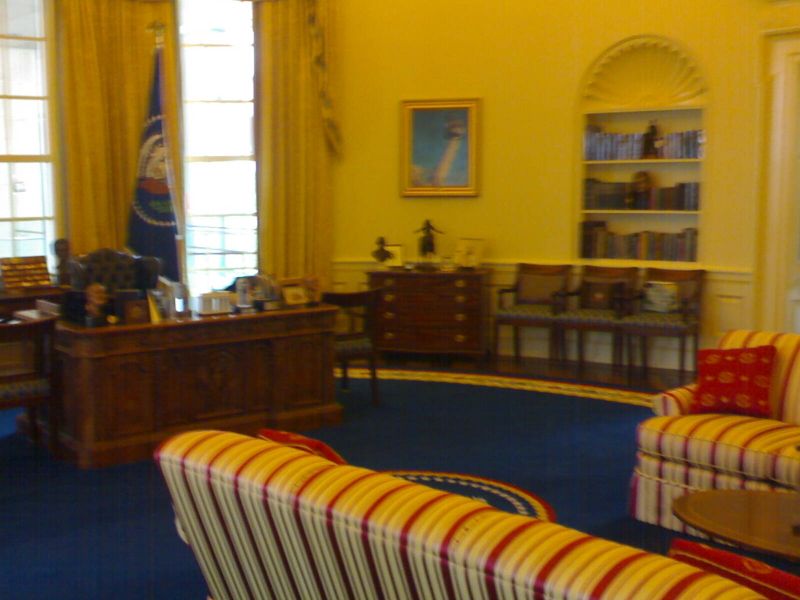
The Clinton Library and Museum includes a replica of the Oval Office as it was when President Clinton occupied it. According to the staff, the former President often moves objects around or borrows them during his monthly or bi-monthly visits to the Library (he has an apartment upstairs with room for his secret service agents).
The docents tell me that President Clinton knows them all by name and is closely involved in almost everything that happens at the Library. I spoke at length with one docent, Jane Cazort, whose father-in-law was lieutenant governor of Arkansas and whose granddaughter went to school with Chelsea Clinton.
Coincidentally, next week I’ll be attending the Fortune Brainstorm: Green 2009 conference in Laguna Niguel, California at which President Clinton is speaking. More on that later.
Categories: Collaborative Leadership, Concepts, Organizational Culture, People, Travel, Workplace Design -
Collaborating out of the Downturn Focus of Blog Talk Radio Interview
I discussed collaboration with Zane Safrit yesterday morning on his hour-long Blog Talk Radio show. You can listen to the show here.
When he was CEO of Conference Calls Unlimited, Zane masterfully used blogging as a marketing and business tool. His small company, based in a rural Iowa community, adopted collaborative culture and tools as an advantage in a marketplace saturated with large players. Zane is a super-capable, collaborative leader.
Our conversation ranged from common denominators and motivators for companies wanting to adopt collaborative culture and the biggest mistakes companies make. We also discussed the need to replace star-oriented culture and the role of collaboration in an economic recovery.
Zane asked me how companies can balance the need for collaboration with the need for consistency, routines and procedures. It’s a thoughtful question that organizations should consider. I explained that it’s necessary to include collaboration in policies and procedures, so that people are consistently collaborative J.
Towards the end of the show, we focused more on the economy. Zane asked me about the biggest trends regarding collaborative culture over the next two years. Here’s what I said:
People are going to realize what collaboration is and what it isn’t, and I absolutely believe that collaboration will help deliver us from the downturn. We need to abandon the herd mentality. I blogged about this on March 15, 2009 with a call to action. You can read the post here.
There’s a misconception that collaboration is about running with the herd. Real collaboration involves constructive confrontation….coming together to hash out issues, make decisions, improve processes and develop products and services. And it’s much broader than companies. It’s about governments collaborating across agencies and departments, with citizens and with other governments. It’s about people working together to create value in our communities.
It’s about changing education so that we’re developing collaborators. The more educated people are, the more competitive they are. Our educational system beats collaboration out of us. That’s changing.
I’ve lived and worked in smaller communities where many people get jobs right out of high school. They’re used to working together to cook dinner at the VFW or help neighbors repair tornado damage. It’s this type of attitude that we need to nourish in our country, in higher education, in companies, in and among governments. Coming out of this downturn, star culture and internal competition are unaffordable. Collaboration will drive the recovery.
“How will that change our economy, culture, country?” Zane asked me.
I responded:
It’ll be back to basics…working together to create real value. The mortgage mess, the financial collapse were rooted in artificial value. We gave the keys to the country and the economy to star competitors… the best and the brightest who went to top schools and competed for themselves without considering the bigger picture. Now we need to entrust our companies, governments and communities to collaborators. And we’re going to build long-term, sustainable value.


