Food and Drink


  • Collaboration to Change Product Use and Brand Perception

    The Apple iPod began as a music player and became a video player in part because consumers discovered a new use for the device. The brand perception then shifted.  Lego Mindstorms began as company-provided software and hardware to create small robots. Then consumers hacked the code, changed the products together and Lego ultimately began providing the source code and collaborating with its customers on new products. In time, consumers began perceiving Mindstorms as a collaborative activity.

    As in these cases, sometimes consumers collaborate to alter a product or its use and this ultimately changes the brand perception. In other cases, companies can collaborate with partners to discover new uses for products and change how consumers perceive the brand.

    Gin has traditionally involved martinis or gin and tonic—and at least one gin producer is collaborating with partners to change this use and brand perception. When Bombay Sapphire East

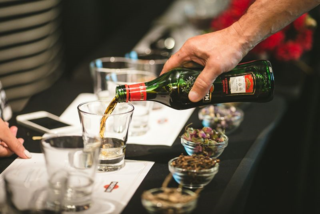
    Bombay Custom Tonic Bar
    The LUCKYRICE festival’s “custom tonic bar”: bartenders mix flavor extracts with Bombay Sapphire East gin and club soda

    emerged in test markets as the first product line extension of Bombay Sapphire gin in 2011, reviews described the gin as spicy. That’s because Bombay Sapphire East adds two new botanicals to Bombay Sapphire: lemongrass and black pepper. This “flavor profile” may seem a bit assertive to accompany typical cocktail fare like cheese and crackers. Therefore, it’s necessary for this brand to gain traction in a different culinary arena, namely Asian food.

    This past Friday evening, Bombay Sapphire East sponsored the 6th Annual LUCKYRICE feast at the Bently Reserve venue in San Francisco’s financial district. As I entered the event, an Asian woman handed me one of many varieties of exotic drinks bartenders were mixing with Bombay Sapphire East. A who’s who roster of upscale Asian restaurants with tables scattered around the event were cranking out specialties to accompany Bombay Sapphire East. The brand was clearly collaborating with chefs to create the perception that the gin goes well with Asian food. This is by no means a stretch.

    I sampled a drink called Piman which includes Bombay Sapphire East, yellow pepper puree and Kalamansi (an orange/kumquat hybrid) syrup.  I also checked out the Bombay Sapphire East “custom tonic” bar at which bartenders combined such flavor extracts as bergamot and elderflower with club soda and gin (see above image). These drinks complimented available dishes including Dosa restaurant’s Hyderabad chicken biryani, M.Y. China’s black pepper beef with mushrooms and Brussels sprouts, and Asian Box’s lamb meatballs in coconut curry.

    Collaborating with Asian chefs, the people behind Bombay Sapphire East are not only changing consumer perceptions about their gin. They’re also working with Asian restaurants to co-create and sell cocktails using a gin accented with botanicals that compliment Asian food.  This creates value for the restaurants and for Bacardi Limited, which owns Bombay Sapphire East.

    Whether the product is booze, blenders, toothpaste or technology, collaborating with partners to change brand use and perception can transform a sleeper product into a sales leader.




  • Coffee and Collaboration

    In San Francisco, where I live, coffee plays a major role in lifestyles and work styles. People stand in long lines at artisanal coffee businesses for coffee that’s sourced, roasted and prepared with care. CoffeeIt has become de rigueur for leading technology and social media companies to make artisanal coffee available to team members. Google stocks beans from the better San Francisco purveyors in snack areas throughout its “Googleplex” in Mountain View, California. Team members can grind the beans, brew a cup, or pull a shot of espresso on demand.

    As the artisanal movement in coffee, often called “Third Wave Coffee,” sweeps the U.S. and infiltrates workplaces, people are becoming particular about what’s in their mug. Commercial brew just won’t do. Yet coffee consumption remains primarily a solitary activity. People fiddle with their smart phones or work on notebook computers as they sip that Yirgacheffe or Antigua drip-by-the-cup in cafes and in workplaces.

    In contrast, workplace coffee consumption in Sweden is primarily a social activity. Swedes embrace the ritual consumption of coffee rather than the coffee itself. So Swedes care less about sourcing, roasting and preparation and more about gathering around a table with colleagues to consume the beverage.

    I recently returned from Gothenburg, Sweden where I gave a keynote speech on collaboration to a group of government leaders, healthcare professionals and pharmaceutical executives. While in Sweden, I engaged in Fika which is an institution in the Swedish workplace. Fika is scheduled twice a day, typically at 9 a.m. and 3 p.m. Work groups sit around tables in break areas. They drink coffee, eat cake sometimes baked by a team member, and they discuss issues pertinent to their work. Fika helps achieve the consensus that is integral to Swedish business culture (consensus is not integral to collaboration, but that’s a different post). Fika’s limitation is that people share coffee and cake with the same team members every day.

    Both U.S. and Swedish workplaces can enhance collaboration by changing how they consume coffee—but the challenges are different for each culture. In the U.S., the challenge is to put down the devices and engage others while enjoying that artisanal cup of joe.

    In Sweden, the challenge is to include people from other levels, roles and regions so that fika is less insular. Collaborative tools such as telepresence could bridge the distance gap and offer the opportunity for a video fika. Because fika is so engrained in the Swedish business culture, it is a critical channel Swedes can use to enhance organizational collaboration.


  • Collaboration Keeps Martini Thriving for 150 Years

    Winemaking, at its best, involves collaboration. Making vermouth adds a layer of complexity to winemaking and therefore requires an extra dose of collaboration along with added alcohol, sugar and botanicals. Martini, also known as Martini and Rossi, is the top-selling vermouth producer globally.

    In the building known as Department 54 at Martini near Turin, Italy, winemakers and herbalists

    Martini botanicals
    Making vermouth involves blending wine and botanicals. (Photo: Gary Sexton)

    collaborate to blend wine with botanicals. These include such herbs as dittany from Crete, a purported aphrodisiac, and the bitter artemesia. Also in the mix are flowers including roses and violets plus such fruits as raspberry and lemon. Martini winemakers and herbalists also include woods including quassia from Jamaica and cascarilla bark from the Bahamas plus many roots and spices.

    Many of these ingredients lined tables at San Francisco’s Dirty Habit restaurant a couple of weeks ago where I joined Martini Master Blender Giuseppe Musso, Operations Director Giorgio Castagnotti and Head Wine Maker Franco Brezza as they explained the intricacies of vermouth blending and production. The Martini team was in San Francisco to introduce Gran Lusso, a new vermouth celebrating the company’s 150 years.

    As Giuseppe described the woods, herbs and other botanicals, twenty or so writers and guests sipped

    Martini vermouth
    Botanicals line the tables at Martini’s vermouth tasting. (Photo: Gary Sexton)

    vermouths. Giuseppe has spent his entire 30-year career with Martini. His emotion bubbled to the surface as he described how Martini people treat each another as family and how the company emphasizes sharing skills and techniques from one generation to the next. Since 1992, Martini has been part of Bacardi Limited, the largest privately-held, family-owned spirits company.

    Most vermouths use white wine. For the new Gran Lusso vermouth, Martini blends red wine from Barbera grapes with white wine from          Trebbiano grapes.  To extract the botanicals, the winemakers and herbalists have created a new method for Gran Lusso. They combine grape must from Moscato di Canelli grapes with a natural spirit, and then they age the mixture for a year before adding botanicals. They then add a “secret ingredient” called “extract 94” which originates from a Martini recipe reportedly from 1904. The result is a bitter sweet vermouth with aromatic complexity.

    What struck me about the Martini team’s formal presentations and informal discussions with guests is the lack of marketing bravado and genuine love for their products and company which they constantly referred to as “family.” At dog-and-pony shows staged by less collaborative companies, people pepper presentations and conversations with empty superlatives such as “Our products are best-of-breed” or “Nobody can do what we do.”

    In The Culture of Collaboration book, I call this Superlative Syndrome. It’s a manifestation of what the Greeks called hubris or excessive pride. Superlative Syndrome often masks defects and can ruin a business as trust evaporates. Customers, financial analysts and the media become conditioned to doubt the company’s messages. Team members learn to cut corners and lie. In contrast, Martini delivers its message with sincerity and cultivates long relationships with business partners, customers and team members.


  • Multicultural Collaboration Produces Unique Spa

    Bridging cultures, particularly regional cultures, produces a broader perspective that gives collaborators an edge. In disciplines like aerospace engineering, team members trained in one country’s engineering tradition may view a creative challenge differently than their colleagues who were trained in a different country’s system. Drawing from their collective global knowledge, cross-cultural collaborators can spark synergies and create greater value. In The Culture of Collaboration book, I call this the Dynamic Dimension of Cross-Cultural Collaboration.

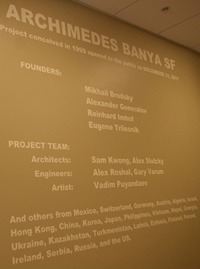
    This dimension is alive and well at Archimedes Banya, a spa complex that opened in San Francisco last New Year’s Eve after twelve years of development and construction. People from twenty different countries collaborated on the project. Managing partner Mikhail Brodsky of Russia had the original idea. Reinhard Imhof of Switzerland led the indoor construction. Architect Sam Kwong of China developed the plans. Other partners are from countries including Korea, Israel, Germany, Japan, and Mexico.

    The concept began when Brodsky, a mathematician, arrived in San Francisco from Moscow in 1989. A lBanya2over of Russian bath complexes or banyas, Brodsky was disappointed to find no such facilities in his adopted city. He longed to start a banya. In the summer of 1998, Brodsky, then a professor at the University of California at Berkeley, applied for a job as chair of the mathematics department at San Francisco State University. SFSU’s rejection sparked Brodsky’s interest in doing something significant in San Francisco while delivering on his banya dream.

    Brodsky, Imhof and two other partners formed a company, and in 1999 bought a lot in India Basin near San Francisco’s former Hunters Point Shipyard. Though in an obscure neighborhood, the lot provided sweeping views of San Francisco Bay. To construct the building, Brodsky and his partners would need to recruit more partners. Like many ethnic groups living in the United States, many Russians do business only within their community. Therefore, logic would dictate engaging Russians to finance, design and build the project. But some Russians who Brodsky approached had difficulty seeing past the many roadblocks to the project ranging from building permits and location to construction costs and customer base. So, Brodsky decided to broaden his reach, involving people from as many countries as possible. The common thread was a passion for the Banya project plus mutual trust and common goals, two of the Ten Cultural Elements of Collaboration I identify in The Culture of Collaboration book.

    In a departure from the command-and-control approach to business in which “stars” grab the credit, Archimedes Banya recognizes multiple contributions in much the same way Adobe Systems includes a Banya Wallcredit role in its software products. When I visited Archimedes Banya recently, the first thing I noticed was a wall near the entrance listing the names of the multicultural collaborators who turned the concept into reality. Also apparent was the amazing art ranging from mosaics depicting bathing traditions to murals and inlaid ceiling tiles. Including art in public bathing facilities is a tradition dating back to the Roman Empire.

    Artist Vadim Puyandaev of Kazakhstan collaborated with Brodsky to evoke the right atmosphere. “I
    wanted very simple, clear images of emotion,” says Brodsky. And the images also reflect action. “In a Russian banya, people move. It’s an active place. It’s not just sitting and sweating.” The complex is geared to socializing and offers facilities ranging from a rooftop sun deck with a San Francisco Bay view to private reception rooms replete with bars and kitchens.

    The Banya offers a spa experience reflecting the cultural melting pot. I checked out two Russian saunas, the Finish dry sauna, the steam room, warm soaking pools, cold plunge and relaxation room. After loosening up in the various saunas, I experienced a Russian venika platza treatment that involved a tall Moldovan fellow clad in a towel and sweat-soaked Banya hat brushing and lashing bunches of Latvian birch leaves on me to increase circulation.

    Following this, I laid on a table as an attendant scrubbed me with an exfoliating soap and then rinsed me with buckets of warm water. Then my muscles were relaxed enough for a massage from a masseuse from the United States. Afterwards, I headed to the café upstairs for pelmini or Russian dumplings, stuffed cabbage, hearty Russian beef soup, fresh-sqeezed juices spiked with kombucha, which is fermented tea and housemade kvass, a non-alcoholic beer made from fermented rye bread.

    An ambitious spa project that began as one person’s vision ultimately reflects the combined vision and execution of multiple people from many cultures. Collaboration involves marrying talents that are worth far more collectively than individually. Brodsky describes himself as a “starter.” But to make the project a reality, he collaborated with Imhof, a “finisher.” Because of the Swiss tradition of quality workmanship, Imhof shared Brodsky’s values of using the best materials and constructing a banya for the long term. The concept of “starters” and “finishers” has broad ramifications. A starter may have an incredible idea, but creating a company that produces substantial value may require collaborating with a finisher.

    As we collaborate, we can create awesome value by engaging and involving people with multiple talents and backrounds and, yes, from multiple cultures. The Dynamic Dimension of Cross-Cultural Collaboration delivers results otherwise unattainable.


  • Slow Money Collaboration

    In a cavernous, nearly empty room above the Readers Café & Bookstore in Building C of San Francisco’s Fort Mason Center, Woody Tasch sits at a corner table by a lone window looking out on the Bay. It’s the eve of the Slow Money National Gathering, and the organization’s chairman is putting the finishing touches on his opening remarks. He must fend off criticism that his model is “fantasy economics” and impress on the three hundred investors and five hundred or so other attendees that our industrialized food system has become as imbalanced as the financial system was during the depths of the 2008 crisis.

    Woody, a former New York venture capitalist who now lives off the grid near Taos, New Mexico, wants to change how we finance food businesses as dramatically as he has changed his own life and career. In the 1980’s, Woody worked as a self-proclaimed “small-time VC” making healthcare investments for Prince Ventures, owned by the Prince family of Chicago.  Ultimately, he transformed himself from a mathematics-driven investor to one with a social conscience with stops along the way as treasurer for a foundation and chairman of an angel investor network called Investors Circle.

    “It’s no longer about how much we can take off the table for ourselves,” Woody insists. After getting involved with the global Slow Food movement, the antithesis of fast food in its promotion of sustainability, Woody and his collaborators sought to address the difficulty many sustainable food businesses have getting financing. “It hit me that patient capital plus slow food equals slow money,” he explains.

    Woody and his colleagues are enabling microfinance for the food industry and, since 2009, have sparked $6 million in micro loans. Slow Money links growers, restaurants, organic farm suppliers and other food entrepreneurs with consumers willing to lend businesses a few thousand—or even a few hundred—dollars.

    “This is not a typical fiduciary model,” Woody explains. “What we are going to be proving over the next decade is that collective intelligence and local knowledge of groups of individuals effectively collaborating will produce positive outcomes both in arithmetic and impact on the community.” In other words, investors can do good and simultaneously get a modest return on investment. At the moment, 3 percent a year in interest is typical.

    Slow Money is evolving from advocating individual investments to promoting investment clubs. Compared to angel investing, for which investors must have assets of at least a million dollars or a yearly salary of at least $200,000, the investment club barrier to entry is much lower. As a model, Slow Food organizers point to the No Small Potatoes Investment Club, which provides low-interest loans to Maine farmers and food producers. So far, fifteen investors have each put up five thousand dollars.

    After talking with Woody, I stop by the rehearsal for the entrepreneur pitches. These five-minute presentations are not unlike those for technology companies at venture capital conferences. But there is something perhaps more wholesome and genuine and, yes, rougher around the edges, about these pitches.  Some of these food businesspeople have never before spoken at an event. George Weld, owner of both Egg restaurant in Brooklyn and a farm in Oak Hill, New York, speaks of the need to curb the “recurring alienation between rural and urban that plagues the food economy.”

    One of the better-received pitches comes from Dr. Hubert Karreman, a veterinarian and founder of Bovinity Health. Hubert’s company manufactures natural alternatives to antibiotics for livestock. He clicks through financials including $250,000 in sales in 2011, provides market share projections and leaves the rehearsal audience whispering "he's gonna get funded."

    Slow Food’s goal is for a million Americans to be investing one percent of their money in local food systems within a decade. Meantime, Woody Tasch offers his prescription for the economy. “What we need is rebalancing. Right now we’re lurching towards the global race to the bottom. It’s buy low, sell high, GMO [genetically modified organism], CDO [collateralized debt obligation] capitalism. We have to compete for cheap labor around the planet subsidized by cheap oil and ignoring the medium and long-term social and environmental impact.” Collaborating requires a longer-term focus, and Slow Money is helping enable that evolution.


  • Interspecies Collaboration and New York Times letter

    Today The New York Times published my letter to the editor headlined “A Monkey With Good Taste.” The letter comments on the Times story on August 14 headlined “Will No Cage Hold Him? Monkey Again Escapes Zoo,” which describes the adventures of a 9-year old capuchin monkey named OliverOliver_the_monkey  who has escaped twice from the Tupelo Buffalo Park and Zoo in Mississippi. Here’s the text of my letter:

    Image: Northeast Mississippi Daily Journal

    To the Editor:

    Re "Will No Cage Hold Him? Monkey Again Escapes Zoo" (news article, Aug. 14):

    Oliver, the 9-year-old capuchin monkey who has escaped twice from the Tupelo Buffalo Park and Zoo in Mississippi, may be sending his captors a message about diet — and we’d all do well to take notice.

    Kirk Nemechek, the zoo manager, reportedly tried luring Oliver with "chips, candy, Fruit Loops, anything." However, Oliver was spotted looting a vegetable garden. Clearly, the monkey has more sensible food preferences than his human captors. It’s a reminder that the best ideas often come from beyond the usual sources.

    Evan Rosen, San Francisco, Aug. 15, 2007

    The last line ties in with The Culture of Collaboration. Great ideas come from all kinds of sources. For a collaborative culture to flourish, people on the front lines or the factory floor must feel comfortable contributing to key decisions. Too often, however, organizations become mired in silo syndrome, as I describe in The Culture of Collaboration book. The syndrome is that sales people rarely interact with marketing folks, marketing rarely works with R&D, and facilities almost never deals with public affairs, and so on.  

    Effective organizations ensure that decisions reflect broad input regardless of department, level, region, business unit, function—and, as Oliver the Mississippi monkey has taught us, species. J

    For more on Oliver and his fight for freedom, check out this excellent post on the blog called Baudrillard’s Bastard.


  • Collaboration and Star Culture

    Collaboration requires collaborative culture. That’s the whole point of this blog. The opposite of collaborative culture is star culture, which our collective culture—particularly in the United States—perpetuates. The media is certainly complicit, because celebrity stories draw audiences. Therefore, the media has a vested interest in manufacturing stars—not just Hollywood people, but business leaders, athletes, entrepreneurs, surgeons, chefs and others. Food writers are particularly culpable, and we’ve certainly seen the celebrity craze spread to winemakers.

    Now, apparently, star culture is trying to envelop tequila makers. Last Friday, the San Francisco Chronicle ran a short article by Camper English headlined “Next big thing: Tequila bottle signings.” You can read the article here. The story begins, “Further evidence that distillers are the new rock stars…” We learn from the article that Carlos Camarena, owner and third-generation master distiller of El Tesoro Tequila, will be in San Francisco to sign autographs on $185 bottles of tequila at a liquor store.

    Clearly, Mr. Camarena is not alone in contributing to the success of El Tesoro. According to El Tesoro’s web site, making tequila begins with the jimador, the person who hand picks perfectly-ripe agaves and separates the pina, the juicy blue core, from the rest of the plant. “Most other tequila producers use an automated system that processes the entire stem,” the web site notes. Next workers cut the pinas into quarters with a special ax. In the next stage, workers use the traditional method of baking the pina quarters for 36 hours and cooling them for another 36 hours. Next workers use a one-ton stone wheel called a tahona to crush the pinas, extracting their juices. There are three more steps.

    The point is that many people with a variety of expertise collaborate to make El Tesoro tequila. While I appreciate the marketing benefits of Mr. Camarena signing tequila bottles during his rock star-style tour, this feeds into star culture and sends the wrong message to the public and to El Tesoro team members. Promoting the CEO as a star may produce a momentary marketing bounce, but a collaborative culture sustains greater business value than a star culture.