Health


  • Health Insurance Company Experiences The Bounty Effect

    When Presbyterian Health Plan denied Dave Bexfield of Albuquerque, New Mexico reimbursement for a multiple sclerosis treatment trial, Bexfield launched a campaign to recover the $200,000 he spent on the treatment. He contacted media, bombarded Presbyterian with calls and emails, and ultimately lined his garage walls with the insurer’s denial letters, according to an August 1, 2014 column by David Segal in the New York Times.

    The treatment was a stem cell transplant trial sponsored by the National Institutes of Health. The trial worked in that Bexfield no longer takes M.S. medication and the disease is in remission. But the stem cell transplant was apparently not a covered benefit when Bexfield received the treatment. Ironically, Presbyterian Health Plan added this treatment to the benefits for Bexfield’s plan a few months after he finished the trial. A Presbyterian spokesperson reportedly called the timing “unfortunate.”

    Unfortunate indeed for Presbyterian Health Plan in that Bexfield refused to back down. Presbyterian reportedly insisted that the only reason the company had added stem cell transplants for M.S. as a benefit was that the federal government had mandated it. So Bexfield submitted a Freedom of Information Act request and received documents indicating there was no federal mandate. This suggested that Presbyterian had decided on its own based on the treatment’s merits to begin covering stem cell transplants after Bexfield had completed the trial. After receiving many additional letters and media calls, Presbyterian changed course. Presbyterian Health Plan President Lisa Farrell Lujan agreed to reimburse Bexfield not only the $200,000, but also an additional $198,000 in interest at 18 percent, according to the Times.

    Boom. The Bounty Effect had arrived at Presbyterian Health Plan, and the company seized the opportunity to change. The Bounty Effect happens when exigent circumstances compel businesses, governments and organizations to change their structures from command-and-control to collaborative. The exigent circumstances were groundbreaking advances in stem cell research. Bexfield’s campaign and the resulting media attention drove The Bounty Effect home. In this situation, Presbyterian adopted a more collaborative approach. Often structural change starts small and grows. This episode may pave the way for more fundamental structural changes at the company.

    In my latest book, The Bounty Effect: 7 Steps to The Culture of Collaboration, one of the 7 steps is Processes. And a key process is employing Measurement Counter-Measures which curb the measurement mania that can complicate collaboration and compromise value. The point is that a maniacal focus on measurement can produce the opposite of the intended result. Clearly, Presbyterian’s measurement mania produced myopia in that claims representative had difficulty seeing beyond the numbers.

    The $200,000 for the stem cell transplant would cost the insurer in the short run, but the money produces a living, breathing example of an insurance customer who may potentially avoid further treatment for M.S. and save the insurer plenty. One measurement counter-measure is to perform a common sense reality check. If the numbers defy common sense, that’s our cue to pause and reconsider. Employing Measurement Counter-Measures is often the hardest collaborative process for financial professionals to adopt.

    Lujan, Presbyterian’s president, is the company’s former CFO and was previously an audit manager with Arthur Andersen. She told the Times that the individual decisions Presbyterian made in Bexfield’s case were correct but that consistent policies had to be balanced against fairness. “When I looked at the forest, I came to a different conclusion than those who had looked at each individual tree,” according to Lujan.

    The old reimbursement decision was obsolete, because of scientific breakthroughs. Clinging to an antiquated coverage decision would expose the company to possible litigation, bad publicity, and a hit to its reputation. More fundamentally, the old decision—and the structure that produced that decision—failed the fairness test and the common sense reality check.

    The Bounty Effect prompted Lujan to take a key step—but changing the structure requires much more. If only the CEO can see the forest and use a fairness test, the organization flies blind and the business suffers. In adopting a collaborative structure, the challenge for Presbyterian and for many organizations is empowering people at all levels to consider the big picture, participate in decisions and take action. This requires, among other shifts, changing the recognition and reward system and enabling spontaneous interaction so that all Presbyterian Health System team members share a view of the forest and not just individual trees.


  • Fixing General Motors and Curing Veterans Affairs

    General Motors chief executive Mary Barra has vowed to change the company’s culture and has testified
    GM Logo1before Congress that GM has taken steps to increase internal transparency and information sharing. This commitment follows a report exposing that GM discouraged raising or sharing safety concerns. The company commissioned the report, because GM failed to recall thousands of cars with defective ignition switches for eleven years.

    Similar calls for culture change have followed the Veterans Health Administration’s wait-for-care and numbers fudging scandal. President Obama has remarked that VA Image the VA needs a culture change so that “bad news gets surfaced quickly.” Not content to wait for culture change, House and Senate negotiators today announced a $17 billion plan that, among other provisions, provides money to lease clinics so that veterans can get treatment outside the VA’s system.

    Culture change emphasizes the result without a way to get there. It’s like telling a poor person to become rich. Culture change has become a common prescription from leaders, pundits and management gurus. The prescription often fails, because the shift originates with executives without detail, discussion or broad buy-in. Meantime, the organizational structure stays the same.

    The Bounty Effect has hit GM and the VA. As I describe in my new book, The Bounty Effect happens when exigent circumstances compel businesses, government and organizations to change their structures from command-and-control to collaborative. The solution for these organizations is to seize the opportunity The Bounty Effect provides and fundamentally change their structures so that people can spontaneously engage one another, share information and participate in decisions regardless of level, role or region. This will cost far less than $17 billion.

    Many organizations, including GM and the VA, still operate with a structure that has barely changed since the Industrial Age.  This obsolete structure based on command-and-control promotes hierarchy and internal competition plus rewards information hoarding, secrecy, and cutting corners. GM and the VA also share a need to go through channels. This inhibits the participation and information flow critical to Information Age organizations.

    Safety concerns apparently never reached GM’s chief executive, nor did problems with scheduling reporting systems apparently flow to former VA Secretary Eric Shinseki.  And both organizations apparently discouraged people from sharing concerns. VA supervisors often retaliated against workers who raised valid complaints, according to a White House report.

    GM chief executive Mary Barra has said that culture change must be leader-led. Barra has also promoted a program called “speak up for safety” plus three GM “core values.” These are “the customer is our compass, relationships matter, and individual excellence is crucial.” But a leader’s words have modest impact without structural change. Yes, GM has added safety investigators, increased safety data mining, and created a vice president of safety position. Nevertheless, none of these actions will reduce information hoarding and internal competition. None of these actions will change GM’s structure from command-and-control to collaborative. 

    When an organization rewards obsolete behavior, change dies on the vine despite a leader’s mandate. If hoarding and hiding information or failing to act on knowledge results in a raise or a promotion, people are unlikely to share information or take action. Pushing safety issues at GM was seemingly no path to promotion. VA managers reportedly kept patient names off the official waiting list, because bonuses depended on concealing information. Recognition and reward systems in obsolete organizational structures often reinforce bad behavior and the status quo regardless of culture change efforts. The same flawed practices and processes that encourage internal competition and information hoarding lead companies to compromise safety and fudge numbers.

    Changing the VA’s structure will enhance transparency and efficiency while saving money rather than costing the $17 billion Congress is authorizing. Changing GM’s structure will ensure that people across the organization share and act on critical information.  And changing the structure of GM and the VA will accomplish what many leaders and pundits are recommending: culture change.


  • Clinton Foundation Collaborates to Improve Health

    Collaborating across sectors—government, private industry, non-governmental organizations (NGOs) and education—can solve some of the world’s greatest challenges. These challenges include global health, economic inequality, childhood obesity, climate change, and health and wellness—which, incidentally, are the five main areas in which the William J. Clinton Foundation works.


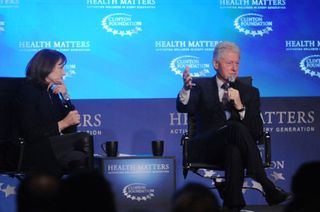
    Health and wellness was front and center last Tuesday as President Bill Clinton and his daughter, Chelsea, assembled a few hundred people in the California desert for the Clinton Foundation’s Health Matters conference. Despite the focus, themes are interrelated. So global health, economic inequality, and childhood obesity crept into the discussion. In his opening remarks, President Clinton noted that the rising cost of health insurance premiums often prevents employers from increasing wages. “We cannot ignore the link between health and the economy,” said President Clinton.

    Clinton Health Matters


    Invited guests and speakers at the La Quinta Resort in La Quinta, California included hospital and insurance executives, health policy experts, and veterans of government service including Dr. David Satcher, Surgeon General of the United States during the Clinton Administration. Others including Dr. Deepak Chopra, Dr. Dean Ornish, and actress Barbra Streisand are partnering with the Clinton Foundation to advance health and wellness agendas. Long-standing relationships among some participants coupled with the relaxed resort atmosphere sparked an exchange of actionable ideas. President Clinton and Chelsea seemed as comfortable sitting in the audience asking questions and refining ideas as they were on stage.

    “We’re moving into an era where the only way you can create enough jobs for people and generate enough wealth to have decently-rising wages is if you have creative networks of cooperation. I think the same thing is true of this health challenge,” President Clinton insisted during a discussion with NBC News Chief Medical Correspondent Nancy Snyderman, a friend of the former president for thirty years. “It’s the only thing that works. It works everywhere in the world.” This is another way of saying that collaboration creates value.

    I practically muttered “Amen” aloud when President Clinton cited a study that found that if you put a group of people with average IQs together and ask them to work on a problem for a year and you give the same problem to a genius, over the long run the group of people with average intelligence working together will do better than one genius acting alone.

    One of the most impactful ways that collaboration can improve healthcare is to remove the barriers that exist between front-line doctors and other health professionals. Too often primary care doctors practice in silos. Dr. Mark Weissman rose from the audience to insist that he and other primary care doctors are awash in patient data but lack regular access to other medical professionals who can collaborate with them on the data and on patient care. Pediatrician Donald Berwick, former administrator of the Centers for Medicare and Medicaid Services and a possible candidate for governor of Massachusetts, responded to Weissman that it’s necessary for doctors to learn that “I’m no longer the hero who saves the day, but I’m interdependent with others to give care. That’s what works.”

    I’ve written often in this space and in The Culture of Collaboration book about how engaged team members working in a collaborative culture create far more value than do team members working in a culture of fear and internal competition.  Dr. Deepak Chopra noted that employee disengagement costs the United States economy $300 billion a year. “If your supervisor ignores you, you start to get disengaged and within a few months you start to get ill,” Chopra explained. “If your supervisor doesn’t ignore you but criticizes you, you actually get better.” This is because we would rather be acknowledged than ignored even if we’re receiving criticism. “And if your supervisor notices a single strength that you have, your rate of disengagement goes down to 1 percent,” according to Chopra.

    The Health Matters conference is as much about taking action as about exchanging ideas. Corporations, government entities, non-profit organizations, and individuals pledged to take action in preventing disease and improving health. Financial pledges total over $100 million. One such pledge by entrepreneur and philanthropist Vinod Gupta will support a new Clinton Foundation program to address prescription drug abuse. Gupta’s son, Benjamin, died accidentally after taking prescription painkillers and consuming alcohol in December of 2011. Gupta and the Clinton Foundation will educate the public, particularly college students, about the dangers of prescription painkillers.

    As I was checking out of the La Quinta Resort, I noticed that Surgeon General Satcher was next to me in line. We chatted about his recent work guiding the Satcher Health Leadership Institute at the Morehouse School of Medicine in Atlanta. Dr. Satcher noted that at Morehouse he’s building on his work as surgeon general by collaboratively focusing on neglected diseases and underserved populations. Like so many other disciplines, improving health and wellness requires collaboration.


  • Mayo Clinic Enhancing Collaboration

    The Mayo Clinic, founded on the principle of collaboration, is taking collaboration and innovation to the next level. With a mission nothing short of transforming how healthcare is experienced and delivered, Mayo’s Center for Innovation integrates emerging collaborative tools into processes and culture. The Center for Innovation includes Mayo’s innovative S.P.A.R.C. design lab.


    While writing The Culture of Collaboration book, I conducted on-site research at S.P.A.R.C. and throughout Mayo. Now it’s time for an update. The catalyst was a recent conversation with Chris Yeh of PBworks, which offers a hosted wiki-oriented business collaboration platform with newly-added integrated voice conferencing. Mayo is piloting PBworks along with other online collaborative spaces. “We call it a sandbox where people can figure things out,” Francesca Dickson of Mayo’s Center for Innovation told me yesterday during a Skype video call.


    Francesca and Beth Kreofsky of Mayo’s Center for Innovation provided an inside view of how Mayo is evolving, and we talked about the role of tools. Aside from PBworks, Mayo is also piloting “ideation” tools that let team members share ideas and build on them based on “focused questions.” One such tool is Jive.


    Besides asynchronous social tools, Mayo is now piloting instant messaging in several departments including nursing and radiology. Paging, a precursor to instant messaging, is deeply engrained in Mayo’s culture. Anybody can page the CEO and expect a prompt call back. Hierarchy is muted at Mayo, and the CEO is always a practicing physician. Mayo’s culture is ripe for IM and unified communications through which people can connect spontaneously through IM, voice or video regardless of level, role or region.


    Meantime, paging persists at Mayo. The Center for Innovation’s mission is to keep Mayo, well, innovating. So the Center is demonstrating to the organization that IM offers a clear advantage over paging.


    Video is another tool that’s part-and-parcel of Mayo’s culture. Mayo was an early user of videoconferencing to encourage collaboration among its three campuses. Mayo has already piloted Cisco TelePresence with a hospital in Duluth, Minnesota. And beginning in April, patients in Canon Falls, Minnesota will receive consultations from Mayo specialists via TelePresence.


    By integrating new collaborative tools into its already collaborative culture, Mayo will likely enhance healthcare delivery and create greater value.


  • Collaboration Curing Multiple Sclerosis

    It was definitely unorthodox. Many said it was impossible. But it looks like The Myelin Repair Foundation has done it. MRF, which is working on curing multiple sclerosis, is about to meet its ambitious goal of licensing a discovery for commercial drug development within five years. Through a collaborative research model, the Silicon Valley-based foundation has reduced drug development time from 15 years to 5 years. MRF is negotiating with a biotech company and believes a license agreement is in the works.


    Intuit Founder Scott Cook, a foundation supporter, suggested I research MRF when I was writing The Culture of Collaboration book.  In the book, I tell the story of how Scott Johnson, who has MS, learned that a cure was taking three or four times as long because of competition among researchers. This prompted Johnson to rethink the culture of medical research and begin changing that culture. Scientists often refuse to share data and information, because they compete for limited grant money and for publishing articles in top medical journals. The answer was to get experts in different disciplines to collaborate. So Johnson raised money, ultimately plowed $20 million into drug discovery work, and built a collaborative medical research foundation.


    Johnson brought in fellow tech start-up veteran Russell Bromley as chief operating officer. And Johnson and Bromley recruited five principal investigators who head labs.  They proposed a level of collaboration for curing disease that none of the scientists had ever experienced. Their focus was to repair myelin, the sheath that surrounds the nerves, which MS damages. Johnson and Bromley with input from the researchers developed a Collaborative Research Process, which addresses everything from tools to incentives.


    Since its founding in 2004, MRF has advanced work towards a cure for MS beyond anything anybody else had imagined within this timeframe. “Because of our work, we have a much clearer understanding of how to drive neural stem cells to the site of myelin damage in the central nervous system and instruct the myelin-producing cells to remyelinate,” Johnson writes in his recent president’s message.


    The Myelin Repair Foundation’s game-changing collaborative approach sets a new standard for medical research. The broader medical research community should sit up and take notice that collaboration among researchers creates greater value than competition.


  • Kaiser’s Garfield Center Enhances Innovation, Collaboration

    With the growing use of tools enabling collaboration at a distance, it’s easy to forget the value of same-room collaboration and the role of the physical workplace environment. Environment—both physical and virtual– is one of the Ten Cultural Elements of Collaboration that I identify in The Culture of Collaboration book.


    It’s essential to bring collaborative capabilities to people so that collaboration becomes integrated with work styles. Forcing people to walk down the hall or go someplace to collaborate falls short. Therefore, it may seem counter-intuitive that dedicated collaborative spaces not only enhance collaboration, but also are crucial components of collaborative organizations.


    Our research at The Culture of Collaboration® Institute shows that the most collaborative organizations integrate dedicated collaborative spaces into work flow. The distinction is that these physical spaces are by no means the primary means of organizational collaboration. In some cases, dedicated collaborative spaces bridge physical and virtual environments by including geographically-dispersed team members through telepresence or videoconferencing.  


    Garfield Center Yesterday, I had the opportunity to explore one such dedicated collaborative space. From the outside, Kaiser Permanente’s Sidney R. Garfield Health Care Innovation Center looks like a warehouse. In fact, it’s a former check processing center in an industrial park in San Leandro, California. On the inside, the Garfield Center is anything but ordinary. The future of healthcare delivery is unfolding in this 37-thousand square foot laboratory. The Garfield Center includes multiple environments ranging from patient room prototypes to homes outfitted with monitoring and telemedicine technologies.


    There are lots of gee-whiz technologies and environments including a concept operating room in which researchers are testing tools including augmented virtual reality. But what’s most significant about the Garfield Center is that people from across Kaiser regardless of level, role or region come together to brainstorm, innovate and collaborate. Doctors and nurses partner with architects and technologists to create prototypes for patient care in this “touchdown location for innovation work” as Sherry Fry, operations specialist for the Center, describes it. Anybody at Kaiser can use the facility as long as the activity is interdisciplinary. “The Garfield Center has become synonymous with innovation at Kaiser,” notes Dr. Yan Chow, associate director of innovation and advanced technology for Kaiser Permanente.


    In developing the 3-year-old Garfield Center, Kaiser researchers studied models outside healthcare, notably the McDonald’s Innovation Center near Chicago. Kaiser also studied Mayo Clinic's S.P.A.R.C. unit, which I describe in my book. S.P.A.R.C. stands for See Plan Act Refine Communicate. Through S.P.A.R.C., Mayo assembles cross-functional collaborators to conduct live prototyping of healthcare service delivery.


    The value of dedicated collaborative spaces is that they help break down barriers among silos. As doctors engage architects and facilities people brainstorm with technologists, ideas become prototypes which ultimately deliver measurable value.


  • Reflection Enhances Collaboration

    Recently, I’ve grown concerned about the lack of reflection that can compromise collaboration. I define reflection as “pausing to think.” Reflection is increasingly lost in our interrupt and interact-driven culture. It may seem counter-intuitive in that reflection suggests working alone or in a vacuum. But there’s a difference.


    Some people think they do their best work by going off in a corner and making their mistakes in private. They prefer to interact with others only after they feel they got their part right on their own. Once their part is complete, they prefer to toss their work over the fence to the next person to do their part. This assembly-line approach to decision making, problem solving and product and service development compromises value.  This behavior clearly undermines collaboration.


    The other extreme is that in this Twitter-twitching, Facebook feeding, blog-obsessed culture, we feel compelled to constantly interact. Some health experts insist the fallout from these potentially obsessive behaviors includes everything from repetitive strain injuries to heart attacks, not to mention neglect of loved ones or divorce. Like endless face-to-face meetings, much of this online interaction is falsely labeled collaboration.


    In The Culture of Collaboration book, I define collaboration as “working together to create value while sharing virtual or physical space.” Also, value is one of the Ten Cultural Elements of Collaboration that I identify in the book. Creating value is critical to collaboration. In fact, it’s a useful acid test.


    Social networking includes a portfolio of tools and behaviors that can lead to collaboration, but it takes  more than a tweet, post, text or instant message to collaborate. Social networking and social media output can be much like cable television chatter. The difference is that social networking lets us participate, and we tend to dip in and out all day long. It’s easy to devote big chunks of time to chatter. And there’s nothing wrong with chatter, but it’s not necessarily collaboration.


    Constant interaction without reflection can compromise collaboration and value creation. Brainstorming, sharing ideas, and co-creation produces incredible value. When we pause to think, however, we can contribute more effectively when we’re collaborating. Reflection enhances value creation for collaborators.


    Using collaborative tools for chatter and fun helps instill behavior that sparks collaboration, but it’s easy to just keep chattering and never get around to creating value. Use value creation as an acid test for collaboration, and we derive greater satisfaction and real results from social networking and other collaborative tools. And reflection is part of that equation.


  • Telehealth Revisited

    Telehealth is back on radar screens of policy makers, health care professionals, engineers and marketers. As we rethink healthcare economics and delivery systems, technology advances are enabling new approaches and better execution of old approaches. Telehealth can enable healthcare access for underserved populations including rural areas, inner city areas, isolated regions, developing countries, and prisons.


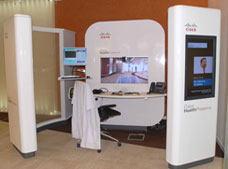
    Michigan Corrections Polycom  Telepresence creates new opportunities for virtual consultations to approximate face-to-face encounters between providers and patients and among providers. Tandberg and Polycom, established vendors in  telehealth, now offer telepresence for healthcare. Polycom announced last month at the American Telemedicine Association 14th Annual Meeting and Exposition that the Michigan Department of Corrections is using Polycom telepresence for everything from tele-psychiatry to tele-nephrology.  Cisco’s Internet Business Solutions Group hasCisco HealthPresence developed HealthPresence, which combines Cisco TelePresence with patient health data captured by connected medical devices such as stethoscopes and vital signs monitors.


    In the late 1990’s, I conducted research in telehealth and wrote the “Personal Telemedicine” column for Telemedicine Today magazine. The magazine allowed me to write about every aspect of telehealth with an emphasis on how the tools and delivery mechanisms impact people. The name of the column played off my first book, Personal Videoconferencing (Manning/Prentice Hall, 1996). Since many of the telehealth topics I researched then are now re-emerging, I’ll share one column that’s still available online. It’s called "Twenty Minutes in the Life of a Tele-Home Health Nurse," which appeared in the December, 1997 issue of Telemedicine Today. You can read the column here.