Lifestyle


  • Lagoons and Collaborative Development

    As the Falcon 2000LX reaches 41,000 feet, Uri Man begins answering questions from real estate developers. “It’s not stagnant. It’s circulating,” Man, the CEO of Crystal Lagoons USA, tells one inquiring passenger.

    Soon we would see for ourselves. Man had chartered the plush jet and scooped up some developers and this author attending the Urban Land Institute’s Fall Meeting in San Francisco last Monday. Now we’re bound for Cabo San Lucas to tour a human-made lagoon.

    “We are a technology company collaborating with developers,” Man explains. This unique collaboration for large-scale real estate development projects had piqued my interest. Crystal Lagoons has 300 lagoon projects underway globally.  Man did a stint as a developer before Crystal Lagoons founder Fernando Fischmann recruited him to accelerate lagoon projects in the U.S. “Right now we’re going to Cabo, because I can’t show you one yet in the U.S.” That’s about to change. The first Crystal Lagoon in the U.S. will reportedly open next summer at Epperson Ranch in Pasco County, Florida.

    Meantime, we’re headed to the southern tip of Mexico’s Baja peninsula to see what a 10-acre salt water lagoon looks and feels like. As Man begins a slide presentation on his notebook computer, I begin

    Crystal Lagoons Diamante web
    A 10-acre Crystal Lagoon at Diamante Cabo San Lucas, Mexico. (Photo credit: K.R. Hirzel)

    visualizing the collaborative potential of lagoons. Resort developers need a new amenity to differentiate their projects. Coastal resorts can increase their waterfront, and inland resorts can gain a coastal experience. A Crystal Lagoons architect and project team collaborates with the developer’s planning team until they conceive a project with a lagoon as the centerpiece. The Crystal Lagoons technology uses disinfection “pulses” that reportedly allow using up to 100 times fewer chemicals than a swimming pool and an ultrasonic filtration system that allows using up to 50 times less energy than conventional filtration systems.

    The Crystal Lagoons business model has nothing to do with construction and everything to do with licensing. The company has a major stake in the success of development projects, because it receives roughly two percent of every condominium and house sale and a similar cut of each time share dollar. For developers, constructing lagoons costs an average of $100,000 to $200,000 per acre.

    The Falcon 2000X lands, and a greeting party boards the plane and passes out hand-blown shot glasses. After a ride through some dusty Cabo streets, we arrive at the Diamante development west of the city on the Pacific Ocean. After we tour the resort, I change into my swim suit and plunge into the salt water lagoon. As I swim laps in a life-guarded area near one of two beaches, kayaks explore the expanse of this man-made mini ocean.

    En route back to San Francisco, Uri Man talks about the future of Crystal Lagoons with the gusto of a bond trader (he used to be one) and the chutzpah of a guy who once hit on Fox News anchor Ainsley Earhardt on live TV (which he did). That future may involve cross-sector collaboration among industry and governments.

    Crystal Lagoons-Uri En Route to Cabo web
    Crystal Lagoons USA CEO Uri Man on board a Falcon 2000LX en route to Cabo San Lucas, Mexico. (Photo credit: K.R. Hirzel)

    “Parks are big money losers for states, cities and countries,” Man insists. So why not collaborate with governments to transform parks with lagoons? “Then it’s not just ten people showing up with their dogs,” says Man. “You could have hundreds of thousands showing up.”

    The licensing revenue business model, which the company would likely modify for government work, ties the success of Crystal Lagoons to the achievements of developers and their large-scale projects. Both parties share wins and losses. So Crystal Lagoons enters into collaborations carefully and works with developers to create mutual value. More broadly, business partners can achieve smashing success if incentives and business models foster symbiotic relationships and collaborative value creation.

  • Collaboration to Change Product Use and Brand Perception

    The Apple iPod began as a music player and became a video player in part because consumers discovered a new use for the device. The brand perception then shifted.  Lego Mindstorms began as company-provided software and hardware to create small robots. Then consumers hacked the code, changed the products together and Lego ultimately began providing the source code and collaborating with its customers on new products. In time, consumers began perceiving Mindstorms as a collaborative activity.

    As in these cases, sometimes consumers collaborate to alter a product or its use and this ultimately changes the brand perception. In other cases, companies can collaborate with partners to discover new uses for products and change how consumers perceive the brand.

    Gin has traditionally involved martinis or gin and tonic—and at least one gin producer is collaborating with partners to change this use and brand perception. When Bombay Sapphire East

    Bombay Custom Tonic Bar
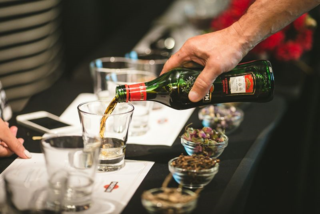
    The LUCKYRICE festival’s “custom tonic bar”: bartenders mix flavor extracts with Bombay Sapphire East gin and club soda

    emerged in test markets as the first product line extension of Bombay Sapphire gin in 2011, reviews described the gin as spicy. That’s because Bombay Sapphire East adds two new botanicals to Bombay Sapphire: lemongrass and black pepper. This “flavor profile” may seem a bit assertive to accompany typical cocktail fare like cheese and crackers. Therefore, it’s necessary for this brand to gain traction in a different culinary arena, namely Asian food.

    This past Friday evening, Bombay Sapphire East sponsored the 6th Annual LUCKYRICE feast at the Bently Reserve venue in San Francisco’s financial district. As I entered the event, an Asian woman handed me one of many varieties of exotic drinks bartenders were mixing with Bombay Sapphire East. A who’s who roster of upscale Asian restaurants with tables scattered around the event were cranking out specialties to accompany Bombay Sapphire East. The brand was clearly collaborating with chefs to create the perception that the gin goes well with Asian food. This is by no means a stretch.

    I sampled a drink called Piman which includes Bombay Sapphire East, yellow pepper puree and Kalamansi (an orange/kumquat hybrid) syrup.  I also checked out the Bombay Sapphire East “custom tonic” bar at which bartenders combined such flavor extracts as bergamot and elderflower with club soda and gin (see above image). These drinks complimented available dishes including Dosa restaurant’s Hyderabad chicken biryani, M.Y. China’s black pepper beef with mushrooms and Brussels sprouts, and Asian Box’s lamb meatballs in coconut curry.

    Collaborating with Asian chefs, the people behind Bombay Sapphire East are not only changing consumer perceptions about their gin. They’re also working with Asian restaurants to co-create and sell cocktails using a gin accented with botanicals that compliment Asian food.  This creates value for the restaurants and for Bacardi Limited, which owns Bombay Sapphire East.

    Whether the product is booze, blenders, toothpaste or technology, collaborating with partners to change brand use and perception can transform a sleeper product into a sales leader.


  • Collaboration Keeps Martini Thriving for 150 Years

    Winemaking, at its best, involves collaboration. Making vermouth adds a layer of complexity to winemaking and therefore requires an extra dose of collaboration along with added alcohol, sugar and botanicals. Martini, also known as Martini and Rossi, is the top-selling vermouth producer globally.

    In the building known as Department 54 at Martini near Turin, Italy, winemakers and herbalists

    Martini botanicals
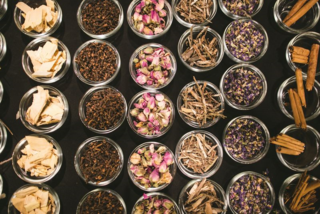
    Making vermouth involves blending wine and botanicals. (Photo: Gary Sexton)

    collaborate to blend wine with botanicals. These include such herbs as dittany from Crete, a purported aphrodisiac, and the bitter artemesia. Also in the mix are flowers including roses and violets plus such fruits as raspberry and lemon. Martini winemakers and herbalists also include woods including quassia from Jamaica and cascarilla bark from the Bahamas plus many roots and spices.

    Many of these ingredients lined tables at San Francisco’s Dirty Habit restaurant a couple of weeks ago where I joined Martini Master Blender Giuseppe Musso, Operations Director Giorgio Castagnotti and Head Wine Maker Franco Brezza as they explained the intricacies of vermouth blending and production. The Martini team was in San Francisco to introduce Gran Lusso, a new vermouth celebrating the company’s 150 years.

    As Giuseppe described the woods, herbs and other botanicals, twenty or so writers and guests sipped

    Martini vermouth
    Botanicals line the tables at Martini’s vermouth tasting. (Photo: Gary Sexton)

    vermouths. Giuseppe has spent his entire 30-year career with Martini. His emotion bubbled to the surface as he described how Martini people treat each another as family and how the company emphasizes sharing skills and techniques from one generation to the next. Since 1992, Martini has been part of Bacardi Limited, the largest privately-held, family-owned spirits company.

    Most vermouths use white wine. For the new Gran Lusso vermouth, Martini blends red wine from Barbera grapes with white wine from          Trebbiano grapes.  To extract the botanicals, the winemakers and herbalists have created a new method for Gran Lusso. They combine grape must from Moscato di Canelli grapes with a natural spirit, and then they age the mixture for a year before adding botanicals. They then add a “secret ingredient” called “extract 94” which originates from a Martini recipe reportedly from 1904. The result is a bitter sweet vermouth with aromatic complexity.

    What struck me about the Martini team’s formal presentations and informal discussions with guests is the lack of marketing bravado and genuine love for their products and company which they constantly referred to as “family.” At dog-and-pony shows staged by less collaborative companies, people pepper presentations and conversations with empty superlatives such as “Our products are best-of-breed” or “Nobody can do what we do.”

    In The Culture of Collaboration book, I call this Superlative Syndrome. It’s a manifestation of what the Greeks called hubris or excessive pride. Superlative Syndrome often masks defects and can ruin a business as trust evaporates. Customers, financial analysts and the media become conditioned to doubt the company’s messages. Team members learn to cut corners and lie. In contrast, Martini delivers its message with sincerity and cultivates long relationships with business partners, customers and team members.


  • Multicultural Collaboration Produces Unique Spa

    Bridging cultures, particularly regional cultures, produces a broader perspective that gives collaborators an edge. In disciplines like aerospace engineering, team members trained in one country’s engineering tradition may view a creative challenge differently than their colleagues who were trained in a different country’s system. Drawing from their collective global knowledge, cross-cultural collaborators can spark synergies and create greater value. In The Culture of Collaboration book, I call this the Dynamic Dimension of Cross-Cultural Collaboration.

    This dimension is alive and well at Archimedes Banya, a spa complex that opened in San Francisco last New Year’s Eve after twelve years of development and construction. People from twenty different countries collaborated on the project. Managing partner Mikhail Brodsky of Russia had the original idea. Reinhard Imhof of Switzerland led the indoor construction. Architect Sam Kwong of China developed the plans. Other partners are from countries including Korea, Israel, Germany, Japan, and Mexico.

    The concept began when Brodsky, a mathematician, arrived in San Francisco from Moscow in 1989. A lBanya2over of Russian bath complexes or banyas, Brodsky was disappointed to find no such facilities in his adopted city. He longed to start a banya. In the summer of 1998, Brodsky, then a professor at the University of California at Berkeley, applied for a job as chair of the mathematics department at San Francisco State University. SFSU’s rejection sparked Brodsky’s interest in doing something significant in San Francisco while delivering on his banya dream.

    Brodsky, Imhof and two other partners formed a company, and in 1999 bought a lot in India Basin near San Francisco’s former Hunters Point Shipyard. Though in an obscure neighborhood, the lot provided sweeping views of San Francisco Bay. To construct the building, Brodsky and his partners would need to recruit more partners. Like many ethnic groups living in the United States, many Russians do business only within their community. Therefore, logic would dictate engaging Russians to finance, design and build the project. But some Russians who Brodsky approached had difficulty seeing past the many roadblocks to the project ranging from building permits and location to construction costs and customer base. So, Brodsky decided to broaden his reach, involving people from as many countries as possible. The common thread was a passion for the Banya project plus mutual trust and common goals, two of the Ten Cultural Elements of Collaboration I identify in The Culture of Collaboration book.

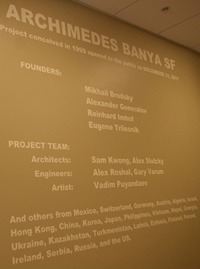
    In a departure from the command-and-control approach to business in which “stars” grab the credit, Archimedes Banya recognizes multiple contributions in much the same way Adobe Systems includes a Banya Wallcredit role in its software products. When I visited Archimedes Banya recently, the first thing I noticed was a wall near the entrance listing the names of the multicultural collaborators who turned the concept into reality. Also apparent was the amazing art ranging from mosaics depicting bathing traditions to murals and inlaid ceiling tiles. Including art in public bathing facilities is a tradition dating back to the Roman Empire.

    Artist Vadim Puyandaev of Kazakhstan collaborated with Brodsky to evoke the right atmosphere. “I
    wanted very simple, clear images of emotion,” says Brodsky. And the images also reflect action. “In a Russian banya, people move. It’s an active place. It’s not just sitting and sweating.” The complex is geared to socializing and offers facilities ranging from a rooftop sun deck with a San Francisco Bay view to private reception rooms replete with bars and kitchens.

    The Banya offers a spa experience reflecting the cultural melting pot. I checked out two Russian saunas, the Finish dry sauna, the steam room, warm soaking pools, cold plunge and relaxation room. After loosening up in the various saunas, I experienced a Russian venika platza treatment that involved a tall Moldovan fellow clad in a towel and sweat-soaked Banya hat brushing and lashing bunches of Latvian birch leaves on me to increase circulation.

    Following this, I laid on a table as an attendant scrubbed me with an exfoliating soap and then rinsed me with buckets of warm water. Then my muscles were relaxed enough for a massage from a masseuse from the United States. Afterwards, I headed to the café upstairs for pelmini or Russian dumplings, stuffed cabbage, hearty Russian beef soup, fresh-sqeezed juices spiked with kombucha, which is fermented tea and housemade kvass, a non-alcoholic beer made from fermented rye bread.

    An ambitious spa project that began as one person’s vision ultimately reflects the combined vision and execution of multiple people from many cultures. Collaboration involves marrying talents that are worth far more collectively than individually. Brodsky describes himself as a “starter.” But to make the project a reality, he collaborated with Imhof, a “finisher.” Because of the Swiss tradition of quality workmanship, Imhof shared Brodsky’s values of using the best materials and constructing a banya for the long term. The concept of “starters” and “finishers” has broad ramifications. A starter may have an incredible idea, but creating a company that produces substantial value may require collaborating with a finisher.

    As we collaborate, we can create awesome value by engaging and involving people with multiple talents and backrounds and, yes, from multiple cultures. The Dynamic Dimension of Cross-Cultural Collaboration delivers results otherwise unattainable.