
Budding musicians, filmmakers and other artists are creating value through collaborative production. Online creative collaboration now goes well beyond finding and meeting like-minded artists. Now people are producing artistic works collaboratively without sharing physical space. This is having an increasing impact on creativity, the product and the business of art.
Not long ago, gatekeepers controlled the relationship between artists and audiences. NPR’s “All Things Considered” broadcast a compelling story last Saturday about Robert Goldstein, an NPR staff librarian. You can listen to the story here. In the late 1970’s, Goldstein was a guitarist for the Urban Verbs, a Washington, D.C. band. The Urban Verbs almost made it…
Band members had a connection with the Talking Heads and producer, Brian Eno. Eno was reportedly “blown away” by the Urban Verbs and offered to produce some tracks. Record labels were initially enthusiastic, and Warner Brothers signed the band. However, Warner Brothers reportedly dumped the Urban Verbs after Rolling Stone “slaughtered” the band with a bad review.
While gatekeepers including big media, distributors, producers and others still have an impact, the balance is clearly shifting in favor of unknown artists. Aside from social media sites like Facebook and MySpace, which connect artists with fans and other artists, collaborative production sites take creative collaboration to the next level. These include TheNetStudio for music and Rootclip for film and video. The difference between these and social networking sites is analogous to the difference between using enterprise collaboration tools to design and produce products and services and using such tools for meetings. Collaborative production clearly creates greater value than just connecting.
TheNetStudio is a virtual recording studio through which artists can submit songs for collaboration. Somebody on an island in the South Pacific who has composed a great song can collaboratively create a finished product with musicians in Paris, New York or Los Angeles without ever sharing the same physical space. TheNetStudio, which uses a subscription model, currently enables asynchronous collaboration but will ultimately provide real-time music production as technology evolves to support ultra high quality 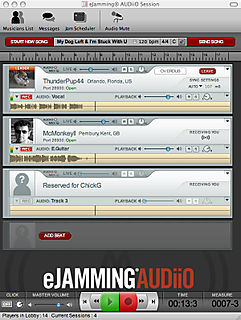 synchronous sound over the Internet. Currently, sites including Ninjam, eJamming and Musigy offer real-time, online musical collaboration.
In the film and video realm, Rootclip provides an initial “root” clip, one-to-two minutes of video that begins a story. Collaborators determine the path the visual story takes by submitting one-minute videos to move the story from one chapter to the next. The Rootclip community votes on which videos should be used for the next chapter. The creator of each winning video chapter receives $500 and acknowledgment in the credits. The winner of the final chapter round gets a trip to the Traverse City Film Festival in Michigan and a meeting with filmmaker, Michael Moore. Rootclip’s business model is advertising, and ironically big media (the E.W. Scripps Company) is supporting the startup through its venture capital arm.
The big-picture impact of collaborative production is how the medium is changing the product. This phenomenon goes well beyond reproducing or approximating musical or video collaboration in which collaborators share the same physical space. As efforts like TheNetStudio and Rootclip proliferate, artistic endeavors will reflect the input of people from multiple cultures and regions. Finished works will increasingly reflect a broader and perhaps different perspective.
Oh…as for the Urban Verbs, the band recently reunited for a show at the 9:30 Club in D.C.


 The Culture of Collaboration Blog