Travel


  • Star Culture Trips Up Venice

    It’s called Ponte della Costituzione, the fourth footbridge over Venice’s Grand Canal. The glass and steel structure has caused nothing but headaches—and some muscle aches—for  tourists, Venetians and the officials who run their city.

    When Venice commissioned an architect to build the new bridge in the late 1990s, the job went to Santiago Calatrava. Named by Time magazine to the Time 100, one of the hundred most influential people in 2005, Calatrava has chalked up dozens of awards and honorary doctorates. His celebrated projects range from the World Trade Center Transportation Hub in New York City to the Museum of Tomorrow in Rio de Janeiro, Brazil. And the New York Times calls Calatrava a “star architect.”
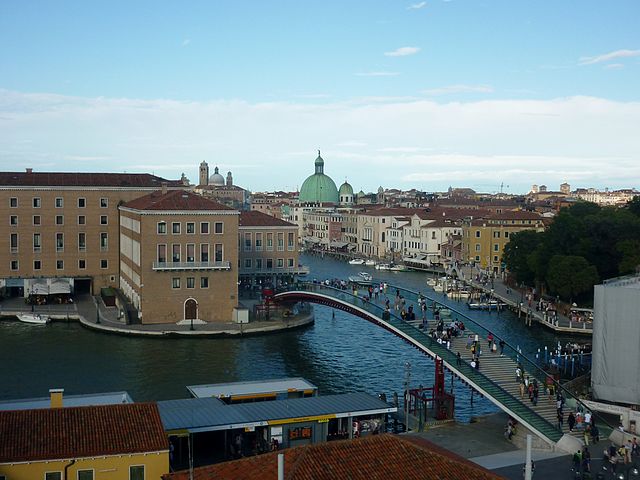
    Ponte della Costituzione
    Venice’s Ponte della Constituzione. Photo by Christoph Radtke. Licensed under CC BY 3.0. No changes made.

    The problem is that the Zurich, Switzerland based architect apparently failed to adequately consider practicalities impacting Venetians who cross the bridge regularly and tourists who cross when visiting one of Italy’s most visited cities. For starters, the bridge lacks disabled access. Also, the glass floor has caused many people to slip and fall. According to a story in Architectural Digest, some Venetians have cracked their chins and foreheads and others have reportedly broken bones. City officials have told media outlets that injuries occur almost daily.

    Because too many injured pedestrians have sued the City of Venice over the multimillion dollar bridge, the city has decided to allocate more than half a million dollars to replace the glass with trachyte stone. This expense comes after a failed 1.5 million Euro modification to install a cable car so that people could cross the bridge without injury.

    What has caused heartache, bone ache, lawsuits and wasted taxpayer dollars is star culture. Rather than designing a bridge for the practical needs of tourists and others who regularly cross the canal, Calatrava was apparently too focused on capturing and representing Venice’s “embrace of modernity” as the New York Times puts it. Rome’s Court of Auditors found that Calatrava was negligent in failing to account for the number of tourists dragging their bags across the bridge. Calatrava argued that bag dragging constitutes “incorrect use.”

    Stars tend to get swept up by things like symbolism, messaging and virtue signaling. Collaborative architects seek input from people who will use the structure they’re designing. In The Bounty Effect: 7 Steps to The Culture of Collaboration®, I describe how architect Renzo Piano made no sales presentation but rather pulled ideas from his clients in collaboratively conceptualizing and designing the California Academy of Sciences in San Francisco.

    Undoubtedly, Calatrava has chalked up major accomplishments, but accomplished professionals run the risk of buying their own hype. When people are made to believe they can do no wrong, they often make decisions in a vacuum and may work without adequate input from others. This feeds star culture for which the media has an insatiable appetite. Yet we must resist the temptation, because star culture sucks value out of companies, governments and communities.

  • Multicultural Collaboration Produces Unique Spa

    Bridging cultures, particularly regional cultures, produces a broader perspective that gives collaborators an edge. In disciplines like aerospace engineering, team members trained in one country’s engineering tradition may view a creative challenge differently than their colleagues who were trained in a different country’s system. Drawing from their collective global knowledge, cross-cultural collaborators can spark synergies and create greater value. In The Culture of Collaboration book, I call this the Dynamic Dimension of Cross-Cultural Collaboration.

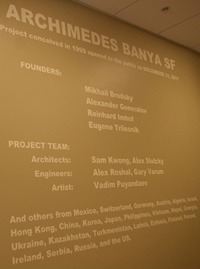
    This dimension is alive and well at Archimedes Banya, a spa complex that opened in San Francisco last New Year’s Eve after twelve years of development and construction. People from twenty different countries collaborated on the project. Managing partner Mikhail Brodsky of Russia had the original idea. Reinhard Imhof of Switzerland led the indoor construction. Architect Sam Kwong of China developed the plans. Other partners are from countries including Korea, Israel, Germany, Japan, and Mexico.

    The concept began when Brodsky, a mathematician, arrived in San Francisco from Moscow in 1989. A lBanya2over of Russian bath complexes or banyas, Brodsky was disappointed to find no such facilities in his adopted city. He longed to start a banya. In the summer of 1998, Brodsky, then a professor at the University of California at Berkeley, applied for a job as chair of the mathematics department at San Francisco State University. SFSU’s rejection sparked Brodsky’s interest in doing something significant in San Francisco while delivering on his banya dream.

    Brodsky, Imhof and two other partners formed a company, and in 1999 bought a lot in India Basin near San Francisco’s former Hunters Point Shipyard. Though in an obscure neighborhood, the lot provided sweeping views of San Francisco Bay. To construct the building, Brodsky and his partners would need to recruit more partners. Like many ethnic groups living in the United States, many Russians do business only within their community. Therefore, logic would dictate engaging Russians to finance, design and build the project. But some Russians who Brodsky approached had difficulty seeing past the many roadblocks to the project ranging from building permits and location to construction costs and customer base. So, Brodsky decided to broaden his reach, involving people from as many countries as possible. The common thread was a passion for the Banya project plus mutual trust and common goals, two of the Ten Cultural Elements of Collaboration I identify in The Culture of Collaboration book.

    In a departure from the command-and-control approach to business in which “stars” grab the credit, Archimedes Banya recognizes multiple contributions in much the same way Adobe Systems includes a Banya Wallcredit role in its software products. When I visited Archimedes Banya recently, the first thing I noticed was a wall near the entrance listing the names of the multicultural collaborators who turned the concept into reality. Also apparent was the amazing art ranging from mosaics depicting bathing traditions to murals and inlaid ceiling tiles. Including art in public bathing facilities is a tradition dating back to the Roman Empire.

    Artist Vadim Puyandaev of Kazakhstan collaborated with Brodsky to evoke the right atmosphere. “I
    wanted very simple, clear images of emotion,” says Brodsky. And the images also reflect action. “In a Russian banya, people move. It’s an active place. It’s not just sitting and sweating.” The complex is geared to socializing and offers facilities ranging from a rooftop sun deck with a San Francisco Bay view to private reception rooms replete with bars and kitchens.

    The Banya offers a spa experience reflecting the cultural melting pot. I checked out two Russian saunas, the Finish dry sauna, the steam room, warm soaking pools, cold plunge and relaxation room. After loosening up in the various saunas, I experienced a Russian venika platza treatment that involved a tall Moldovan fellow clad in a towel and sweat-soaked Banya hat brushing and lashing bunches of Latvian birch leaves on me to increase circulation.

    Following this, I laid on a table as an attendant scrubbed me with an exfoliating soap and then rinsed me with buckets of warm water. Then my muscles were relaxed enough for a massage from a masseuse from the United States. Afterwards, I headed to the café upstairs for pelmini or Russian dumplings, stuffed cabbage, hearty Russian beef soup, fresh-sqeezed juices spiked with kombucha, which is fermented tea and housemade kvass, a non-alcoholic beer made from fermented rye bread.

    An ambitious spa project that began as one person’s vision ultimately reflects the combined vision and execution of multiple people from many cultures. Collaboration involves marrying talents that are worth far more collectively than individually. Brodsky describes himself as a “starter.” But to make the project a reality, he collaborated with Imhof, a “finisher.” Because of the Swiss tradition of quality workmanship, Imhof shared Brodsky’s values of using the best materials and constructing a banya for the long term. The concept of “starters” and “finishers” has broad ramifications. A starter may have an incredible idea, but creating a company that produces substantial value may require collaborating with a finisher.

    As we collaborate, we can create awesome value by engaging and involving people with multiple talents and backrounds and, yes, from multiple cultures. The Dynamic Dimension of Cross-Cultural Collaboration delivers results otherwise unattainable.


  • Telepresence Enhancing Travel?

    Videoconferencing and telepresence vendors have traditionally marketed their products as a replacement for travel. This is shortsighted in that real value creation comes from integrating real-time video into business processes. Using telepresence so that people can come together spontaneously and design an airplane or develop animation or create a 24-hour healthcare delivery service produces far greater value than travel savings.


    Considering the obsession with marketing real-time video as a travel replacement, you might think hotels would be lukewarm about videoconferencing and telepresence. But there was nothing tepid about Mary Casey and Bob Hermany’s view of Cisco TelePresence as they announced on Tuesday Starwood’s roll out of public TelePresence rooms. The first two Starwood properties to offer TelePresence are the Sheraton on the Park in Sydney, Australia and the W Chicago. You can view the announcement video here. Incidentally, Mary is Starwood’s vice president of global corporate sales and Bob is Starwood’s senior vice president of operations.


    Starwood will also install Cisco TelePresence at the Sheraton New York Hotel & Towers, the Westin Los Angeles Airport and the Sheraton Centre Toronto during 2010. Later, the hotel chain will adopt TelePresence at properties in San Francisco, Dallas, Brussels and Frankfurt, among others. In my October 15, 2008 post, I wrote that Cisco and its partner, Tata Communications, were introducing public TelePresence rooms and that the first hotel chain to participate was the Taj Hotels.


    During a TelePresence call linking several global locations, Sean Hunt, a Starwood executive who manages the Sheraton on the Park in Sydney positioned Australia’s first public TelePresence room as both a travel benefit and alternative. “The problem is we’re isolated from the rest of the world, so this is a great alternative to long-haul travel.” The point is that rather than replace travel, TelePresence lets somebody outside Australia who may never have taken the flight get face-to-face with colleagues and partners.

    Aside from marketing and public relations advantages, there are potentially tangible benefits for hotels that adopt TelePresence. Besides renting rooms at rates that can approach $500 a day, hotels can charge $500 an hour for TelePresence. That’s the rate at the Sheraton on the Park in Sydney. Australian dollars, of course.


  • Constructive Confrontation at the Clinton Library and Museum

    When I’m on the road, I keep my eyes open for collaboration insights.


    This week I was in Memphis and made a detour to Little Rock. In Memphis, I stayed at the Peabody Hotel, the grand old hotel of the south famous for the daily parade of ducks from the hotel roof to the fountain.  The site of several ducks marching in formation through the hotel lobby certainly requires coordination and arguably collaboration.


    Here in Little Rock…I’m staying at the Capital Hotel, which has an elevator big enough to supposedly have accommodated Ulysses Grant and his horse. Also, the Capital serves one of the best hotel breakfasts I’ve ever eaten. Everything is made from scratch! All of this in a gorgeous, old-world dining room.


    Back to collaboration. Regardless of politics and how you may feel about Bill Clinton, any leader would do well to take note of Little Rock’s favorite son and his thoughts about hiring, culture, and decision-making:


    “I don’t care how smart you are…” Bill Clinton’s voice boomed into my audio tour headset at the William J. Clinton Presidential Library and Museum. “Success and failure depends on how well the staff and cabinet debate honestly and openly and then unite once you’ve made a decision. “


    I was standing in the replica of the White House cabinet room, and President Clinton was setting the scene for the debates that occurred in that room on his watch as the 42nd President of the United States. “You never can tell when somebody who’s in an unrelated agency will have a really keen insight…thinking people, caring people who came from all different backgrounds from all over America.” Amen! Cross-functional collaboration!


    President Clinton was essentially talking about constructive confrontation, one of the Ten Cultural Elements of Collaboration that I identify in my book, The Culture of Collaboration. To effectively collaborate, the culture of any organization—whether it’s the federal government, a large enterprise, a non-profit, or a small business—must encourage debate and constructive confrontation regardless of level, role or region. 


    Constructive means that the confrontation is about making a better decision rather than personality conflicts or posturing. At some point, debate ends and an organization coalesces behind a united position.  Smart organizations encourage debate as President Clinton did among his staff and cabinet rather than blind agreement with the boss.

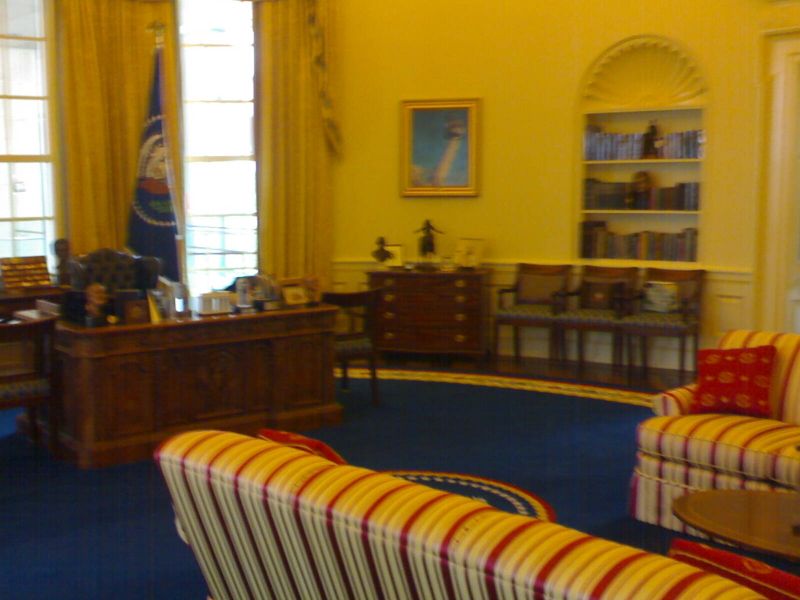
    Oval Office Replica

    The Clinton Library and Museum includes a replica of the Oval Office as it was when President Clinton occupied it. According to the staff, the former President often moves objects around or borrows them during his monthly or bi-monthly visits to the Library (he has an apartment upstairs with room for his secret service agents). 


    The docents tell me that President Clinton knows them all by name and is closely involved in almost everything that happens at the Library. I spoke at length with one docent, Jane Cazort, whose father-in-law was lieutenant governor of Arkansas and whose granddaughter went to school with Chelsea Clinton.


    Coincidentally, next week I’ll be attending the Fortune Brainstorm: Green 2009 conference in Laguna Niguel, California at which President Clinton is speaking.  More on that later.


  • Collaborating with Cuba

    On a flight from Montego Bay, Jamaica a couple of weeks ago, I was passing the time by monitoring pilot/control tower communications. United Airlines lets passengers eavesdrop on Channel 9 of the airline’s audio system. As the plane left Jamaican air space, the controller signed off with a customary “Good day.” Shortly thereafter, I heard a female Spanish accent. The plane was entering Cuban air space, and the pilot had established a link with Havana air traffic control. There was constant conversation as the Cuban controller guided the pilot in his ascent. This collaboration continued until the Cuban controller handed off the pilot to controllers in Miami but not before signing off with a friendly “Buenas tardes.”

    It makes absolute sense, of course, that U.S. commercial airline pilots collaborate with Cuban air traffic controllers as planes enter and leave Cuban air space. Nevertheless, the U.S. embargo suggests that Cuba is an enemy of the state. So, in effect, the United pilot was collaborating with the “enemy.”

    In the business realm, competitors are often considered enemies. Does it make sense to collaborate with competitors? Sometimes. Consider the many joint ventures among competitors and such consortiums as Exostar in the aerospace industry. Exostar lets competitor/partners and suppliers collaborate asynchronously through team rooms and synchronously through web conferencing. It’s a situation in which people may be collaborators in the morning and competitors in the afternoon. The acid test of whether collaborating with competitors makes sense is whether the collaboration creates value for all of the collaborators.