Work Styles


  • Mayo Clinic Enhancing Collaboration

    The Mayo Clinic, founded on the principle of collaboration, is taking collaboration and innovation to the next level. With a mission nothing short of transforming how healthcare is experienced and delivered, Mayo’s Center for Innovation integrates emerging collaborative tools into processes and culture. The Center for Innovation includes Mayo’s innovative S.P.A.R.C. design lab.


    While writing The Culture of Collaboration book, I conducted on-site research at S.P.A.R.C. and throughout Mayo. Now it’s time for an update. The catalyst was a recent conversation with Chris Yeh of PBworks, which offers a hosted wiki-oriented business collaboration platform with newly-added integrated voice conferencing. Mayo is piloting PBworks along with other online collaborative spaces. “We call it a sandbox where people can figure things out,” Francesca Dickson of Mayo’s Center for Innovation told me yesterday during a Skype video call.


    Francesca and Beth Kreofsky of Mayo’s Center for Innovation provided an inside view of how Mayo is evolving, and we talked about the role of tools. Aside from PBworks, Mayo is also piloting “ideation” tools that let team members share ideas and build on them based on “focused questions.” One such tool is Jive.


    Besides asynchronous social tools, Mayo is now piloting instant messaging in several departments including nursing and radiology. Paging, a precursor to instant messaging, is deeply engrained in Mayo’s culture. Anybody can page the CEO and expect a prompt call back. Hierarchy is muted at Mayo, and the CEO is always a practicing physician. Mayo’s culture is ripe for IM and unified communications through which people can connect spontaneously through IM, voice or video regardless of level, role or region.


    Meantime, paging persists at Mayo. The Center for Innovation’s mission is to keep Mayo, well, innovating. So the Center is demonstrating to the organization that IM offers a clear advantage over paging.


    Video is another tool that’s part-and-parcel of Mayo’s culture. Mayo was an early user of videoconferencing to encourage collaboration among its three campuses. Mayo has already piloted Cisco TelePresence with a hospital in Duluth, Minnesota. And beginning in April, patients in Canon Falls, Minnesota will receive consultations from Mayo specialists via TelePresence.


    By integrating new collaborative tools into its already collaborative culture, Mayo will likely enhance healthcare delivery and create greater value.


  • Telepresence Enhancing Travel?

    Videoconferencing and telepresence vendors have traditionally marketed their products as a replacement for travel. This is shortsighted in that real value creation comes from integrating real-time video into business processes. Using telepresence so that people can come together spontaneously and design an airplane or develop animation or create a 24-hour healthcare delivery service produces far greater value than travel savings.


    Considering the obsession with marketing real-time video as a travel replacement, you might think hotels would be lukewarm about videoconferencing and telepresence. But there was nothing tepid about Mary Casey and Bob Hermany’s view of Cisco TelePresence as they announced on Tuesday Starwood’s roll out of public TelePresence rooms. The first two Starwood properties to offer TelePresence are the Sheraton on the Park in Sydney, Australia and the W Chicago. You can view the announcement video here. Incidentally, Mary is Starwood’s vice president of global corporate sales and Bob is Starwood’s senior vice president of operations.


    Starwood will also install Cisco TelePresence at the Sheraton New York Hotel & Towers, the Westin Los Angeles Airport and the Sheraton Centre Toronto during 2010. Later, the hotel chain will adopt TelePresence at properties in San Francisco, Dallas, Brussels and Frankfurt, among others. In my October 15, 2008 post, I wrote that Cisco and its partner, Tata Communications, were introducing public TelePresence rooms and that the first hotel chain to participate was the Taj Hotels.


    During a TelePresence call linking several global locations, Sean Hunt, a Starwood executive who manages the Sheraton on the Park in Sydney positioned Australia’s first public TelePresence room as both a travel benefit and alternative. “The problem is we’re isolated from the rest of the world, so this is a great alternative to long-haul travel.” The point is that rather than replace travel, TelePresence lets somebody outside Australia who may never have taken the flight get face-to-face with colleagues and partners.

    Aside from marketing and public relations advantages, there are potentially tangible benefits for hotels that adopt TelePresence. Besides renting rooms at rates that can approach $500 a day, hotels can charge $500 an hour for TelePresence. That’s the rate at the Sheraton on the Park in Sydney. Australian dollars, of course.


  • Reflection Enhances Collaboration

    Recently, I’ve grown concerned about the lack of reflection that can compromise collaboration. I define reflection as “pausing to think.” Reflection is increasingly lost in our interrupt and interact-driven culture. It may seem counter-intuitive in that reflection suggests working alone or in a vacuum. But there’s a difference.


    Some people think they do their best work by going off in a corner and making their mistakes in private. They prefer to interact with others only after they feel they got their part right on their own. Once their part is complete, they prefer to toss their work over the fence to the next person to do their part. This assembly-line approach to decision making, problem solving and product and service development compromises value.  This behavior clearly undermines collaboration.


    The other extreme is that in this Twitter-twitching, Facebook feeding, blog-obsessed culture, we feel compelled to constantly interact. Some health experts insist the fallout from these potentially obsessive behaviors includes everything from repetitive strain injuries to heart attacks, not to mention neglect of loved ones or divorce. Like endless face-to-face meetings, much of this online interaction is falsely labeled collaboration.


    In The Culture of Collaboration book, I define collaboration as “working together to create value while sharing virtual or physical space.” Also, value is one of the Ten Cultural Elements of Collaboration that I identify in the book. Creating value is critical to collaboration. In fact, it’s a useful acid test.


    Social networking includes a portfolio of tools and behaviors that can lead to collaboration, but it takes  more than a tweet, post, text or instant message to collaborate. Social networking and social media output can be much like cable television chatter. The difference is that social networking lets us participate, and we tend to dip in and out all day long. It’s easy to devote big chunks of time to chatter. And there’s nothing wrong with chatter, but it’s not necessarily collaboration.


    Constant interaction without reflection can compromise collaboration and value creation. Brainstorming, sharing ideas, and co-creation produces incredible value. When we pause to think, however, we can contribute more effectively when we’re collaborating. Reflection enhances value creation for collaborators.


    Using collaborative tools for chatter and fun helps instill behavior that sparks collaboration, but it’s easy to just keep chattering and never get around to creating value. Use value creation as an acid test for collaboration, and we derive greater satisfaction and real results from social networking and other collaborative tools. And reflection is part of that equation.


  • Managing Workflow through the Virtual Worlds of Qwaq Forums

    Some businesspeople are spending most of their day in 3D, immersive environments known as virtual worlds. This development emerged during a wide-ranging discussion last week with Greg Nuyens, CEO of Qwaq, which provides tools to create virtual worlds or “forums” optimized for business users.


    Greg, whose company is today releasing version 2.0 of Qwaq Forums at the 3D Learning, Training and Collaboration conference (3D TLC)  in Washington, D.C., observed that there are three types of Qwaq users. The first group spends about two thirds of the day in Qwaq and likely uses the software’s IP audio capability for most voice calls. The second group jumps in and out of the forums throughout the day, leaving the virtual “lobby” up all day long.  The third group uses Qwaq periodically through a browser, which is a new capability included in version 2.0.


    Qwaq combines the real-time collaboration functionality of web conferencing with the 3D immersive experience of virtual worlds. For background on Qwaq, see my March 13, 2007 post and my September 21, 2007 post.  Clearly, the Qwaq development team has invested significant time and thought into integrating the tool into enterprise workflow.  The version 2.0 interface is more geared to workplace collaboration with greater ability to move easily and gracefully around the virtual workplace– from the lobby to meeting rooms to cubicles to offices to auditoriums to command centers and around campuses. Meantime, users can share documents, slides, MPEG4 video, browsers, whiteboards, and other applications. Also, Qwaq supports real-time, interactive Webcam video and recording/capture of virtual meetings.


    Qwaq customers announced today include Chevron and the U.S. Naval Undersea Warfare Center, two of the roughly one hundred enterprise customers that Qwaq has reportedly garnered.  The Navy is using Qwaq as part of its virtual Combat Systems Center to remotely train submarine operators. The software running in the Center’s Qwaq Forum is the same software running on the weapons console. So the boundaries between real and virtual are clearly fading.


    According to Greg, Qwaq’s goals include “bridging distance to make meetings in forums more efficient than in the same room.” As I noted in my book, The Culture of Collaboration, as collaborative tools get more advanced, the next frontier is making same-room collaboration as effective as collaborating at a distance.


  • Virtual Events Becoming Economic Necessity

    Companies in many industries are slashing conference, trade show and sales meeting budgets and replacing traditional events with virtual ones. Publishing is one such industry. According to a story in last Monday’s New York Times, Macmillan will hold two out of three of its 2009 sales conferences virtually via web conferencing. This contrasts sharply with the sales and marketing meeting Macmillan held at the Hotel del Coronado in San Diego last month during which participants participated in wine tastings and got massages. 


    However, it takes more than adopting tools for virtual events to become a collaborative organization. For many companies, true collaboration requires a wholesale shift. Exigent circumstances can raise consciousness for the shift even in otherwise intransigent cultures. Exigent circumstances include industry realignments, disruptive technology, new competition, and economic downturns.

    Facing market challenges in the current recession, many companies are getting a wake up call. 


    Sparked by reduced budgets, many companies are accelerating their adoption or use of real-time collaborative tools to transform their events and meetings into virtual encounters. These tools include virtual worlds, telepresence, web conferencing and videoconferencing.


    The right tool choice depends on situations and cultures. For external events such as trade shows and job fairs, it’s necessary to create an experience that will draw people to a brand. To recreate that experience virtually, the 3D immersive quality of virtual worlds like Second Life or Qwaq makes sense. Qwaq is geared to business users and combines an immersive experience with web conferencing functionality. So users can work together while sharing applications in a virtual auditorium or conference room. CNN recently ran an interesting story on virtual trade shows. You can view the story here.


    For leadership retreats, strategy sessions and board meetings, detecting subtleties such as eye movement is critical. Therefore, telepresence fits the bill, because of its quality visual experience and the feeling that participants are sharing the same space.  To replace a data-driven sales meeting, web conferencing makes sense because the focus is on the slides or spreadsheet more than people. For a cross-functional meeting that includes, say, sales and marketing people, relationship time is necessary before plunging into data. In that case, telepresence or videoconferencing is appropriate.


    For Macmillan and other organizations, creating value through collaboration requires more than holding two out of three sales conferences virtually. So, perhaps Macmillan is considering adopting collaboration more broadly. It’s time to move beyond sporadic, scheduled use of collaborative tools. Value-driven organizations are integrating collaborative practices and tools into work styles and collaborative culture into organizational DNA.


    In this downturn, the smart money is rethinking how we do business, reconsidering command-and-control approaches, and moving collaboration to the front burner. This will help organizations survive short term and thrive long term.


  • Cisco, Tata and Taj Hotels Bringing Telepresence to Smaller Companies and the Public

    As I walked into Cisco’s new public telepresence suites yesterday at the WebEx tower in Santa Clara, Cisco Video Receptionist California, I was greeted by a video receptionist. “Hi, may I help you?,” the receptionist said. I immediately sensed professional intimacy, because of the quality of the visual experience. “I’m here for a Cisco telepresence session,” I explained. The receptionist then invited me to help myself to the catered breakfast in the outer lobby. I then grabbed a cup of milky, cardamom-spiced Indian coffee, which hinted at the global nature of what was about to happen.
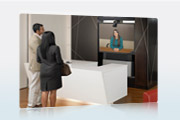
     

    Down the corridor were several public telepresence rooms of different sizes. Cisco people including Marthin De Beer, senior vice president of the emerging technology group, were in one room with Peter Quinlan, director of telepresence managed services for Tata Communications. I was in another room with the research director of The Culture of CollaborationÒ Institute plus a few journalists and analysts.


    Joining from his home in Bangalore, India was Wim Elfrink, Cisco’s chief globalization officer, presumably conducting his last meeting of the day at 11:00 p.m. Bangalore time. In London, Vinod Kumar, chief operating officer of Tata Communications, and his colleagues participated. From Boston, Taj Boston Hotel General Manager David Gibbons joined us from the Taj’s new telepresence public room. From New York, an industry analyst was also connected.  So, our group spanned the globe—six connections in four time zones. However, we felt almost as if we were sitting across the table from each other.


    Cisco and its partners are challenging the notion that telepresence is an exclusive tool for Fortune 500 executives. “We have found that the largest users of telepresence are the mid-management level in our organization,” says Kumar of Tata Communications, a subsidiary of the $62.5 billion Tata Group. If you’ve been to India, you know that the Tata name is everywhere—on motor vehicles, industrial equipment, and even tea. In recent years,Tata has become a global company.


    Tata is a highly-strategic relationship for Cisco in that besides its communications business, the Mumbai, India-based conglomerate has holdings in engineering and building, services, chemicals and consumer products. Taj Hotels, a Tata company, is providing public telepresence rooms in Boston, London, Bangalore, Mumbai and other cities throughout India. “Small and medium-sized businesses will be the greatest users,” predicted Gibbons of the Taj Boston Hotel. There will be a hundred public TelePresence (note that Cisco capitalizes the “P” in its trademarked product name) suites globally by late 2009, according to Cisco. Hourly fees currently range from $299 for a 1-2 participant room to $899 for an 18-participant room.


    Unlike office buildings that typically close nights, weekends and holidays, hotels are open 24/7 every day of the year and provide perhaps the best opportunity to maximize a global business environment through pay-per-use telepresence. It’s a holiday in your city, but you need to connect intimately with colleagues in another region where it’s a regular work day? Hotel-based telepresence addresses that issue.


    Significant from a technical perspective, Cisco and Tata are providing secure, encrypted conversation through any company’s firewall. “This has not been possible before with any technology,” noted Marthin De Beer of Cisco. Tata Communications delivers converged voice, video and data over Internet protocol (IP). Tata’s strategy is to get companies used to telepresence through public rooms and work on migrating some companies to invest in their own telepresence rooms.

    Cisco says it has integrated 300 telepresence systems into its own operations globally. Some senior leaders including De Beer have their own systems, and Wim Elfrink, Cisco’s chief globalization officer, joined yesterday’s telepresence session from his home office in Bangalore, India.


    While much has been made about videoconferencing and telepresence reducing long-distance travel, these tools can also reduce local travel and commuting. De Beer noted that he saves an hour per day by using telepresence instead of driving to meetings on and around Cisco’s campus. As telepresence becomes more widespread, people will gain the opportunity to work globally while reconnecting with their physical—as opposed to virtual—communities. Telepresence will also allow for better work/life balance and potentially take social responsibility to the next level.


    After the session, as I said goodbye to the video receptionist, I wondered whether receptionists in Mumbai, Manila and Montego Bay will soon be greeting visitors in corporate lobbies in Memphis, Modesto and Milwaukee. Well, Cisco’s Marthin De Beer, who is based at the company’s headquarters in California, has a video assistant who works from Texas and virtually greets visitors to his office. So, Cisco is clearly practicing what it’s preaching.


  • Collaborating in the Same Room—What a Concept!

    Collaboration happens because of the interplay of culture, environment and tools with an emphasis on culture. While tools are key enablers, collaboration never happens solely because of tools. That said, real-time tools including instant messaging, web conferencing, videoconferencing, telepresence and virtual worlds plus asynchronous tools including wikis, team sites and social networking are extending and enhancing collaborative culture and eliminating distance as a barrier to business and relationships.


    Ironically, we’re getting better at collaborating at a distance than when we’re face to face. Assuming we work in a collaborative culture and effectively use tools, we are more likely to share applications and collaboratively produce products and services when distance is an issue. In contrast, when we’re all in the same room, too often we meet rather than collaborate. Some highly-collaborative organizations are designing their workplace environments to enhance brainstorming and collaboration.


    Microsoft has created a new research entity in its business division called Office Labs, which is focusing on the future of how we work. One effort involves exploring how to more naturally interact with information.  At the Microsoft CEO Summit in May, Bill Gates demonstrated an “intelligent white board” or touch wall called Plex. Plex has scanning cameras at its base, so that it can detect when users touch its surface. Using our hands, we can zoom out to reveal documents, images, spreadsheets, presentations, browsers and other applications. We can touch a document, flip through its pages, and zoom in to examine flow charts and other embedded elements. We can also use our fingers to draw on Plex.


    Intelligent white boards are one tool that may enhance collaboration when we’re sharing the same physical space. Ultimately, every horizontal and vertical surface in collaborative rooms could be an inexpensive intelligent display. Like collaboration at a distance, same-room collaboration requires the right culture, environment and tools.


  • Is Coworking Collaborative?

    Researchers are studying it. The traditional media is reporting it. And bloggers, obviously, are writing about coworking. It’s the latest work style trend to emerge. Coworking typically involves renting a desk or paying for the right to plop down at a shared table in a communal workspace. It’s a growing option for home-based or freelance professionals seeking to curb isolation and build camaraderie.

    In a story in yesterday’s New York Times, Dan Fost describes the coworking movement. In Tuesday’s San Francisco Chronicle, Ilana DeBare reported on “Shared Work Spaces a Wave of the Future.” Clearly, there’s something happening here.

    Coworking Most coworking facilities look and feel much different from temporary or drop-in corporate office space (the image on the left is a coworking space called the Hat Factory in San Francisco). In fact, some coworking facilities remind me of my college radio station. The studios and communal areas of WCBN-FM in Ann Arbor, Michigan were usually messy, often chaotic, and almost always a creative outlet.

    Coworking is most effective for professionals who talk sparingly on phones, since people are expected to step outside the coworking space for phone calls. Imagine five people around a table on their phones simultaneously!

    So, is coworking collaborative? That depends. Undoubtedly, including people engaged in different enterprises under the same roof sparks synergies. And without offices or cubicles, interaction can happen on the fly. An entrepreneur working across from a web designer need only call across the table to get design input. A technical writer can engage a software developer with a tap on the shoulder. Relationships form, and trust may develop.

    Collaboration, however, requires many cultural elements including shared goals. In collaborative organizations, people come together across disciplines, departments, roles and regions to create value. The shared goal may involve slashing product development time or closing sales more effectively or curing a disease. Coworking invites input from others, but usually without shared goals. One person has a stake in the input, while the other provides advice as a friendly gesture or deposit in the favor bank. Coworking may lead to collaboration, but collaboration is by no means automatic. Of course, coworkers may discover they share some goals and then join forces to start a business or curb climate change or elect a candidate.

    The main connection between coworking and collaboration involves people from different disciplines interacting in an informal physical environment. This, in turn, encourages informal interaction which reinforces, but does not create, The Culture of Collaboration.