Star Culture


  • Star Culture Trips Up Venice

    It’s called Ponte della Costituzione, the fourth footbridge over Venice’s Grand Canal. The glass and steel structure has caused nothing but headaches—and some muscle aches—for  tourists, Venetians and the officials who run their city.

    When Venice commissioned an architect to build the new bridge in the late 1990s, the job went to Santiago Calatrava. Named by Time magazine to the Time 100, one of the hundred most influential people in 2005, Calatrava has chalked up dozens of awards and honorary doctorates. His celebrated projects range from the World Trade Center Transportation Hub in New York City to the Museum of Tomorrow in Rio de Janeiro, Brazil. And the New York Times calls Calatrava a “star architect.”
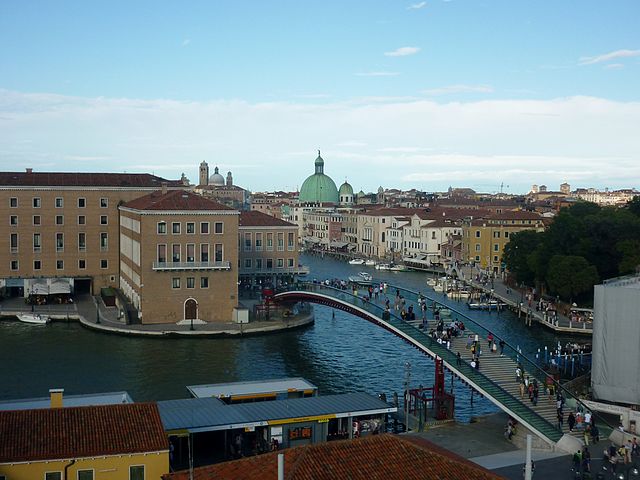
    Ponte della Costituzione
    Venice’s Ponte della Constituzione. Photo by Christoph Radtke. Licensed under CC BY 3.0. No changes made.

    The problem is that the Zurich, Switzerland based architect apparently failed to adequately consider practicalities impacting Venetians who cross the bridge regularly and tourists who cross when visiting one of Italy’s most visited cities. For starters, the bridge lacks disabled access. Also, the glass floor has caused many people to slip and fall. According to a story in Architectural Digest, some Venetians have cracked their chins and foreheads and others have reportedly broken bones. City officials have told media outlets that injuries occur almost daily.

    Because too many injured pedestrians have sued the City of Venice over the multimillion dollar bridge, the city has decided to allocate more than half a million dollars to replace the glass with trachyte stone. This expense comes after a failed 1.5 million Euro modification to install a cable car so that people could cross the bridge without injury.

    What has caused heartache, bone ache, lawsuits and wasted taxpayer dollars is star culture. Rather than designing a bridge for the practical needs of tourists and others who regularly cross the canal, Calatrava was apparently too focused on capturing and representing Venice’s “embrace of modernity” as the New York Times puts it. Rome’s Court of Auditors found that Calatrava was negligent in failing to account for the number of tourists dragging their bags across the bridge. Calatrava argued that bag dragging constitutes “incorrect use.”

    Stars tend to get swept up by things like symbolism, messaging and virtue signaling. Collaborative architects seek input from people who will use the structure they’re designing. In The Bounty Effect: 7 Steps to The Culture of Collaboration®, I describe how architect Renzo Piano made no sales presentation but rather pulled ideas from his clients in collaboratively conceptualizing and designing the California Academy of Sciences in San Francisco.

    Undoubtedly, Calatrava has chalked up major accomplishments, but accomplished professionals run the risk of buying their own hype. When people are made to believe they can do no wrong, they often make decisions in a vacuum and may work without adequate input from others. This feeds star culture for which the media has an insatiable appetite. Yet we must resist the temptation, because star culture sucks value out of companies, governments and communities.


  • Fidelity’s Amazing, Disappearing Star Fund Manager?

    The era of the star fund manager is waning.

    Fidelity Investments may replace a star-oriented fund management system with a collaborative approach after a consultant's report. As is so often the case when organizations suddenly consider—and often embrace— a more collaborative structure and culture, exigent circumstances precipitated the potential move. I call this phenomenon The Bounty Effect, and I’ve written extensively about it in the book by the same name. The Bounty Effect occurs when an event or circumstance creates a fundamental shift, changes the game and accelerates collaboration.

    The Bounty Effect for Fidelity occurred because of two exigent circumstances:

    Last year Fidelity reportedly fired Gavin Baker, manager of Fidelity OTC Portfolio, for allegedly sexually harassing a junior female staff member though Baker denies the allegations. This happened against the backdrop of the #MeToo movement. The apparent firing prompted Fidelity to conduct a “cultural review” of its stock picking unit.

    The other exigent circumstance is the reported outflow of $40 billion from Fidelity’s actively-managed funds in 2017, according to Morningstar, as investors have increasingly embraced exchange-traded funds (ETFs) and passively managed index mutual funds meaning those linked to the performance of a particular index such as the S&P 500. Active fund management essentially means one star manager with a supporting cast of analysts attempts to beat a particular index. Fidelity built its reputation in the 1980s around successful active managers including Peter Lynch who managed the Fidelity Magellan Fund.

    The decline of the “star” fund manager mirrors trends in other industries and throughout workplaces. Before the rise of human resources as a valued discipline, swashbuckling managers made hiring and tactical decisions based on gut and sometimes whim. Executives often made strategy decisions in a vacuum.  As HR has become more data driven, the era of the swashbuckling manager has ebbed. Leaders make few decisions without input or at least without consulting HR, finance, IT, communications or some other function. Companies measure everything and everybody which, incidentally, can short circuit collaboration.

    Fidelity would likely argue that “star” managers never made decisions in a vacuum but rather consulted Fidelity’s extensive research team and worked with analysts assigned to each fund. Nevertheless the funds industry—including Fidelity—has historically embraced star culture. And so have such industries as sports, food and beverage, medicine, journalism, the film industry and so many others. The media still goes to bizarre lengths to reinforce star culture, because media decision makers believe that personalities sell newspapers and drive viewership and eyeballs translating into advertising dollars. I’ve even read stories on “star” butchers. And while I appreciate the skill involved in selecting and cutting meat, putting certain butchers on a pedestal feeds a misleading perception that the vast majority of butchers fail to measure up to the so-called stars.

    When we turn athletes, chefs, doctors, television hosts, movie producers and others into stars, these so-called “stars” start believing the rules that apply to everybody else never apply to them. This breeds bad behavior. Star culture has also diminished the contributions of people who work with “stars” which makes these people feel sidelined and less likely to provide valuable input. In short, star culture costs organizations dearly. In contrast, embracing a collaborative culture and structure creates value.

    If Fidelity abandons its “star” manager system, the question is whether the move is window dressing or real structural change. We may learn that one person never really “managed” Fidelity’s actively-managed funds and that fund management was always an inherently-collaborative process among colleagues despite Fidelity’s marketing so-called “star” managers.


  • Fake Data and the Death of Star Culture

    The recent rash of sexual misconduct accusations against prominent men provide a lens through which we can view the death of star culture. For generations, we have bestowed God-like status on so-called stars whether they’re politicians, chefs, entertainers, executives, athletes or show hosts. This exalted status makes “stars” believe they are special.

    The #metoo movement is a proxy for rejecting star culture. And now this cultural shift is manifesting in other ways. Viewership for last Sunday’s Grammy Awards dropped 24 percent compared with viewership for last year’s Grammy Awards. We’re tired of stars.

    If “stars” like Bill Cosby, Harvey Weinstein, Matt Lauer, Mario Batali, Kevin Spacey, Charlie Rose, Steve Wynn and so many others get a pass on just about everything for being stars, our star culture is responsible for their transgressions. We elevate them to status so rarified that they may believe laws and standards of fairness and decency do not apply to them.

    Star culture reinforces the false notion that we achieve great feats by ourselves. Whether the so-called star is a movie producer, chef, tv host, actor or executive, the reality is that he or she succeeds because of others. Nobody achieves great feats entirely on their own. Behind the scenes, many people work to make the movie, the meal, the talk show, the team, the business a success regardless of the “star.”

    In The Culture of Collaboration book, I describe the Myth of the Single Cowboy. This is the notion that one self-suf­ficient, rugged individual can achieve smashing success without help from anybody. When we perpetuate this myth, we make so-called stars feel that they’re a breed apart and can conduct themselves without consequences.

    Star culture reinforced by the media and society at large also infects organizations. The result is that contributors who are not considered A-listers get sidelined. Their input and ideas are lost, and value creation suffers. Plus internal competition to become a star increases bad behavior such as sabotaging others and hoarding information.

    Our excuse for star culture and for tolerating transgressions is that stars supposedly create more revenue. There is evidence, though, that the financial performance of stars is often overstated. NBC’s Today Show picked up more viewers after the network fired Matt Lauer.

    Rejecting star culture is nothing short of a fundamental shift in our society. This shift will impact companies, universities, government agencies and organizations of all types. Smart organizations will get ahead of the curve and take the necessary steps to replace star culture with a collaborative culture

    People who become stars often cheat to achieve or keep their rarefied status. Social media is a case in point. One way we measure star power is to count the number of followers on social media. Did we really think that stars are so popular that millions of people read their posts and tweets? It turns out that “stars” and wannabe “stars” pay for fake followers which create fake data on which companies base advertising and endorsement decisions.

    A reporting team at the New York Times recently investigated a company named Devumi that sells Twitter followers and retweets. The company reportedly has at least 3.5 million automated accounts for rent. Customers include reality television “stars.”

    So it turns out that star culture is related to another unfortunate phenomenon that compromises collaboration: measurement mania and the tyranny of data. Fake data is by no means limited to social media. In command-and-control organizational cultures that foster internal competition and information hoarding, team members get the message that the goal is winning at all costs. In this type of culture, numbers get fudged and corners get cut.

    Fake data scandals cost these companies plenty. A recent glaring example is the fake bank account scandal at Wells Fargo. Companies that embrace fake data are often the same companies that promote “stars” and minimize the contributions of others.

    Many companies have yet to catch up with our evolving society. Successful organizations use real data and replace star culture with collaborative culture.