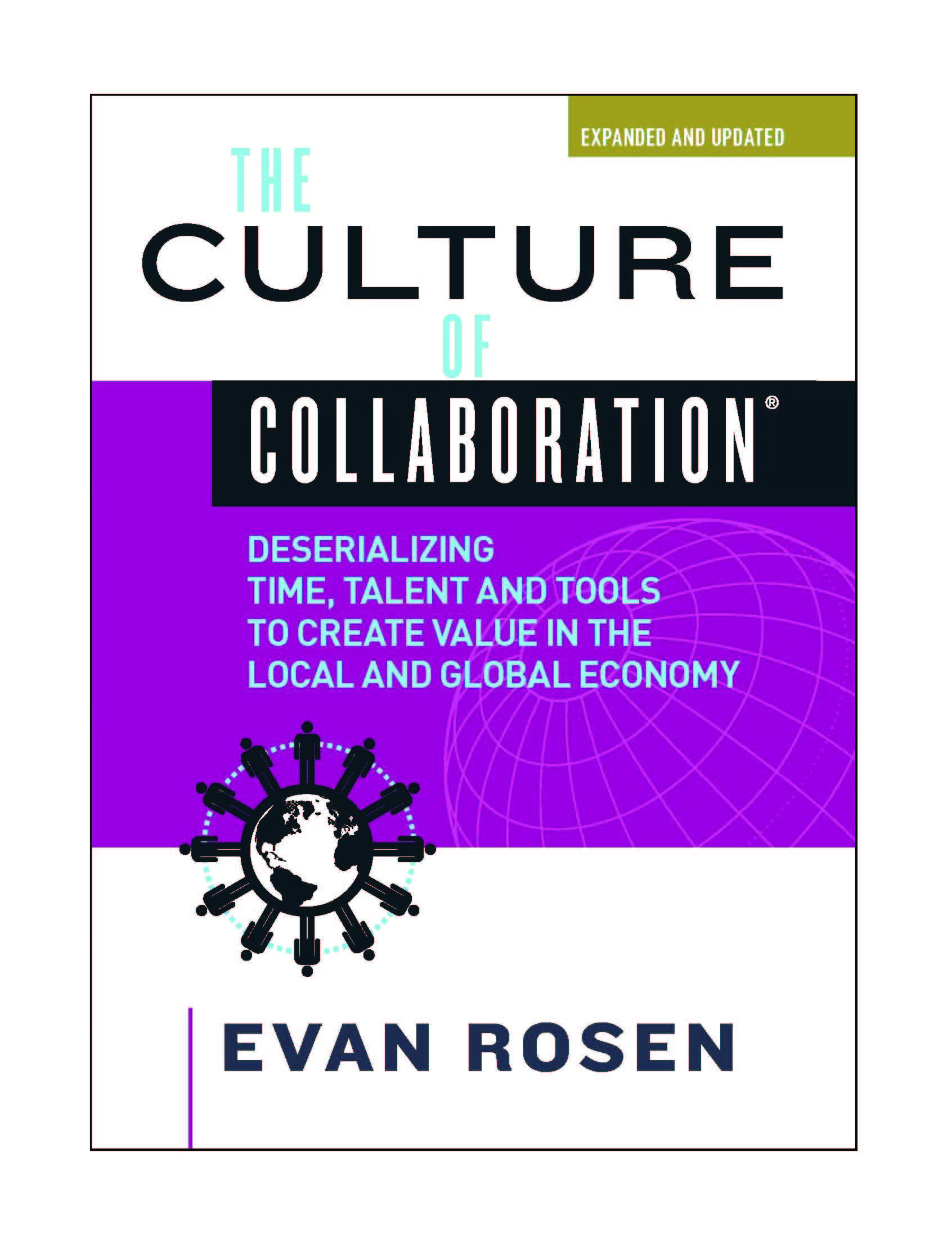
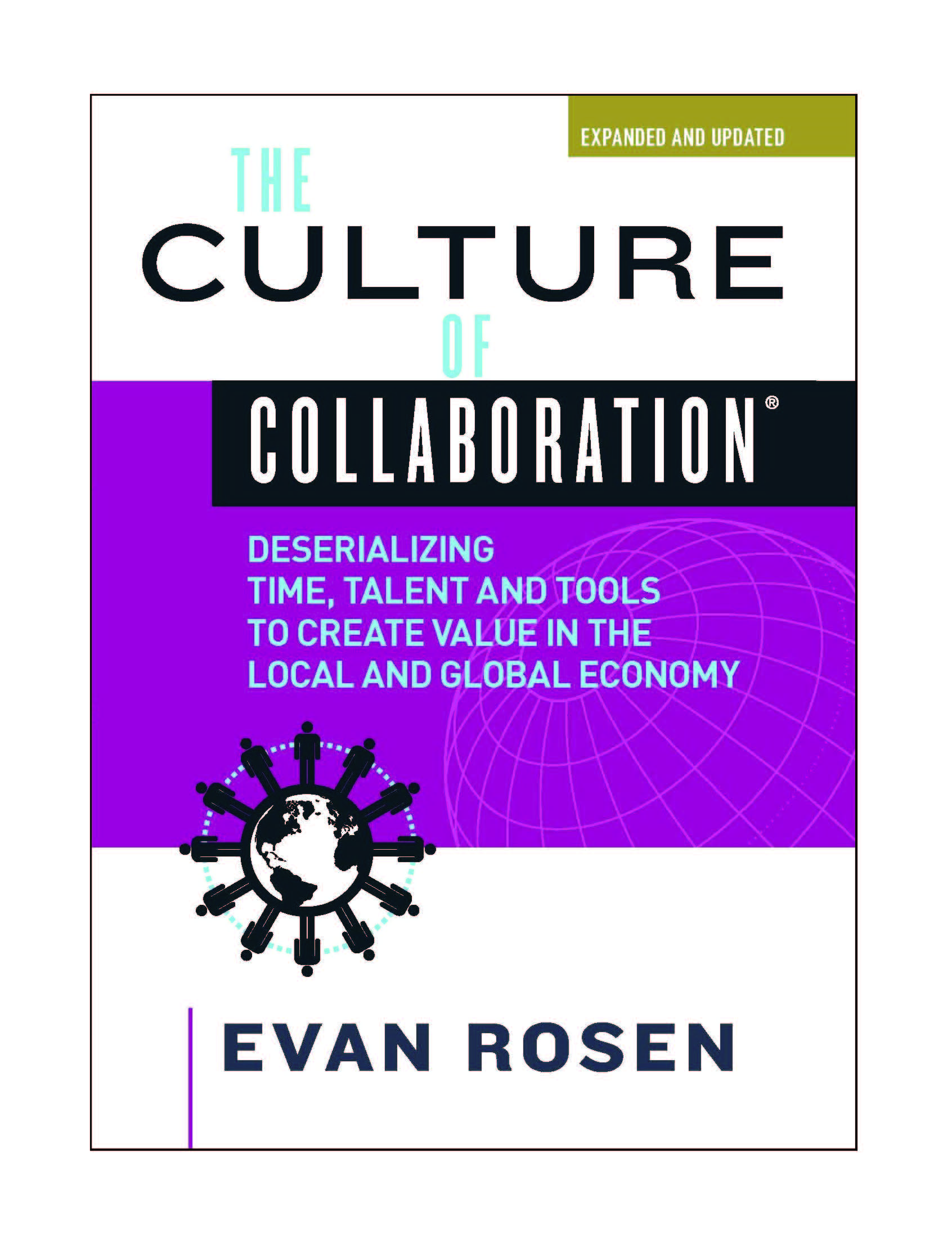
How has collaboration evolved? What is the current state of collaboration at Toyota, Mayo Clinic, Industrial Light & Magic, Boeing and other companies profiled in the first edition of The Culture of Collaboration® book? What are the keys to long-term value creation through collaboration?
These are questions I sought to answer as I went back inside collaborative companies to research and write the new, expanded and updated edition of The Culture of Collaboration® book.
The expanded and updated edition has just been released, and I’m proud of the finished work. The 363-page business book includes 54 images and illustrations and a beefy index. By the way, 54 images and illustrations is no easy feat in 2024. Ever wonder why most business books lack pictures? It’s time-consuming to license even a single image from a large organization.
One thing I’ve learned is that deserialization and collaboration go together like peanut butter and jelly. Deserialization means removing sequences from the lifecycle of products and services. The idea is to collapse outmoded sequential approaches and replace them with spontaneous, real-time processes.
Deserialization also involves removing sequences from interaction. This means killing what’s left of the in-box culture. In short, deserialization is the key to long-term value creation through collaboration. That’s why the subtitle of the expanded and updated edition of The Culture of Collaboration® is: Deserializing Time, Talent and Tools to create Value in the Local and Global Economy.
I’ve also learned that despite best efforts, collaboration can stall within highly-collaborative organizations. Paradoxically, collaboration happens in companies in which the dominant culture is command and control. Likewise, internal competition and command and control exist in mostly-collaborative organizations. Many factors, as I explain in the expanded and updated edition, influence both the evolution and regression of The Culture of Collaboration.
More broadly… as I write in the preface, in some ways we’re less collaborative than we were in the early 2000s. Social media lets us broadcast opinions without refining ideas through real-time interaction. We join groups that make rules for how we should think. Videoconferencing enables interaction at a distance, but too often we’re wasting time in scheduled virtual meetings rather than creating value together spontaneously. While in the same room, we meet rather than collaborate. We leave meetings to work and then schedule follow-up meetings to review work. This serial process zaps value.
My objective in revisiting this topic is to consider whether we have evolved or veered off track and to provide a new framework for unblocking collaboration and unlocking value.
Karl Benz is often credited with inventing the first true car. In 1885, Benz built the Benz Patent-Motorwagen powered by an internal combustion gasoline engine.
Did he act alone? Of course not. We collaborators know that nobody achieves great feats by themselves. Karl Benz had help. One collaborator was his wife, Bertha, who funded the project and took a later version of the Benz on its first long-distance journey. Benz’s company eventually merged with Daimler Motoren Gesselschaft.
Now the company that invented the automobile is collaborating to reinvent the truck. At the Tokyo Auto Show last Wednesday, Daimler announced a purely electric truck and bus brand called E-FUSO and pledged to electrify all vehicles produced by Daimler’s Mitsubishi Fuso Truck and Bus Corporation subsidiary.
Some hours later at the Mercedes-Benz Research and Development Center in Silicon Valley, journalists gathered for a briefing. Before the event, Daimler leaders and I had a far-reaching discussion about how Daimler collaborates internally and with partners and governments. We also discussed how electric trucks and buses will change life particularly for those of us who live in cities.
Daimler Fuso’s e-Canter all-electric light truck. Image copyright Daimler. All rights reserved.
Daimler’s Fuso is currently selling the eCanter light truck which it assembles in Portugal for the North American market. 7-Eleven in Japan and UPS in Atlanta are using the eCanter which has a range of 60 miles between battery charges. The optimal use of the eCanter is for deliveries within cities.
“We want to make the cities a better place to live. We want the world to change to the next level,” explained an energetic Marc Llistosella, president and CEO of Daimler’s Mitsubishi Fuso Truck and Bus Corporation. Marc, who is anything but a staid leader, was animated and clearly comfortable climbing aboard the concept E-Fuso Vision One truck and giving us a live tour via real-time, interactive video. The concept truck, which is several years from production, has a 220-mile range between battery charges and carries a payload of eleven tons. This would enable metro and regional delivery routes.
Benoit Tallec, head of design for Mitsubishi Fuso, noted that a central touch display replaces dials and switches on the Vision One so that the driver focuses on the road. He compared the evolution of Fuso trucks to the evolution of boats from sail to steam power in the early 19th Century. Fuso’s technological advances are “the result of a team effort across three continents,” he said.
Daimler FUSO’s Vision One concept all-electric truck. Image copyright Daimler. All rights reserved.
After the discussion and presentation, I hopped aboard the eCanter and drove the quietly-purring vehicle by some of Sunnyvale’s
technology company parking lots as some curious engineers took notice.
Daimler’s E-FUSO unit faces two big challenges: infrastructure for charging trucks and increasing battery range. Overcoming these challenges could one day make electric trucks economically viable for longer routes. While consumers may buy electric cars as much for novelty as economics, truck customers demand a business case that proves electric vehicles create value. Making that case through technology advances and cost reduction will require continued collaboration within Daimler, with business partners and with governments.
Wells Fargo CEO John Stumpf will testify before the Senate Banking Committee next Tuesday about the company’s sales practices. This word comes less than a week after Wells Fargo agreed to pay $185 million in fines from the Consumer Financial Protection Bureau, the Comptroller of the Currency and the City Attorney of Los Angeles. So what went wrong?
Well, I’ve seen similar disasters in other companies when the structure—and, yes, the culture—of the organization encourages competing with colleagues and cutting corners rather than collaborating with colleagues, customers and partners. The key building blocks of the organizational structure are principles, practices and processes. We get clues about Wells Fargo’s principles from its written “vision and values” which include:
“Our ethics are the sum of all the decisions each of us makes every day. If you want to find out how strong a company’s ethics are, don’t listen to what its people say. Watch what they do.”
So what exactly did Wells Fargo people do to cost the company $185 million plus untold damage to its brand and reputation?
According to the Consumer Financial Protection Bureau, Wells Fargo opened over 1.5 million unauthorized deposit accounts and may have funded these accounts by transferring funds from existing customer accounts without consent or through “simulated” funding. This practice generated about two million dollars in fees from 85,000 accounts. The CFPB consent order also states that Wells Fargo submitted credit card applications, ordered debit cards and enrolled consumers in online banking without customer consent. Clearly, this behavior represents at best a disconnect between principles and processes particularly the reward system process.
Wells Fargo’s “vision and values” cover everything from ethics to doing what’s right for customers. But written “vision and values” and mission statements don’t tell the whole story for many companies. Often, the real principles that govern an organization are unwritten. These principles manifest in break rooms, cafeterias, meetings, “off-site” sessions and sometimes during dreaded performance reviews. At best, Wells Fargo’s unwritten principles echo its written values and the problem is a disconnect between principles and processes that culminated in widespread abuses.
At worst, the company’s unwritten principles are something like “win at all costs” and “loyalty above all” which by some accounts were the unwritten principles of Lehman Brothers. Lehman, once the fourth largest investment bank in the United States, no longer exists. Neither does Enron which embraced the principle of following orders without questioning them. The wrong unwritten principles or a disconnect between the right principles and processes can start small with, say, approving mortgages for people who don’t qualify and culminate in a near collapse of the financial system.
Many organizations espouse collaborative principles while short circuiting collaboration and value creation through reward systems that reinforce internally-competitive, command-and-control behavior which can easily morph into cutting corners and illegally fudging numbers. Along the way, trust dies among team members and ultimately among customers, partners, regulators and others. This happens in industries ranging from financial services and healthcare to manufacturing and technology. And it doesn’t help that increasingly team members across multiple industries prefer to interact with devices and computer systems rather than with their customers.
Why would the third largest U.S. bank by assets—and a favorite stock of Warren Buffett—risk its reputation by cutting corners? The most likely answer: to keep the squeeze on team members through a reward system that the bank believed would deliver ever better quarterly returns.
When I hear analysts and others suggest that a company has a secret sauce shrouded in mystery that delivers outlier returns, alarm bells reverberate in my brain. This is also true of financial advisors touting a particular investment. In 2009, Warren Buffett suggested in a Fortune interview that there was something special about how Wells Fargo does business. “The key to the future of Wells Fargo is continuing to get the money in at very low costs, selling all kinds of services to their customer and having spreads like nobody else has.” This sounds sort of like a secret sauce—and there go the alarm bells. Sometimes there’s a reason why a company is an outlier. Mostly, what Buffett was referring to is the Wells Fargo practice of cross selling which is simply selling more products to existing customers. It turns out that cross selling involved phantom sales. Wells has told some team members to stop cross-selling amid the crisis.
So how can Wells Fargo be fixed? The company has fired more than 5000 employees, because of the illegal practices. But is the real problem these team members or the company’s principles, practices and processes? Wells Fargo CFO John Shrewsberry apparently feels it’s the former. Shrewsberry reportedly told the Barclays Global Financial Conference in New York on Tuesday that the team members who committed the illegal acts were “at the lower end of the performance scale” and they were trying to hold onto their jobs.
Wells Fargo senior leaders are missing the point. The real villain is the reward system they created or approved that drives the behavior of team members at bank branches. This system apparently rewarded employees for opening accounts regardless of whether customers funded these accounts with new money. What value does this create? None. In fact, it likely costs more to open and ultimately close an unauthorized account than to do nothing. It makes little sense to blame bank branch employees for trying to retain their jobs when senior leaders have likely created principles, practices and processes that prevented more than 5000 people from acting ethically, selling products and creating value.
As its CEO prepares to testify before the Senate Banking Committee, Wells Fargo announced today the company is eliminating sales goals for retail bankers. Fixing the reward system without systemic repair may help for a while, but a lasting solution requires a more comprehensive approach. I’ve learned that trying to change an ingrained culture fails without changing the organizational structure.
The unfolding crisis provides an opportunity for Wells Fargo and many other companies in multiple industries with similar issues to replace an obsolete organizational structure while revamping the flawed reward system. This involves focusing like a laser beam on the key building blocks of a value-creating collaborative company: principles, practices and processes. Only then can the culture evolve.
As the Falcon 2000LX reaches 41,000 feet, Uri Man begins answering questions from real estate developers. “It’s not stagnant. It’s circulating,” Man, the CEO of Crystal Lagoons USA, tells one inquiring passenger.
Soon we would see for ourselves. Man had chartered the plush jet and scooped up some developers and this author attending the Urban Land Institute’s Fall Meeting in San Francisco last Monday. Now we’re bound for Cabo San Lucas to tour a human-made lagoon.
“We are a technology company collaborating with developers,” Man explains. This unique collaboration for large-scale real estate development projects had piqued my interest. Crystal Lagoons has 300 lagoon projects underway globally. Man did a stint as a developer before Crystal Lagoons founder Fernando Fischmann recruited him to accelerate lagoon projects in the U.S. “Right now we’re going to Cabo, because I can’t show you one yet in the U.S.” That’s about to change. The first Crystal Lagoon in the U.S. will reportedly open next summer at Epperson Ranch in Pasco County, Florida.
Meantime, we’re headed to the southern tip of Mexico’s Baja peninsula to see what a 10-acre salt water lagoon looks and feels like. As Man begins a slide presentation on his notebook computer, I begin
A 10-acre Crystal Lagoon at Diamante Cabo San Lucas, Mexico. (Photo credit: K.R. Hirzel)
visualizing the collaborative potential of lagoons. Resort developers need a new amenity to differentiate their projects. Coastal resorts can increase their waterfront, and inland resorts can gain a coastal experience. A Crystal Lagoons architect and project team collaborates with the developer’s planning team until they conceive a project with a lagoon as the centerpiece. The Crystal Lagoons technology uses disinfection “pulses” that reportedly allow using up to 100 times fewer chemicals than a swimming pool and an ultrasonic filtration system that allows using up to 50 times less energy than conventional filtration systems.
The Crystal Lagoons business model has nothing to do with construction and everything to do with licensing. The company has a major stake in the success of development projects, because it receives roughly two percent of every condominium and house sale and a similar cut of each time share dollar. For developers, constructing lagoons costs an average of $100,000 to $200,000 per acre.
The Falcon 2000X lands, and a greeting party boards the plane and passes out hand-blown shot glasses. After a ride through some dusty Cabo streets, we arrive at the Diamante development west of the city on the Pacific Ocean. After we tour the resort, I change into my swim suit and plunge into the salt water lagoon. As I swim laps in a life-guarded area near one of two beaches, kayaks explore the expanse of this man-made mini ocean.
En route back to San Francisco, Uri Man talks about the future of Crystal Lagoons with the gusto of a bond trader (he used to be one) and the chutzpah of a guy who once hit on Fox News anchor Ainsley Earhardt on live TV (which he did). That future may involve cross-sector collaboration among industry and governments.
Crystal Lagoons USA CEO Uri Man on board a Falcon 2000LX en route to Cabo San Lucas, Mexico. (Photo credit: K.R. Hirzel)
“Parks are big money losers for states, cities and countries,” Man insists. So why not collaborate with governments to transform parks with lagoons? “Then it’s not just ten people showing up with their dogs,” says Man. “You could have hundreds of thousands showing up.”
The licensing revenue business model, which the company would likely modify for government work, ties the success of Crystal Lagoons to the achievements of developers and their large-scale projects. Both parties share wins and losses. So Crystal Lagoons enters into collaborations carefully and works with developers to create mutual value. More broadly, business partners can achieve smashing success if incentives and business models foster symbiotic relationships and collaborative value creation.
The Apple iPod began as a music player and became a video player in part because consumers discovered a new use for the device. The brand perception then shifted. Lego Mindstorms began as company-provided software and hardware to create small robots. Then consumers hacked the code, changed the products together and Lego ultimately began providing the source code and collaborating with its customers on new products. In time, consumers began perceiving Mindstorms as a collaborative activity.
As in these cases, sometimes consumers collaborate to alter a product or its use and this ultimately changes the brand perception. In other cases, companies can collaborate with partners to discover new uses for products and change how consumers perceive the brand.
Gin has traditionally involved martinis or gin and tonic—and at least one gin producer is collaborating with partners to change this use and brand perception. When Bombay Sapphire East
The LUCKYRICE festival’s “custom tonic bar”: bartenders mix flavor extracts with Bombay Sapphire East gin and club soda
emerged in test markets as the first product line extension of Bombay Sapphire gin in 2011, reviews described the gin as spicy. That’s because Bombay Sapphire East adds two new botanicals to Bombay Sapphire: lemongrass and black pepper. This “flavor profile” may seem a bit assertive to accompany typical cocktail fare like cheese and crackers. Therefore, it’s necessary for this brand to gain traction in a different culinary arena, namely Asian food.
This past Friday evening, Bombay Sapphire East sponsored the 6th Annual LUCKYRICE feast at the Bently Reserve venue in San Francisco’s financial district. As I entered the event, an Asian woman handed me one of many varieties of exotic drinks bartenders were mixing with Bombay Sapphire East. A who’s who roster of upscale Asian restaurants with tables scattered around the event were cranking out specialties to accompany Bombay Sapphire East. The brand was clearly collaborating with chefs to create the perception that the gin goes well with Asian food. This is by no means a stretch.
I sampled a drink called Piman which includes Bombay Sapphire East, yellow pepper puree and Kalamansi (an orange/kumquat hybrid) syrup. I also checked out the Bombay Sapphire East “custom tonic” bar at which bartenders combined such flavor extracts as bergamot and elderflower with club soda and gin (see above image). These drinks complimented available dishes including Dosa restaurant’s Hyderabad chicken biryani, M.Y. China’s black pepper beef with mushrooms and Brussels sprouts, and Asian Box’s lamb meatballs in coconut curry.
Collaborating with Asian chefs, the people behind Bombay Sapphire East are not only changing consumer perceptions about their gin. They’re also working with Asian restaurants to co-create and sell cocktails using a gin accented with botanicals that compliment Asian food. This creates value for the restaurants and for Bacardi Limited, which owns Bombay Sapphire East.
Whether the product is booze, blenders, toothpaste or technology, collaborating with partners to change brand use and perception can transform a sleeper product into a sales leader.
My new book, The Bounty Effect: 7 Steps to The Culture of Collaboration, has received two favorable reviews: one in Publishers Weekly and the other in Library Journal. Both reviews focus on the 7 Steps: Plan, People, Principles, Practices, Processes, Planet and Payoff.
I’m delighted that both reviewers understood the book’s premise that businesses must abandon obsolete organizational structures designed for the Industrial Age and replace them with infinitely more valuable collaborative structures suitable for the Information Age. Leigh Mihlrad of the National Institutes of Health reviewedThe Bounty Effect for Library Journal. “Rosen declares that while the control method might have worked in the Industrial Age, it does not work in today’s Information Age,” according to the review. Mihlrad concludes with the Library Journal's verdict: “For those in positions to bring about organizational change, this book provides many useful examples.”
The Publishers Weeklyreview highlights my point that The Bounty Effect is by no means limited to corporations. “Rosen argues that collaboration moves well beyond organizational boundaries, as it applies to neighborhoods, communities, and government,” according to Publishers Weekly. “Collaboration creates greater value, enhances achievement, and produces sustainable business models; the question then becomes how quickly can an organization free itself from the Industrial Age and operate to its maximum capacity in the Information Age.” The sooner an organization starts the seven steps, the faster it can migrate from command-and-control and maximize value through collaboration
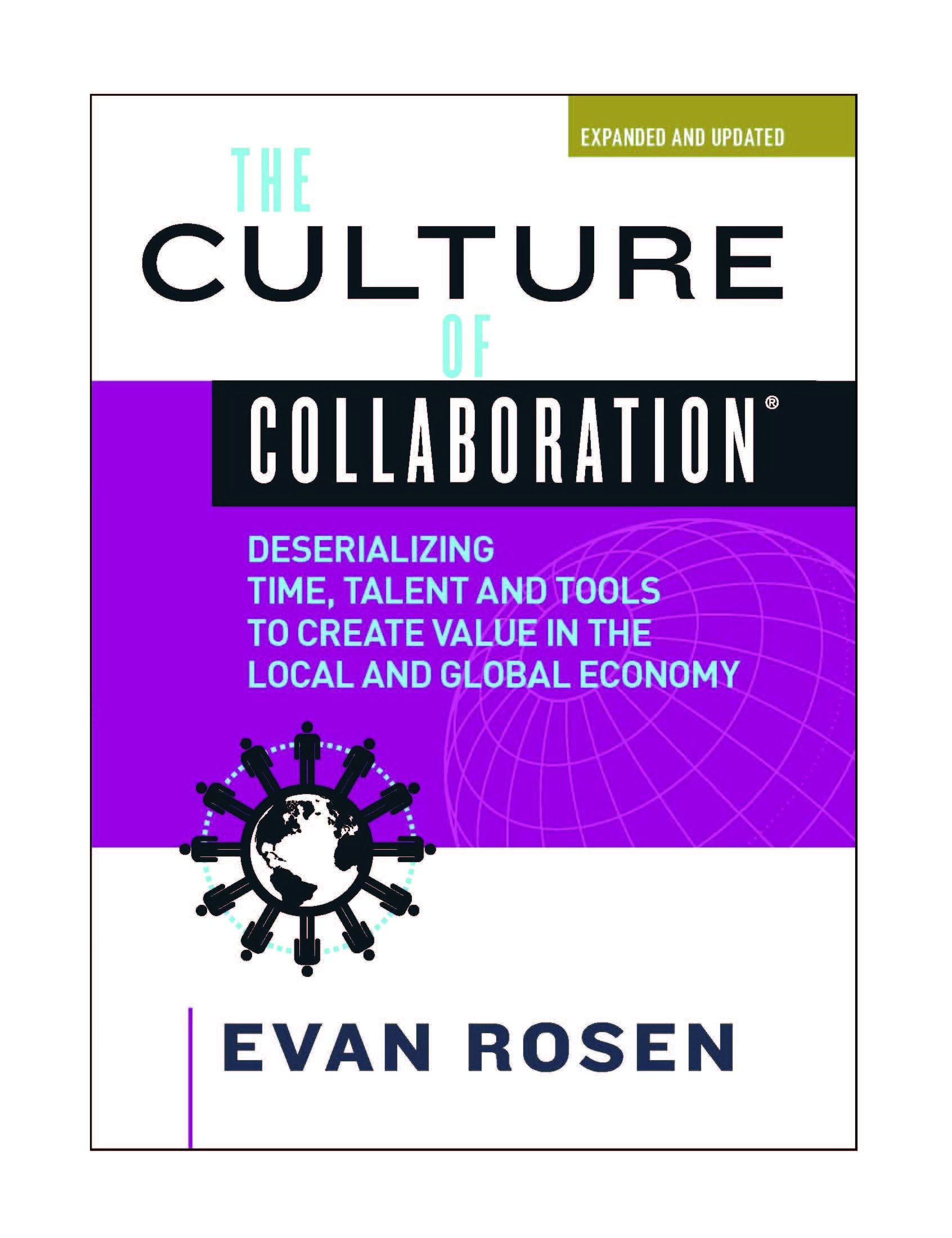
My new book entitled The Bounty Effect: 7 Steps to The Culture of Collaboration® is now available. It’s the second book in a series which includes The Culture of Collaboration®: Maximizing Time, Talent and Tools to Create Value in the Global Economy. The Bounty Effect shows how to change the structure of organizations for collaboration.
Why do organizations need to change their structures? The Industrial Age was command and control. The Information Age is collaboration. Yet Industrial Age structures render collaboration dead on arrival in the Information Age. Remnants of these structures—including organization charts, performance reviews, meetings and mission statements—inhibit organizations from using new collaborative methods and tools that spark innovation. Now we’re at the point where many organizations—from corporations and small businesses to universities and government agencies—have a desire to collaborate. Some have taken action to instill collaborative culture. But what’s holding back collaboration is obsolete organizational structures, which we must change.
The Bounty Effect gets its name from the mutiny that occurred on the H.M.S Bounty in 1789. Before the mutiny, Captain William Bligh used a well-worn management technique: command-and-control. The mutiny forced the structure and culture to change as Bligh became a collaborative leader and his loyalists participated in decisions as they struggled for survival aboard a small boat. The mutiny was an exigent circumstance, one that compels immediate action.
The Bounty Effect happens when exigent circumstances compel businesses, governments and organizations to change their structures from command and control to collaborative. Triggers include disruptive market forces, new competitors, regional slowdowns, natural disasters, terrorist attacks and global downturns.
The book is about how to seize the opportunity that The Bounty Effect provides and change the organizational structure in seven steps. My objective in writing the book is to provide a framework for structural change necessary to transform organizations into collaborative enterprises. And The Bounty Effect demonstrates how collaborative enterprises create far more value than command-and-control organizations. Using the framework, people and organizations can determine how to redesign and adopt a collaborative structure that fits. I welcome your input.
They compete in the marketplace, but now they’re also collaborating.
BMW and Toyota have announced they will collaborate in two areas: the companies will share costs and knowledge for electric car battery research, and BMW will supply diesel engines to Toyota. Toyota owns the luxury brand, Lexus, and therefore BMW and Toyota directly compete in the luxury car segment. Both companies have a significant collaboration track record.
In The Culture of Collaboration book, I describe how BMW and Toyota create value by collaborating internally and with business partners. The preface, which you can read here, reveals how my visit to the BMW design center in Munich some years ago sparked the book.
So why would two competitors collaborate? Collaborating makes sense within enterprises and with partners, but the marketplace requires pure competition. Right? Well, that depends.
Collaborating among competitors makes sense when the collaboration:
Creates value for both parties
Begins with structure and clarity
Involves non-differentiating processes
Clearly, the BMW/Toyota collaboration nails number one. “We think that this collaboration will allow for development of next-generation batteries to be done faster and to a higher level,” Toyota Executive Vice President Takeshi Uchiyamada said at a news conference. Both companies will share the costs of battery development.
Toyota will reportedly use BMW’s 1.6 and 2-liter diesel engines for cars sold in Europe beginning in 2014. This is reportedly the first time Toyota has procured an engine from a competitor. According to a story by Yoshio Takahashi and Kenneth Maxwell in the December 2, 2011 edition of the Wall Street Journal, the collaboration will reduce BMW’s engine production costs per unit by increasing volume. So, value creation is at the heart of this collaboration.
What about #2, structure and clarity? Based on what I know of BMW and Toyota and their approaches to collaboration, chances are this effort involves much of both. In any collaboration among competitors, both parties must establish boundaries for collaboration at the outset. Most importantly, the competing collaborators must determine use and ownership of existing and jointly-created intellectual property. Far fewer problems arise when business unit people, engineers, marketing folks, lawyers and others from both companies hash out these concerns rather than simply handing off the issues to lawyers to hash out in a vacuum.
Regarding #3, I’ve found that collaboration among competitors works best when the effort involves eliminating redundancy in non-differentiating processes. These are typically under-the-hood processes that are not part of a company’s market or product perception. Two companies that each make hot sauce might use the same bottling equipment. Two newspapers in the same market might use the same printing presses. Entire industries participate in consortiums for purchasing, saving each competing company substantial money. These shared, non-differentiating processes are invisible to the customer.
Engines are invisible to all but the most die-hard car enthusiasts, so collaborating on this process arguably fits the bill as non-differentiating. Typically, car batteries have nothing to do with the vehicle perception in the marketplace. In the case of electric cars, though, the jury is still out whether the battery is invisible to the consumer. The technology is in its infancy, and therefore the market consists primarily of early adopters. These consumers are more techno-savvy, realize the lithium-ion battery is intrinsic to the product’s technology and performance, and therefore may place a heavier emphasis on the battery in their purchase decisions.
So, it remains to be seen whether battery research and development is non-differentiating for BMW and Toyota. Nevertheless, if both companies can save substantial money on development and bring vehicles to market sooner and customers perceive and actually get better electric vehicles, this collaboration will prove successful.
In a cavernous, nearly empty room above the Readers Café & Bookstore in Building C of San Francisco’s Fort Mason Center, Woody Tasch sits at a corner table by a lone window looking out on the Bay. It’s the eve of the Slow Money National Gathering, and the organization’s chairman is putting the finishing touches on his opening remarks. He must fend off criticism that his model is “fantasy economics” and impress on the three hundred investors and five hundred or so other attendees that our industrialized food system has become as imbalanced as the financial system was during the depths of the 2008 crisis.
Woody, a former New York venture capitalist who now lives off the grid near Taos, New Mexico, wants to change how we finance food businesses as dramatically as he has changed his own life and career. In the 1980’s, Woody worked as a self-proclaimed “small-time VC” making healthcare investments for Prince Ventures, owned by the Prince family of Chicago. Ultimately, he transformed himself from a mathematics-driven investor to one with a social conscience with stops along the way as treasurer for a foundation and chairman of an angel investor network called Investors Circle.
“It’s no longer about how much we can take off the table for ourselves,” Woody insists. After getting involved with the global Slow Food movement, the antithesis of fast food in its promotion of sustainability, Woody and his collaborators sought to address the difficulty many sustainable food businesses have getting financing. “It hit me that patient capital plus slow food equals slow money,” he explains.
Woody and his colleagues are enabling microfinance for the food industry and, since 2009, have sparked $6 million in micro loans. Slow Money links growers, restaurants, organic farm suppliers and other food entrepreneurs with consumers willing to lend businesses a few thousand—or even a few hundred—dollars.
“This is not a typical fiduciary model,” Woody explains. “What we are going to be proving over the next decade is that collective intelligence and local knowledge of groups of individuals effectively collaborating will produce positive outcomes both in arithmetic and impact on the community.” In other words, investors can do good and simultaneously get a modest return on investment. At the moment, 3 percent a year in interest is typical.
Slow Money is evolving from advocating individual investments to promoting investment clubs. Compared to angel investing, for which investors must have assets of at least a million dollars or a yearly salary of at least $200,000, the investment club barrier to entry is much lower. As a model, Slow Food organizers point to the No Small Potatoes Investment Club, which provides low-interest loans to Maine farmers and food producers. So far, fifteen investors have each put up five thousand dollars.
After talking with Woody, I stop by the rehearsal for the entrepreneur pitches. These five-minute presentations are not unlike those for technology companies at venture capital conferences. But there is something perhaps more wholesome and genuine and, yes, rougher around the edges, about these pitches. Some of these food businesspeople have never before spoken at an event. George Weld, owner of both Egg restaurant in Brooklyn and a farm in Oak Hill, New York, speaks of the need to curb the “recurring alienation between rural and urban that plagues the food economy.”
One of the better-received pitches comes from Dr. Hubert Karreman, a veterinarian and founder of Bovinity Health. Hubert’s company manufactures natural alternatives to antibiotics for livestock. He clicks through financials including $250,000 in sales in 2011, provides market share projections and leaves the rehearsal audience whispering "he's gonna get funded."
Slow Food’s goal is for a million Americans to be investing one percent of their money in local food systems within a decade. Meantime, Woody Tasch offers his prescription for the economy. “What we need is rebalancing. Right now we’re lurching towards the global race to the bottom. It’s buy low, sell high, GMO [genetically modified organism], CDO [collateralized debt obligation] capitalism. We have to compete for cheap labor around the planet subsidized by cheap oil and ignoring the medium and long-term social and environmental impact.” Collaborating requires a longer-term focus, and Slow Money is helping enable that evolution.
The cost of internal competition plagues almost every company. But the private sector is by no means the only sector that competes. With limited funding, particularly during the Great Recession and the fledgling Great Recovery, non-profit organizations have increasingly competed for shrinking grant dollars. And while the for-profit sector may regard the non-profit sector as populated by less-competitive do-gooders, competition in the non-profit arena can rival that of private industry.
For private-sector companies, competing in the marketplace furthers objectives, namely to increase revenue and market share. In contrast, non-profit organizations compromise their objectives when they compete with other non-profits that share their mission. The cynical among us might believe that the first goal of some non-profits is preserving themselves to employ administrators and staff and that their service mission is secondary. Let’s assume, though, that the primary goal of most non-profits is to further their mission. In that case, collaboration among non-profits creates far greater value.
Some foundations have developed programs to encourage non-profit organizations to collaborate. The Myelin Repair Foundation, which is working to cure multiple sclerosis, has recruited five principal investigators from different universities. With input from the researchers, MRF developed a Collaborative Research Process, which addresses everything from tools to incentives. You can read more about MRF in my July 16, 2009 post. The Bill and Melinda Gates Foundation has funded a collaborative research consortia comprising 165 investigators globally to accelerate HIV Vaccine Development. For both MRF and the Gates Foundation, collaboration is reducing time-to-a-cure.
Foundations are by no means the only funders favoring and, in some cases, insisting on collaboration among non-profits that they support. In some cases, funders use a heavy hand in forcing organizations to share resources or join forces. But ordering people to collaborate misses the point. The most successful non-profit collaborations are those in which non-profits and their funders collaborate to achieve common goals.
This is exactly what’s happening with San Francisco’s Tenderloin Technology Lab, which provides computer and Internet access plus instruction to disadvantaged people looking for jobs. Because most jobs require online applications, people struggling with keeping a roof over their heads are often shut out of the job market. The lab is a collaboration among St. Anthony Foundation, San Francisco Network Ministries and the University of San Francisco. Beginning in 2001, USF was providing computers and other support to the two organizations’ separate computer labs. As demand rose with the economic downturn in 2008, USF collaborated with the two organizations to open a combined Tenderloin Technology Lab. The lab now serves a hundred people a day.
Last Thursday, I dropped into the Tenderloin Tech Lab as the collaborating organizations were unveiling an updated space. Rev. Stephen Privett, a Jesuit priest and president of the University of San Francisco, described the collaboration among UCSF, St. Anthony Foundation and San Francisco Network Ministries as three legs of a stool. “Without the three legs, the stool doesn’t stand. We can get a lot more done together than we can separately.” I chatted with Craig Newmark, founder and customer service representative, of craigslist, which supports the lab. (Yes. Craig’s business card includes both titles.) Craig praised the lab for delivering real results to real people. “One thing you learn doing customer service is what’s real,” he insisted.
Shifting from competing to collaborating can create substantial value for non-profits and the people they serve. “It involves putting down our egos and saying we can do this better,” according to Cissie Bonini, director of programs for St. Anthony Foundation, which began feeding San Francisco’s needy in 1950. And the private sector can take a cue from this non-profit collaboration. When we put our egos aside, we can share more, internally compete less—and create far greater value.










 The Culture of Collaboration Blog