Cross-Sector Collaboration


  • New Expanded and Updated Edition of The Culture of Collaboration® Book

    How has collaboration evolved? What is the current state of collaboration at Toyota, Mayo Clinic, Industrial Light & Magic, Boeing and other companies profiled in the first edition of The Culture of Collaboration® book? What are the keys to long-term value creation through collaboration?

    These are questions I sought to answer as I went back inside collaborative companies to research and write the new, expanded and updated edition of The Culture of Collaboration® book.
    Jacket with border CofC EU


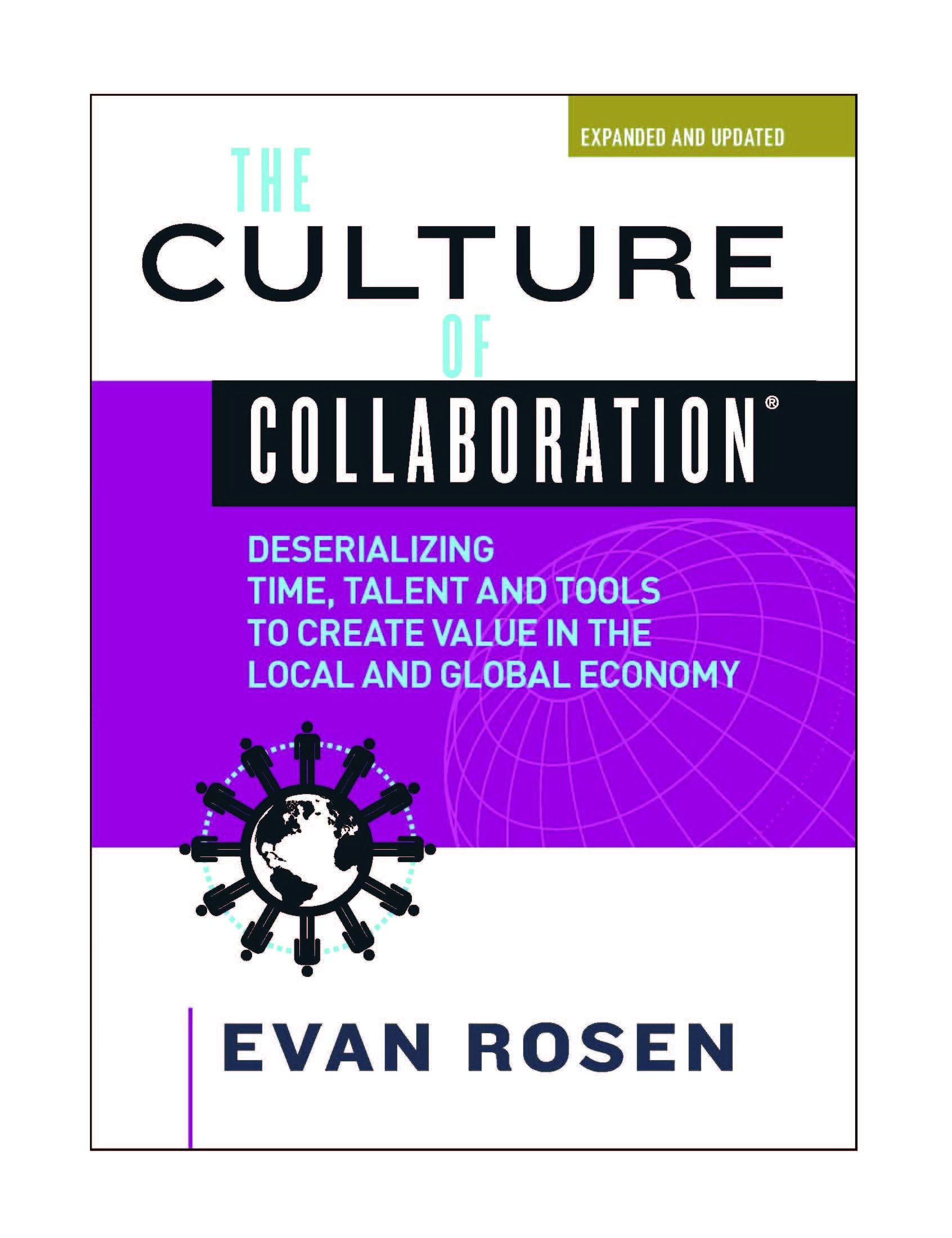
    The expanded and updated edition has just been released, and I’m proud of the finished work. The 363-page business book includes 54 images and illustrations and a beefy index. By the way, 54 images and illustrations is no easy feat in 2024. Ever wonder why most business books lack pictures? It’s time-consuming to license even a single image from a large organization.

    One thing I’ve learned is that deserialization and collaboration go together like peanut butter and jelly. Deserialization means removing sequences from the lifecycle of products and services. The idea is to collapse outmoded sequential approaches and replace them with spontaneous, real-time processes.

    Deserialization also involves removing sequences from interaction. This means killing what’s left of the in-box culture. In short, deserialization is the key to long-term value creation through collaboration. That’s why the subtitle of the expanded and updated edition of The Culture of Collaboration® is: Deserializing Time, Talent and Tools to create Value in the Local and Global Economy.

    I’ve also learned that despite best efforts, collaboration can stall within highly-collaborative organizations. Paradoxically, collaboration happens in companies in which the dominant culture is command and control. Likewise, internal competition and command and control exist in mostly-collaborative organizations. Many factors, as I explain in the expanded and updated edition, influence both the evolution and regression of The Culture of Collaboration.

    More broadly… as I write in the preface, in some ways we’re less collaborative than we were in the early 2000s. Social media lets us broadcast opinions without refining ideas through real-time interaction. We join groups that make rules for how we should think. Videoconferencing enables interaction at a distance, but too often we’re wasting time in scheduled virtual meetings rather than creating value together spontaneously. While in the same room, we meet rather than collaborate. We leave meetings to work and then schedule follow-up meetings to review work. This serial process zaps value.

    My objective in revisiting this topic is to consider whether we have evolved or veered off track and to provide a new framework for unblocking collaboration and unlocking value.

    Let me know your thoughts about the new, expanded and updated edition of The Culture of Collaboration® book.

  • COVID-19 Triggers The Bounty Effect

    We are living in a time of exigent circumstances. What do I mean by exigent circumstances? I mean a do-or-die challenge that raises the stakes for survival.

    Exigent circumstances ignite the structural change necessary to collaborate for governments, companies, non-profits, universities and just about every organization. This is The Bounty Effect which I describe in my book The Bounty Effect: 7 Steps to The Culture of Collaboration®. I call this The Bounty Effect using the metaphor of the mutiny that occurred on the H.M.S. Bounty more than two centuries ago. For Captain Bligh and his loyalists who were cast adrift on a small boat in stormy seas, surviving meant changing the structure and culture from command-and-control to collaborative.

    COVID-19 is an exigent circumstance. COVID-19 is The Bounty Effect.

    The pandemic is kick starting collaboration in myriad ways as command-and-control practices recede. Companies that weeks ago shunned telecommuting now embrace working from home. Organizations that paid a few people to think and paid everybody else to carry out orders want everybody thinking and contributing. It’s all hands on deck!

    Deficit hawks have voted for the largest stimulus in history as legislators of both parties collaborate in ways not seen for at least a decade. Companies are mobilizing and retooling to manufacture medical supplies. Toyota says it’s ready to produce face shields, face masks and respirators.

    Companies that preferred email and messaging are integrating rich, real-time collaboration tools such as videoconferencing into work processes and they’re rediscovering an age-old synchronous tool called the telephone. Companies with centralized decision making at “headquarters” are spreading decision making around the organization.

    Is this actually lasting structural change or just a temporary reaction to an imminent threat? COVID-19 is a watershed event in the modern history of the world, and many shifts in practices and processes will become permanent.

    We’ve seen The Bounty Effect before with pandemics. AIDS changed the structure of vaccine development from competing isolated labs to collaborating across organizational boundaries. Likewise, we will experience not only lasting structural change in organizations of all kinds but also more institutionalized cross-organizational and cross-sector collaboration.


  • Daimler Collaborates to Reinvent Trucks

    Karl Benz is often credited with inventing the first true car. In 1885, Benz built the Benz Patent-Motorwagen powered by an internal combustion gasoline engine.

    Did he act alone? Of course not. We collaborators know that nobody achieves great feats by themselves. Karl Benz had help. One collaborator was his wife, Bertha, who funded the project and took a later version of the Benz on its first long-distance journey. Benz’s company eventually merged with Daimler Motoren Gesselschaft.

    Now the company that invented the automobile is collaborating to reinvent the truck.  At the Tokyo Auto Show last Wednesday, Daimler announced a purely electric truck and bus brand called E-FUSO and pledged to electrify all vehicles produced by Daimler’s Mitsubishi Fuso Truck and Bus Corporation subsidiary. 

    Some hours later at the Mercedes-Benz Research and Development Center in Silicon Valley, journalists gathered for a briefing.  Before the event, Daimler leaders and I had a far-reaching discussion about how Daimler collaborates internally and with partners and governments. We also discussed how electric trucks and buses will change life particularly for those of us who live in cities.

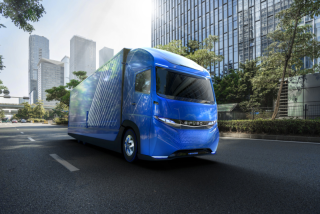
    Daimler Fuso’s e-Canter all-electric light truck. Image copyright Daimler. All rights reserved.

    Daimler’s Fuso is currently selling the eCanter light truck which it assembles in Portugal for the North American market. 7-Eleven in Japan and UPS in Atlanta are using the eCanter which has a range of 60 miles between battery charges. The optimal use of the eCanter is for deliveries within cities.

    “We want to make the cities a better place to live. We want the world to change to the next level,” explained an energetic Marc Llistosella, president and CEO of Daimler’s Mitsubishi Fuso Truck and Bus Corporation. Marc, who is anything but a staid leader, was animated and clearly comfortable climbing aboard the concept E-Fuso Vision One truck and giving us a live tour via real-time, interactive video.  The concept truck, which is several years from production, has a 220-mile range between battery charges and carries a payload of eleven tons. This would enable metro and regional delivery routes.

    Benoit Tallec, head of design for Mitsubishi Fuso, noted that a central touch display replaces dials and switches on the Vision One so that the driver focuses on the road. He compared the evolution of Fuso trucks to the evolution of boats from sail to steam power in the early 19th Century. Fuso’s technological advances are “the result of a team effort across three continents,” he said.

    Daimler FUSO’s Vision One concept all-electric truck. Image copyright Daimler. All rights reserved.

    After the discussion and presentation, I hopped aboard the eCanter and drove the quietly-purring vehicle by some of Sunnyvale’s

    technology company parking lots as some curious engineers took notice.

    Daimler’s E-FUSO unit faces two big challenges: infrastructure for charging trucks and increasing battery range. Overcoming these challenges could one day make electric trucks economically viable for longer routes. While consumers may buy electric cars as much for novelty as economics, truck customers demand a business case that proves electric vehicles create value.  Making that case through technology advances and cost reduction will require continued collaboration within Daimler, with business partners and with governments.


  • Collaboration Creates Leap in Photo Organizing

    Inheriting shoe boxes full of photos presents challenges. You can leave them in the garage or attic gathering dust. You can argue with siblings about who keeps the photos, who scans them, and who shares them electronically with everybody else. You can hire a professional photo organizer. Or you can collaborate with professionals and incorporate their techniques into your system.

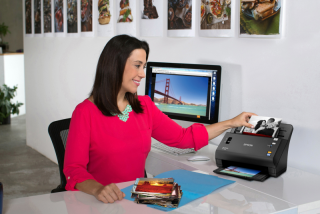
    That’s what Epson has done. And that collaboration has helped produce the FastFoto FF-640 photo scanning system which Epson is

    Epson FF-640
    The Epson FastFoto FF-640 scans and organizes photos. It’s the result of collaboration.

    releasing today. The system combines what Epson says is a one-photo-per-second photo scanner with image organizing software. Epson’s Jack Rieger demonstrated the system a couple of weeks ago during a pre-launch briefing at San Francisco’s Le Meridien hotel. Rieger described Epson’s collaboration with the Association of Personal Photo Organizers (APPO). “We took the best of their techniques and embedded them in software,” explained Rieger, a chemical engineer and former film designer and digital product marketer for Kodak. These techniques include file structure and hierarchy for automated sorting of photos, a file naming system, a capture date that reflects the date the photo was taken, and searchable metadata which is the data about the data.

    According to the Association of Personal Photo Organizers, 1.7 trillion printed photos “languish in boxes and containers.”  Each month, people take another 10 billion pictures globally resulting in what the association calls “photo chaos.” APPO says it equips its more than 500 members who are independent professionals to “rescue” and organize all these photos.  Now APPO has a new tool color in its palette of organizing tools.

    “This is groundbreaking, something that was not possible before,” Rieger insisted. The scanner features a 30-photo auto feeder and scans the front and back of the photo to preserve any writing on the back. The software automatically restores and corrects the color of old photos. Plus the system ties in with frequently-used services including Facebook, Dropbox and Google Drive to enable collaboration among friends and family. So the sibling who inherits the photos can more easily digitize, organize, and share the anthology and collaborate on the collection with other siblings, relatives and friends.

    Tools and technologies never create collaboration, but they can enhance and extend collaboration. This is true whether we’re developing a slide show with siblings or producing a product with colleagues. And the Epson FastFoto FF-640, a product developed through collaboration, also enhances collaboration among its users.