It’s called Ponte della Costituzione, the fourth footbridge over Venice’s Grand Canal. The glass and steel structure has caused nothing but headaches—and some muscle aches—for tourists, Venetians and the officials who run their city.
When Venice commissioned an architect to build the new bridge in the late 1990s, the job went to Santiago Calatrava. Named by Time magazine to the Time 100, one of the hundred most influential people in 2005, Calatrava has chalked up dozens of awards and honorary doctorates. His celebrated projects range from the World Trade Center Transportation Hub in New York City to the Museum of Tomorrow in Rio de Janeiro, Brazil. And the New York Times calls Calatrava a “star architect.”
Venice’s Ponte della Constituzione. Photo by Christoph Radtke. Licensed under CC BY 3.0. No changes made.
The problem is that the Zurich, Switzerland based architect apparently failed to adequately consider practicalities impacting Venetians who cross the bridge regularly and tourists who cross when visiting one of Italy’s most visited cities. For starters, the bridge lacks disabled access. Also, the glass floor has caused many people to slip and fall. According to a story in Architectural Digest, some Venetians have cracked their chins and foreheads and others have reportedly broken bones. City officials have told media outlets that injuries occur almost daily.
Because too many injured pedestrians have sued the City of Venice over the multimillion dollar bridge, the city has decided to allocate more than half a million dollars to replace the glass with trachyte stone. This expense comes after a failed 1.5 million Euro modification to install a cable car so that people could cross the bridge without injury.
What has caused heartache, bone ache, lawsuits and wasted taxpayer dollars is star culture. Rather than designing a bridge for the practical needs of tourists and others who regularly cross the canal, Calatrava was apparently too focused on capturing and representing Venice’s “embrace of modernity” as the New York Times puts it. Rome’s Court of Auditors found that Calatrava was negligent in failing to account for the number of tourists dragging their bags across the bridge. Calatrava argued that bag dragging constitutes “incorrect use.”
Stars tend to get swept up by things like symbolism, messaging and virtue signaling. Collaborative architects seek input from people who will use the structure they’re designing. In The Bounty Effect: 7 Steps to The Culture of Collaboration®, I describe how architect Renzo Piano made no sales presentation but rather pulled ideas from his clients in collaboratively conceptualizing and designing the California Academy of Sciences in San Francisco.
Undoubtedly, Calatrava has chalked up major accomplishments, but accomplished professionals run the risk of buying their own hype. When people are made to believe they can do no wrong, they often make decisions in a vacuum and may work without adequate input from others. This feeds star culture for which the media has an insatiable appetite. Yet we must resist the temptation, because star culture sucks value out of companies, governments and communities.
Texting and instant messaging (IM) have rapidly supplanted voice calls as our preferred communication mode. When we say “I spoke with him” or “I had a conversation with her” often we’re referring to text chat rather than voice. This lack of real talking adversely impacts collaboration.
In many organizations, people never bother to set up their voice mail. And we increasingly view voice calls as intrusive. Yet companies have redesigned their physical spaces ostensibly to encourage intrusions such as on-the-fly and chance encounters which can spark collaboration.
1910 Advertisement for the automatic (dial) telephone service of the Illinois Tunnel Company in Chicago
When I wrote the first edition of The Culture of Collaborationbook in 2006, I summed up the deserialization of work and interaction as the “in-box culture is dead.” The idea was that something called presence would allow us to see who’s available and that we could connect with anybody in the organization via instant messaging. Then—and this is the important point—we could escalate that instant messaging session into a spontaneous voice or video call with the simultaneous capability of collaboratively working on documents, spreadsheets, presentations or in any application. So there was no longer a need to schedule voice and video calls. Through real-time collaboration, we could create far greater value.
Somehow IM took hold in companies but escalation to voice and video calls has seemingly stalled. And use of voice on mobile devices has plummeted. At one time speakerphone quality was a key attribute of devices, but Apple iPhone and Samsung Galaxy marketing barely mention voice.
IM has the advantage over email in that it’s nearly real-time and there’s an expectation of immediate response. So it’s easy to find people and connect with them. The problem is that like email IM and texting are one dimensional. It can be difficult to determine the real meaning and the emotion behind the words. If we talk with each other on a voice call, we can often understand each other better, cut to the chase and resolve issues more quickly than through IM. If the issues are more involved, a video call fits the bill.
Also, people feel less isolated when using real-time voice and video. In fact, there are signs that we are desperate for real connection and interaction that IM and texting can’t deliver. The New York Times recently ran a story on how people are using calls to customer service representatives as therapy sessions. Increasingly, companies are training representatives to show compassion and focus on the emotional needs of the customer rather than rush them off the line.
This phenomenon cuts both ways. Increasingly, customer service representatives are anxious for a real connection. I experienced this first hand when I called a credit card company recently to discuss my airline co-branded card. The representative told me about her background as a former flight attendant and a singer with a band. I also learned that she had a degree in advertising, likes to roller blade and moved from California to Florida. At the end of the call, she arranged a mileage bonus and said “thanks for letting me be me.” We both felt connected in a way that an IM session with the card company could never deliver.
I’m currently writing a new edition of The Culture of Collaboration book and assessing where we’ve gone wrong and how we can get collaboration back on track. When it comes to tools, we’re half way there. Rather than getting stalled with texting and IM (not to mention social media), our challenge is to maximize our ability to find and connect with people. This means turning some of those texting and IM sessions into voice and video calls so that together we can create value.
The recent rash of sexual misconduct accusations against prominent men provide a lens through which we can view the death of star culture. For generations, we have bestowed God-like status on so-called stars whether they’re politicians, chefs, entertainers, executives, athletes or show hosts. This exalted status makes “stars” believe they are special.
The #metoo movement is a proxy for rejecting star culture. And now this cultural shift is manifesting in other ways. Viewership for last Sunday’s Grammy Awards dropped 24 percent compared with viewership for last year’s Grammy Awards. We’re tired of stars.
If “stars” like Bill Cosby, Harvey Weinstein, Matt Lauer, Mario Batali, Kevin Spacey, Charlie Rose, Steve Wynn and so many others get a pass on just about everything for being stars, our star culture is responsible for their transgressions. We elevate them to status so rarified that they may believe laws and standards of fairness and decency do not apply to them.
Star culture reinforces the false notion that we achieve great feats by ourselves. Whether the so-called star is a movie producer, chef, tv host, actor or executive, the reality is that he or she succeeds because of others. Nobody achieves great feats entirely on their own. Behind the scenes, many people work to make the movie, the meal, the talk show, the team, the business a success regardless of the “star.”
In The Culture of Collaboration book, I describe the Myth of the Single Cowboy. This is the notion that one self-sufficient, rugged individual can achieve smashing success without help from anybody. When we perpetuate this myth, we make so-called stars feel that they’re a breed apart and can conduct themselves without consequences.
Star culture reinforced by the media and society at large also infects organizations. The result is that contributors who are not considered A-listers get sidelined. Their input and ideas are lost, and value creation suffers. Plus internal competition to become a star increases bad behavior such as sabotaging others and hoarding information.
Our excuse for star culture and for tolerating transgressions is that stars supposedly create more revenue. There is evidence, though, that the financial performance of stars is often overstated. NBC’s Today Show picked up more viewers after the network fired Matt Lauer.
Rejecting star culture is nothing short of a fundamental shift in our society. This shift will impact companies, universities, government agencies and organizations of all types. Smart organizations will get ahead of the curve and take the necessary steps to replace star culture with a collaborative culture
People who become stars often cheat to achieve or keep their rarefied status. Social media is a case in point. One way we measure star power is to count the number of followers on social media. Did we really think that stars are so popular that millions of people read their posts and tweets? It turns out that “stars” and wannabe “stars” pay for fake followers which create fake data on which companies base advertising and endorsement decisions.
A reporting team at the New York Times recently investigated a company named Devumi that sells Twitter followers and retweets. The company reportedly has at least 3.5 million automated accounts for rent. Customers include reality television “stars.”
So it turns out that star culture is related to another unfortunate phenomenon that compromises collaboration: measurement mania and the tyranny of data. Fake data is by no means limited to social media. In command-and-control organizational cultures that foster internal competition and information hoarding, team members get the message that the goal is winning at all costs. In this type of culture, numbers get fudged and corners get cut.
Fake data scandals cost these companies plenty. A recent glaring example is the fake bank account scandal at Wells Fargo. Companies that embrace fake data are often the same companies that promote “stars” and minimize the contributions of others.
Many companies have yet to catch up with our evolving society. Successful organizations use real data and replace star culture with collaborative culture.
Wells Fargo CEO John Stumpf will testify before the Senate Banking Committee next Tuesday about the company’s sales practices. This word comes less than a week after Wells Fargo agreed to pay $185 million in fines from the Consumer Financial Protection Bureau, the Comptroller of the Currency and the City Attorney of Los Angeles. So what went wrong?
Well, I’ve seen similar disasters in other companies when the structure—and, yes, the culture—of the organization encourages competing with colleagues and cutting corners rather than collaborating with colleagues, customers and partners. The key building blocks of the organizational structure are principles, practices and processes. We get clues about Wells Fargo’s principles from its written “vision and values” which include:
“Our ethics are the sum of all the decisions each of us makes every day. If you want to find out how strong a company’s ethics are, don’t listen to what its people say. Watch what they do.”
So what exactly did Wells Fargo people do to cost the company $185 million plus untold damage to its brand and reputation?
According to the Consumer Financial Protection Bureau, Wells Fargo opened over 1.5 million unauthorized deposit accounts and may have funded these accounts by transferring funds from existing customer accounts without consent or through “simulated” funding. This practice generated about two million dollars in fees from 85,000 accounts. The CFPB consent order also states that Wells Fargo submitted credit card applications, ordered debit cards and enrolled consumers in online banking without customer consent. Clearly, this behavior represents at best a disconnect between principles and processes particularly the reward system process.
Wells Fargo’s “vision and values” cover everything from ethics to doing what’s right for customers. But written “vision and values” and mission statements don’t tell the whole story for many companies. Often, the real principles that govern an organization are unwritten. These principles manifest in break rooms, cafeterias, meetings, “off-site” sessions and sometimes during dreaded performance reviews. At best, Wells Fargo’s unwritten principles echo its written values and the problem is a disconnect between principles and processes that culminated in widespread abuses.
At worst, the company’s unwritten principles are something like “win at all costs” and “loyalty above all” which by some accounts were the unwritten principles of Lehman Brothers. Lehman, once the fourth largest investment bank in the United States, no longer exists. Neither does Enron which embraced the principle of following orders without questioning them. The wrong unwritten principles or a disconnect between the right principles and processes can start small with, say, approving mortgages for people who don’t qualify and culminate in a near collapse of the financial system.
Many organizations espouse collaborative principles while short circuiting collaboration and value creation through reward systems that reinforce internally-competitive, command-and-control behavior which can easily morph into cutting corners and illegally fudging numbers. Along the way, trust dies among team members and ultimately among customers, partners, regulators and others. This happens in industries ranging from financial services and healthcare to manufacturing and technology. And it doesn’t help that increasingly team members across multiple industries prefer to interact with devices and computer systems rather than with their customers.
Why would the third largest U.S. bank by assets—and a favorite stock of Warren Buffett—risk its reputation by cutting corners? The most likely answer: to keep the squeeze on team members through a reward system that the bank believed would deliver ever better quarterly returns.
When I hear analysts and others suggest that a company has a secret sauce shrouded in mystery that delivers outlier returns, alarm bells reverberate in my brain. This is also true of financial advisors touting a particular investment. In 2009, Warren Buffett suggested in a Fortune interview that there was something special about how Wells Fargo does business. “The key to the future of Wells Fargo is continuing to get the money in at very low costs, selling all kinds of services to their customer and having spreads like nobody else has.” This sounds sort of like a secret sauce—and there go the alarm bells. Sometimes there’s a reason why a company is an outlier. Mostly, what Buffett was referring to is the Wells Fargo practice of cross selling which is simply selling more products to existing customers. It turns out that cross selling involved phantom sales. Wells has told some team members to stop cross-selling amid the crisis.
So how can Wells Fargo be fixed? The company has fired more than 5000 employees, because of the illegal practices. But is the real problem these team members or the company’s principles, practices and processes? Wells Fargo CFO John Shrewsberry apparently feels it’s the former. Shrewsberry reportedly told the Barclays Global Financial Conference in New York on Tuesday that the team members who committed the illegal acts were “at the lower end of the performance scale” and they were trying to hold onto their jobs.
Wells Fargo senior leaders are missing the point. The real villain is the reward system they created or approved that drives the behavior of team members at bank branches. This system apparently rewarded employees for opening accounts regardless of whether customers funded these accounts with new money. What value does this create? None. In fact, it likely costs more to open and ultimately close an unauthorized account than to do nothing. It makes little sense to blame bank branch employees for trying to retain their jobs when senior leaders have likely created principles, practices and processes that prevented more than 5000 people from acting ethically, selling products and creating value.
As its CEO prepares to testify before the Senate Banking Committee, Wells Fargo announced today the company is eliminating sales goals for retail bankers. Fixing the reward system without systemic repair may help for a while, but a lasting solution requires a more comprehensive approach. I’ve learned that trying to change an ingrained culture fails without changing the organizational structure.
The unfolding crisis provides an opportunity for Wells Fargo and many other companies in multiple industries with similar issues to replace an obsolete organizational structure while revamping the flawed reward system. This involves focusing like a laser beam on the key building blocks of a value-creating collaborative company: principles, practices and processes. Only then can the culture evolve.
The in-box culture is dead, but that may be news to the mayor and officials in New York City.
New York’s City Hall apparently never got the message about deserialization. What I mean by deserialization is curbing the in-box or pass-along approach to work and interaction that is critical for collaboration and value creation. But New York Mayor Bill de Blasio has sure received plenty of memos…decision memos, that is.
New York City’s City Hall reportedly embraces the pass-along approach to work and interaction
Before Mayor de Blasio makes many decisions, his staff prepares memos. And before these decision memos reach the Mayor, they reportedly require the signatures of at least eight officials including the first deputy mayor, the law department, the Mayor’s counsel, the budget director, the press secretary, the head of intergovernmental affairs and the deputy mayor with direct responsibility, according to a recent story by J. David Goodman in the New York Times. This is the antiquated pass-along approach.
The Wall Street Journalreports that a memo on flight rules for helicopters took at least nine rounds of revisions. Nine rounds! This is pass-along times nine. And we wonder why citizens complain that government is mired in bureaucracy. The Times story quotes the Mayor’s chief of staff Tom Snyder as saying the Mayor’s decision-making process is “extremely granular, engaged, semi-Socratic.”
Actually, Mayor de Blasio’s approach is anything but Socratic. Socrates believed that the way to the truth was through questioning and dialogue. Socrates rejected writing, because writing meant—quite literally in ancient Athens—that ideas were set in stone or wax and that the process of developing those ideas was dead. Socrates also rejected scripted speeches, because these are essentially the recitation of written words. For organizations making decisions, one form of the truth is accurate information—which is dynamic rather than set in stone. As the situation changes, sometimes hour-to-hour, what can be considered accurate information also shifts.
Using memos or email to make decisions compromises collaboration and disrupts value creation. This approach is a hallmark of command-and-control organizational structure and culture. By the time each department head or official has signed off on the course of action and passed the baton to the next official, the “truth” or facts have often changed. Socrates would roll over. Yet dialogue and questioning without a structure can also pose problems particularly for complex organizations such as New York City government and large, distributed enterprises. So what’s the alternative?
My most recent book, The Bounty Effect: 7 Steps to The Culture of Collaboration, shows how to change the structure of organizations so that they can evolve from command and control to collaborative. And a fundamental element is creating an Open-Access Enterprise which enables the organization for spontaneous dialogue. In the Open-Access Enterprise, everybody has access to everybody else—and that access is immediate.
Using unified communications, we can see who is available and connect instantly. We can bring key stakeholders into collaborative group sessions (CGS) so we can hash out issues in real time, make decisions and create a work product without getting mired in the pass-along approach of memos and meetings. A CGS can occur virtually using unified communications and related tools or the session can happen physically with all participants in the same room.
Mayor De Blasio’s apparent goal of getting broad input into decisions makes sense. Embracing the Socratic method has merit. But the structure and processes of the Mayor’s office appear flawed and are short circuiting the goal. This is typical of many organizations that embrace collaboration as a concept but sabotage collaboration with a command-and-control structure that encourages bureaucracy and reinforces hidden agendas and internal competition. The solution is to adopt a collaborative organizational structure that leaves memos and traditional meetings in the dust. The in-box culture is dead.
In San Francisco, where I live, coffee plays a major role in lifestyles and work styles. People stand in long lines at artisanal coffee businesses for coffee that’s sourced, roasted and prepared with care. It has become de rigueur for leading technology and social media companies to make artisanal coffee available to team members. Google stocks beans from the better San Francisco purveyors in snack areas throughout its “Googleplex” in Mountain View, California. Team members can grind the beans, brew a cup, or pull a shot of espresso on demand.
As the artisanal movement in coffee, often called “Third Wave Coffee,” sweeps the U.S. and infiltrates workplaces, people are becoming particular about what’s in their mug. Commercial brew just won’t do. Yet coffee consumption remains primarily a solitary activity. People fiddle with their smart phones or work on notebook computers as they sip that Yirgacheffe or Antigua drip-by-the-cup in cafes and in workplaces.
In contrast, workplace coffee consumption in Sweden is primarily a social activity. Swedes embrace the ritual consumption of coffee rather than the coffee itself. So Swedes care less about sourcing, roasting and preparation and more about gathering around a table with colleagues to consume the beverage.
I recently returned from Gothenburg, Sweden where I gave a keynote speech on collaboration to a group of government leaders, healthcare professionals and pharmaceutical executives. While in Sweden, I engaged in Fika which is an institution in the Swedish workplace. Fika is scheduled twice a day, typically at 9 a.m. and 3 p.m. Work groups sit around tables in break areas. They drink coffee, eat cake sometimes baked by a team member, and they discuss issues pertinent to their work. Fika helps achieve the consensus that is integral to Swedish business culture (consensus is not integral to collaboration, but that’s a different post). Fika’s limitation is that people share coffee and cake with the same team members every day.
Both U.S. and Swedish workplaces can enhance collaboration by changing how they consume coffee—but the challenges are different for each culture. In the U.S., the challenge is to put down the devices and engage others while enjoying that artisanal cup of joe.
In Sweden, the challenge is to include people from other levels, roles and regions so that fika is less insular. Collaborative tools such as telepresence could bridge the distance gap and offer the opportunity for a video fika. Because fika is so engrained in the Swedish business culture, it is a critical channel Swedes can use to enhance organizational collaboration.
General Motors CEO Mary Barra is taking aim at the “C” word.
“I hate the word culture,” Barra is quoted as saying in an article by Joseph B. White in the September 30 edition of the Wall Street Journal. “Culture is really just how we all behave,” according to Barra. The comments are curious in that Barra testified before a Congressional subcommittee last June that she would
GM CEO Mary Barra outlines new strategic plan (Image copyright GM)
not rest until GM’s “deep underlying cultural problems” are resolved. The subcommittee was investigating GM’s failure to recall thousands of cars with defective ignition switches for eleven years.
It’s myopic to dismiss the word culture. Merriam-Webster Dictionary’s third definition of culture is “a way of thinking, behaving, or working that exists in a place or organization.” GM would benefit from focusing on these issues plus the broader context of the word culture. In his Tusculan Disputations, the ancient Roman orator Cicero introduced the concept of culture as cultivation of the soul as a farmer cultivates crops. Culture has come to represent beliefs and customs of societies. Cultural anthropologists study social structure and customs in populations ranging from villages to corporations.
Culture is inextricably intertwined with collaboration in that how “we all behave” in Barra’s words determines whether we’re working together towards common goals or working at cross purposes. Ironically, in a July 28, 2014 post, The Culture of Collaboration® blog took General Motors to task for overemphasizing culture change without structural change. Culture change typically delivered as an edict often highlights the desired result without providing a way to get there. This common prescription from leaders, pundits and management gurus often fails, because the shift originates with executives without detail, discussion or broad buy-in. Meantime, the outmoded organizational structure stays the same. To achieve collaborative culture and the payoff that collaboration provides, it’s necessary to change the organizational structure. Then culture change can happen.
On October 1, GM outlined its new strategic plan that focuses on technology and product advances, growth in China, establishing Cadillac as a separate business unit “headquartered” in New York City and delivering “core operating efficiencies.” Incidentally, the notion of headquarters is a relic of Industrial Age command and control. Nowhere does the plan mention structural change, which the automaker sorely needs. Changing GM’s structure requires overhauling everything from how team members share information across levels, roles and regions to how the company recognizes and rewards people as I detail in my book, The Bounty Effect: 7 Steps to The Culture of Collaboration®.
For the answer, we need look no further than some of the most high-profile corporate scandals. Lehman Brothers, Worldcom and Enron— companies that experienced some of the largest bankruptcies in history— used accounting gimmicks which stemmed from bankrupt cultures. Command-and-control, internally-competitive, autocratic, star-oriented organizational cultures breed unethical and—in extreme cases—illegal behavior.
Now Big Law gives us a new don’t-let-this-happen-to-you poster child for embracing the right culture. Leaders of the once top-tier law firm of Dewey & LeBoeuf overstated revenue and used accounting tricks to hide losses and cash flow shortfalls, according to a 106-count indictment that a New York state grand jury handed up last Thursday. If convicted of the most serious charges, Chairman Steven Davis, Executive Director Stephen DiCarmine and Chief Financial Officer Joel Sanders, each face up to 25 years in prison. Dewey filed for Chapter 11 bankruptcy in May of 2012. The alleged financial shenanigans began as billings dipped and clients evaporated during the depths of the 2008 financial crisis.
But Dewey’s problems began long before the firm’s leaders allegedly began their deceit, as I describe in my new book, The Bounty Effect: 7 Steps to The Culture of Collaboration®. Formed in 2007 from a merger of two venerable firms, Dewey Ballantine and LeBoeuf, Lamb, Greene & MacRae, the firm reportedly employed three thousand people globally at its height. Dewey’s roots date back a century, but it took roughly five years for the firm to come unglued.
Among other cultural defects, the newly-merged firm created a two-tier partnership system in which it treated “stars” differently than other “partners.” After the merger, Dewey began recruiting so-called “lateral partners” rather than promoting from within. These partners received multiyear, multimillion-dollar guarantees. Dewey’s secretive culture prevented the firm from sharing this information with all of the partners. While one lateral partner reportedly had a six-million-dollar-a-year guarantee, other partners received four hundred and fifty thousand dollars a year.
The stars were those who the firm expected would bring in the most business. Dewey considered other partners “service partners,” the ones who wrote briefs and performed or managed the legal heavy lifting. When word of the wide compensation gap spread, the service partners—many of whom had worked for the firm much longer than the newly-recruited “stars”—became resentful. Clearly, star culture had compromised trust and poisoned the organization. And, guess what? Some highly-touted “stars” were unable to live up to their hype, and therefore revenue fell short of what Dewey needed for paying annual compensation commitments to these “stars.”
The merger occurred right before the financial crisis. By the end of 2008, Dewey had more than $100 million in term debt outstanding and available lines of credits totaling more than $130 million with four banks. The firm’s credit agreements required Dewey to maintain a minimum cash flow. To abide by this covenant, the firm’s leaders and others conspired to misrepresent Dewey’s financial performance, according to the indictment.
So brazen were the defendants, according to the indictment, that they created a document called the “Master Plan” which outlined fraudulent accounting tricks. Plus they reportedly discussed the alleged fraud in a series of emails. One of these apparently read, “Can you find another clueless auditor for next year?”
Suppose Dewey had fostered a collaborative rather than command-and-control culture and organizational structure? What if Dewey had shared rather than hoarded information, harnessed broad input into decisions, and encouraged partners to work together both in developing business and producing legal work? The firm may have weathered the financial crisis rather than devolving into apparent unethical and possibly illegal activity.
Dewey is by no means the only law firm with a two-tier partnership system. Nor is it the only firm that embraces a star-oriented, command-and-control culture. Many law firms and organizations in multiple industries and sectors run the risk of financial implosion, because their cultures are bankrupt. The solution, as I describe in The Bounty Effect, is to change the structure of organizations from Industrial Age command-and-control to Information Age collaborative
Bridging cultures, particularly regional cultures, produces a broader perspective that gives collaborators an edge. In disciplines like aerospace engineering, team members trained in one country’s engineering tradition may view a creative challenge differently than their colleagues who were trained in a different country’s system. Drawing from their collective global knowledge, cross-cultural collaborators can spark synergies and create greater value. In The Culture of Collaboration book, I call this the Dynamic Dimension of Cross-Cultural Collaboration.
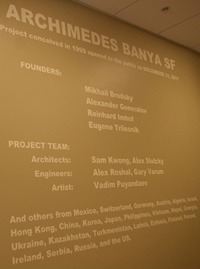
This dimension is alive and well at Archimedes Banya, a spa complex that opened in San Francisco last New Year’s Eve after twelve years of development and construction. People from twenty different countries collaborated on the project. Managing partner Mikhail Brodsky of Russia had the original idea. Reinhard Imhof of Switzerland led the indoor construction. Architect Sam Kwong of China developed the plans. Other partners are from countries including Korea, Israel, Germany, Japan, and Mexico.
The concept began when Brodsky, a mathematician, arrived in San Francisco from Moscow in 1989. A lover of Russian bath complexes or banyas, Brodsky was disappointed to find no such facilities in his adopted city. He longed to start a banya. In the summer of 1998, Brodsky, then a professor at the University of California at Berkeley, applied for a job as chair of the mathematics department at San Francisco State University. SFSU’s rejection sparked Brodsky’s interest in doing something significant in San Francisco while delivering on his banya dream.
Brodsky, Imhof and two other partners formed a company, and in 1999 bought a lot in India Basin near San Francisco’s former Hunters Point Shipyard. Though in an obscure neighborhood, the lot provided sweeping views of San Francisco Bay. To construct the building, Brodsky and his partners would need to recruit more partners. Like many ethnic groups living in the United States, many Russians do business only within their community. Therefore, logic would dictate engaging Russians to finance, design and build the project. But some Russians who Brodsky approached had difficulty seeing past the many roadblocks to the project ranging from building permits and location to construction costs and customer base. So, Brodsky decided to broaden his reach, involving people from as many countries as possible. The common thread was a passion for the Banya project plus mutual trust and common goals, two of the Ten Cultural Elements of Collaboration I identify in The Culture of Collaboration book.
In a departure from the command-and-control approach to business in which “stars” grab the credit, Archimedes Banya recognizes multiple contributions in much the same way Adobe Systems includes a credit role in its software products. When I visited Archimedes Banya recently, the first thing I noticed was a wall near the entrance listing the names of the multicultural collaborators who turned the concept into reality. Also apparent was the amazing art ranging from mosaics depicting bathing traditions to murals and inlaid ceiling tiles. Including art in public bathing facilities is a tradition dating back to the Roman Empire.
Artist Vadim Puyandaev of Kazakhstan collaborated with Brodsky to evoke the right atmosphere. “I wanted very simple, clear images of emotion,” says Brodsky. And the images also reflect action. “In a Russian banya, people move. It’s an active place. It’s not just sitting and sweating.” The complex is geared to socializing and offers facilities ranging from a rooftop sun deck with a San Francisco Bay view to private reception rooms replete with bars and kitchens.
The Banya offers a spa experience reflecting the cultural melting pot. I checked out two Russian saunas, the Finish dry sauna, the steam room, warm soaking pools, cold plunge and relaxation room. After loosening up in the various saunas, I experienced a Russian venika platza treatment that involved a tall Moldovan fellow clad in a towel and sweat-soaked Banya hat brushing and lashing bunches of Latvian birch leaves on me to increase circulation.
Following this, I laid on a table as an attendant scrubbed me with an exfoliating soap and then rinsed me with buckets of warm water. Then my muscles were relaxed enough for a massage from a masseuse from the United States. Afterwards, I headed to the café upstairs for pelmini or Russian dumplings, stuffed cabbage, hearty Russian beef soup, fresh-sqeezed juices spiked with kombucha, which is fermented tea and housemade kvass, a non-alcoholic beer made from fermented rye bread.
An ambitious spa project that began as one person’s vision ultimately reflects the combined vision and execution of multiple people from many cultures. Collaboration involves marrying talents that are worth far more collectively than individually. Brodsky describes himself as a “starter.” But to make the project a reality, he collaborated with Imhof, a “finisher.” Because of the Swiss tradition of quality workmanship, Imhof shared Brodsky’s values of using the best materials and constructing a banya for the long term. The concept of “starters” and “finishers” has broad ramifications. A starter may have an incredible idea, but creating a company that produces substantial value may require collaborating with a finisher.
As we collaborate, we can create awesome value by engaging and involving people with multiple talents and backrounds and, yes, from multiple cultures. The Dynamic Dimension of Cross-Cultural Collaboration delivers results otherwise unattainable.
Journalism, at its best, involves constant collaboration.
In television newsrooms, reporters, producers and assignment editors engage in a continuous conversation about stories and often edit scripts together in real time. While real-time group writing is a relatively new phenomenon in education and business, reporters and producers frequently write story introductions and “teases” together. This traditionally involves no electronic screen-sharing or web conferencing, but rather colleagues shouting to one another across the newsroom or two people hunched over a single terminal. In newspaper newsrooms, a similar continuous dialogue occurs among reporters and editors. Some colleagues get to know one another so well that they even finish each other’s sentences.
All of this newsroom interaction requires informality. Corporations and government agencies are increasingly embracing informality, because of a growing realization that formality compromises value creation. But informality is nothing new in newsrooms. The informality of journalism dates back at least to the early 20th Century when few reporters got “formal” higher education and the socialization that accompanies it. Newsrooms then felt more like police stations in which colleagues sat in an open room exchanging sarcastic, irreverent banter. And though most journalists (and many police) now graduate from college and the journalistic culture has evolved, newsrooms have nevertheless retained much of their informality.
Films about journalism have captured this informality. Examples include the 1931 and 1974 versions of The Front Page, written by Ben Hecht and Charles MacArthur, about newspaper reporting in Chicago. Also, the 1976 film, All the President’s Men, directed by Alan Pakula, about Washington Post reporters Bob Woodward and Carl Bernstein’s investigative reporting on the Watergate scandal, reveals the constant conversation among all the players in the Post newsroom. The conversation continues down corridors and into the elevator where executive editor Ben Bradlee (played by Jason Robards), in a dramatic moment, instructs Woodward (played by Robert Redford) and Bernstein (played by Dustin Hoffman) to “print it” meaning to run a story about Watergate.
Fast forward to 2011. Traditional journalism is under siege, in part because of the Great Recession’s ravages but mostly because of systemic shifts in the media industry. These include shrinking audiences and advertising dollars flowing to Web-based alternatives including social media. Against this backdrop comes Page One: Inside the New York Times, a documentary directed by Andrew Rossi, which attempts to capture a leading newspaper and its people at a pivotal point. (Photo of Times newsroom above courtesy of Magnolia Pictures)
The reviews have been mixed, a charitable adjective for Michael Kinsley’s take on the film that ran in—of all outlets—the New York Times itself. Kinsley takes the documentary to task for flitting “from topic to topic, character to character, explaining almost nothing.” Kinsley suggests that the movie is disjointed and confusing. The film does take up a series of topics: WikiLeaks, the Pentagon Papers, the Times survival, Comcast’s purchase of NBC Universal, Twitter’s impact, the Times’ plagiarism scandal involving former reporter Jayson Blair, Iraq, the Apple iPad, and the ups and downs of the Tribune Company, among others.
And all of this comes in the form of a continuous conversation upon which we as the audience eavesdrop. “Like a shopper at the supermarket without a shopping list, “Page One” careens around the aisles picking up this item and that one, ultimately coming home with three jars of peanut butter and no 2-percent milk,” Kinsley writes. Yes, but the collaborative process is rarely pretty.
In The Culture of Collaboration book, I identify the Ten Cultural Elements of Collaboration that are typically present when collaboration works. One of these elements is collaborative chaos, which is exactly what Page One reveals. Collaborative chaos, the unstructured exchange of ideas to create value, lets the unexpected happen and generate rich returns. In the film, we see former cocaine addict and current Times media columnist David Carr sharing ideas with his sources, his colleagues and his editor, Bruce Headlam. These exchanges culminate in value creation, Carr’s columns. And the film invites us into the Times daily story conferences during which editors jostle over which articles should appear on the front page.
Kinsley, no stranger to journalism as the former editor of the New Republic and Slate, would undoubtedly argue that while confusion may prevail in newsrooms, it’s the job of the filmmaker to present a more organized picture. But attempting to sanitize or beat the collaborative chaos out of the Times or any news operation would present a distorted view. It would be like eating street food in an upscale setting, a current trend in the restaurant business incidentally.
Journalism, and collaboration itself, involves a continuous conversation during which collaborative chaos prevails, recedes, only to prevail again all the while creating value.










 The Culture of Collaboration Blog