Culture


  • Virtual Events Becoming Economic Necessity

    Companies in many industries are slashing conference, trade show and sales meeting budgets and replacing traditional events with virtual ones. Publishing is one such industry. According to a story in last Monday’s New York Times, Macmillan will hold two out of three of its 2009 sales conferences virtually via web conferencing. This contrasts sharply with the sales and marketing meeting Macmillan held at the Hotel del Coronado in San Diego last month during which participants participated in wine tastings and got massages. 


    However, it takes more than adopting tools for virtual events to become a collaborative organization. For many companies, true collaboration requires a wholesale shift. Exigent circumstances can raise consciousness for the shift even in otherwise intransigent cultures. Exigent circumstances include industry realignments, disruptive technology, new competition, and economic downturns.

    Facing market challenges in the current recession, many companies are getting a wake up call. 


    Sparked by reduced budgets, many companies are accelerating their adoption or use of real-time collaborative tools to transform their events and meetings into virtual encounters. These tools include virtual worlds, telepresence, web conferencing and videoconferencing.


    The right tool choice depends on situations and cultures. For external events such as trade shows and job fairs, it’s necessary to create an experience that will draw people to a brand. To recreate that experience virtually, the 3D immersive quality of virtual worlds like Second Life or Qwaq makes sense. Qwaq is geared to business users and combines an immersive experience with web conferencing functionality. So users can work together while sharing applications in a virtual auditorium or conference room. CNN recently ran an interesting story on virtual trade shows. You can view the story here.


    For leadership retreats, strategy sessions and board meetings, detecting subtleties such as eye movement is critical. Therefore, telepresence fits the bill, because of its quality visual experience and the feeling that participants are sharing the same space.  To replace a data-driven sales meeting, web conferencing makes sense because the focus is on the slides or spreadsheet more than people. For a cross-functional meeting that includes, say, sales and marketing people, relationship time is necessary before plunging into data. In that case, telepresence or videoconferencing is appropriate.


    For Macmillan and other organizations, creating value through collaboration requires more than holding two out of three sales conferences virtually. So, perhaps Macmillan is considering adopting collaboration more broadly. It’s time to move beyond sporadic, scheduled use of collaborative tools. Value-driven organizations are integrating collaborative practices and tools into work styles and collaborative culture into organizational DNA.


    In this downturn, the smart money is rethinking how we do business, reconsidering command-and-control approaches, and moving collaboration to the front burner. This will help organizations survive short term and thrive long term.



  • CNBC Featuring The Culture of Collaboration

    CNBC’s 5-part series on collaboration premieres this Sunday, October 12 at 8 p.m. Eastern time (5 p.m. Pacific time) and will re-air at 1 a.m. Eastern time (10 p.m. Pacific time). The series called “Collaboration Now,” sponsored by BT (British Telecom), will also air on CNBC Europe, CNBC Asia Pacific, and other affiliates. You can view the global air schedule here. I’m one of the guests in the first episode dubbed “Collaborating to Compete.” You can read about the episode here


    My participation is in episode one’s block or section about trust, one of the Ten Cultural Elements of Collaboration that I describe in The Culture of Collaboration book. During the trust block, CNBC airs a taped story on the Boeing 787 Dreamliner, which involves an incredible amount of collaboration and trust among Boeing and its global design partners. I put the 787 in perspective by explaining the significant shift in process between the 777 and the 787. The discussion touches on some other key aspects of trust and collaboration.


    You can watch this discussion after the first commercial.  It immediately follows the satellite interview with former Canadian Prime Minister Brian Mulroney. I’m on set with host Donnie Deutsch; Chrystia Freeland, U.S. managing editor of the Financial Times; Richard Tait, former CEO of Cranium and Miles Everson, partner with Pricewaterhouse Coopers. The series features several highly-collaborative organizations featured in my book including Boeing, the Dow Chemical Company, and Mayo Clinic.

    Check out the show on Sunday or the archived video which will be posted here.


  • Community Collaboration and Recycling San Francisco Style

    San Franciscans toss away at least five bicycles a day. When the mountain bike craze ebbed, that number was higher—at times, twenty bikes a day. And SF Recycling & Disposal, Inc. (aka The Dump) also gets ten to twenty pieces of exercise equipment daily—everything from elliptical machines to NordicTrack skiers. Each day the dump also receives about twenty plants, some of which volunteers transfer into the dump’s garden. 


    I learned many of these statistics Saturday morning from Deborah Munk, who coordinates art and education programs for the dump. Deborah was conducting a public tour, which included a heavy dose of recycling and trash facts. I learned that China is paying top dollar for recycled paper. Every day, the San Francisco dump ships hundreds of bales of paper to China, which helps fuel the country’s growth.


    Bicycle Art This particular public tour was crowded with artists vying for the dump’s Artist-in-Residence program, which gives artists a stipend, a studio, a show, and access to San Francisco’s waste stream so that  they can get first dibs on materials for sculptures, paintings, videos, and other media. Paul Cesewski, former artist-in-residence, turns recycled bicycles among other items into kinetic art. Nancy Calef, who was taking Saturday’s tour before applying for the program, uses recycled objects ranging from eyeglasses to emery boards in her 3D “Peoplescapes.” Peoplescapes are sculpted characters and applied objects on canvas which juxtapose people in recognizable places and situations weaving together a story about contemporary life.  Calef also recycles canvases for a technique called “plane slashing,” which combines two or more paintings into one.


    The artists collaborate with the recycling sorters, who look out for requested materials. One artist recently asked for some pens, and a few hours later he received hundreds of them. Those pens are now a sculpture. The artists help promote recycling, and they’re one aspect of how people throughout the dump’s ecosystem work together to create value.


    San Francisco’s recycling program is a study in collaboration. Seventy percent of the two thousand tons of waste a day that flows into the dump is recycled. Clearly, San Franciscans take the time to sort their refuse into bins color-coded for trash, compost and recyclables. And once the waste arrives, union sorters identify items that can be sold as commodities, reusable stuff and electronic waste. The dump makes some stuff, such as recycled latex paint, available for free. Also, more than eighty thousand homes and two thousand restaurants compost their food scraps. San Franciscans get some of their compost back as free soil a couple of times a year, and wineries nourish their vines with soil made from SF compost.


    Some dump team members are pressing to take collaboration to the next level. “We’re just scratching the surface,” insists Bob Besso, recycling manager for Norcal Waste Systems, Inc., which runs the dump. Currently, San Franciscans pay $107 a ton to dump waste. SF Recycling & Disposal, Inc. sells much of the recycled waste as commodities. All that exercise equipment becomes scrap metal. Besso believes the dump should designate drop-off areas where specialists could evaluate specific categories of items such as exercise equipment and bicycles, furniture and textiles, clothing and other items. Rather than charge for accepting these reusable items, the dump could take them for free and sell them at a higher price than that of a commodity. Garbage Reincarnation, Inc, a non-profit in Santa Rosa, California has achieved success of this sort. Besso believes the San Francisco dump could become a model for large-scale reincarnation of waste.


    SFRecycling & Disposal, Inc. comprises an ecosystem of collaborators who are striving to create greater value through innovation, education, and brainstorming. The SF Dump’s approach reminds us that rather than letting new ideas die on the vine, our challenge is to improve ideas through collective input so that we achieve awesome results.


  • Virtual Worlds and Cisco’s Evolving Culture

    As organizations adopt virtual worlds, there is growing confusion about when telepresence or videoconferencing may fit the bill and when virtual worlds make more sense.


    Virtual worlds such as Second Life and Qwaq Forums enable geographically-dispersed colleagues to collaborate in a shared, immersive 3D environment. Qwaq is particularly suited for business. For more on Qwaq, see my September 21, 2007 post. Typically, avatars represent each collaborator and there’s audio without interactive video.


    At the American Society of Training and Development International Conference last month in San Diego, corporate managers packed a session on using virtual worlds in the enterprise. The buzz was that virtual worlds make more sense than videoconferencing in part because people are getting more accustomed to a gaming-type experience. That supposition is debatable, because tools must fit the situation and the culture. For a performance evaluation, virtual worlds would be a poor choice of tool. Telepresence would work, if a team member is a continent away and a face-to-face meeting is impossible.


    On Friday, I had a broad discussion with Chris Thompson, senior director of marketing for Cisco’s unified communications group.  Chris, a Canadian, joined Cisco 18 months ago after serving as vice president of marketing for Netopia, which became the broadband home unit of Motorola. Our discussion ranged from virtual worlds to collaborative culture, and the conversation flowed easily and informally perhaps because Chris was relaxed and enjoying the informality of his cottage on the lake outside Toronto.


    “If it’s a casual relationship, video is less important,” Chris noted. Such a relationship might include tech support sessions, customer service calls, and some sales calls. In such cases, virtual worlds may offer better opportunities for branding than videoconferencing. Several years ago, there were many predictions that we would soon be using interactive video for customer service calls. This has yet to materialize in any meaningful way. However, if vendors begin thinking differently about telesales and customer service and start considering these transient relationships as opportunities to build relationships over time, interactive video may be useful.


    Regarding culture…like many people who work for companies that are adopting collaborative cultures, Chris has had to adjust. He previously embraced the command-and-control approach. However, Cisco has moved away from a competitive, authoritarian culture and has adopted a more collaborative culture in which team members from many functions and regions participate in making decisions.


    My sense is that Cisco has made this shift for at least two reasons:


    1) Collaboration creates greater value


    2) Cisco sells a range of collaborative tools including unified communications and telepresence.


    These tools, as I’ve written about extensively, take hold far more effectively in collaborative cultures. So, Cisco clearly wants to set an example.


    Chris and I also talked about the merging of real-time and asynchronous tools. Cisco is now launching WebEx Connect, which provides a collaborative space through which colleagues can connect in real time through web conferencing plus collaborate after the real-time session ends. Colleagues who may have missed a web conference can search the audio and listen to key parts of a web conference after the fact. Users can also post comments about web conferences.


  • Malcolm Gladwell: Measurement Methods Killing Creativity and Innovation

    Malcolm Gladwell is about to turn talent recruitment and development upside down. Malcolm GladwellLast Monday at the American Society for Training and Development 2008 International Conference and Exposition in San Diego, I talked with Malcolm about his forthcoming book.


    Outliers: Why Some People Succeed and Some Don’t tackles everything from college and graduate school admissions to organizational performance evaluations. An outlier is a statistical term meaning a significant deviation from the mean. The book, which will be published in November, is based largely on the work of David Galenson, an economist at the University of Chicago. For more on Galenson’s work, read the story entitled “What Kind of Genius Are You?” that Daniel H. Pink wrote for the July, 2006 issue of Wired.


    Gladwell’s point is that there’s a disconnect between methodology for evaluating people and individual talents. He’s wary of efforts to predict performance and suspicious of set timeframes to perform. “We’ve become obsessed with this notion that everything can be measured with numbers,” Malcolm insists. “It’s a cultural fixation.” While law schools are obsessed with LSAT scores, Gladwell notes, studies show that people who are admitted with lower scores show no difference 20 years out than those with high scores.


    Gladwell uses the artists Pablo Picasso and Paul Cezanne to illustrate two key types of people. Picassos succeed quickly and often peak early, while Cezannes are typically late bloomers who rely on technique and process and make incremental advances to build a body of work over time. “A late bloomer gives us something you can’t get from a precocious artist. The work is much more powerful and has deeper depth,” says Gladwell. The HBO series, The Sopranos, took three seasons to catch on, Gladwell notes, but ultimately the show developed a deeper level of emotional connection with the audience. This is because HBO is willing to carry a portfolio of under performers; the network realizes the potential for a long-term winner among them.


    At the ASTD conference, I engaged Malcolm about organizational culture, and he agreed that culture plays a huge role in how people are recruited and evaluated. Organizations are clearly comprised of both Picassos and Cezannes, but there is also a collective approach that favors one style over the other. Particularly relevant to collaboration is Malcolm’s use of the U.S. vs. the Japanese auto industry to illustrate his point.  I have written extensively about how collaboration has created substantial value for Toyota and how people throughout the organization provide input into decisions, which are made slowly and carefully. Toyota focuses on incremental improvements over time and building long-term value, a Cezanne approach. Malcolm notes that Detroit-based automakers traditionally rely on big, bold ideas like the SUV and muscle cars. This is more Picasso-like.


    The problem is that measurement and evaluation usually favors Picassos over Cezannes. Organizations value the sprinters over the distance runners and too often sideline people who develop deeper depth over time. Innovation and productivity suffer, because key resources are wasted. This will evolve as organizations become more collaborative, harness talent in all its forms and realize the limitations of a single performance template. Enron selected top performers and pitted them off against each other through “rank and yank.” This created a culture of fear rather than one of collaboration. The company had little tolerance for Cezannes. Look where Enron is now—bankrupt.


    Incidentally, Malcolm’s Wikipedia entry notes that he was an outstanding middle distance runner in high school…


  • Collaborative Music and Video Production Changing Entertainment Business

    Budding musicians, filmmakers and other artists are creating value through collaborative production. Online creative collaboration now goes well beyond finding and meeting like-minded artists. Now people are producing artistic works collaboratively without sharing physical space. This is having an increasing impact on creativity, the product and the business of art.

    Not long ago, gatekeepers controlled the relationship between artists and audiences. NPR’s “All Things Considered” broadcast a compelling story last Saturday about Robert Goldstein, an NPR staff librarian. You can listen to the story here. In the late 1970’s, Goldstein was a guitarist for the Urban Verbs, a Washington, D.C. band. The Urban Verbs almost made it…

     Band members had a connection with the Talking Heads and producer, Brian Eno. Eno was reportedly “blown away” by the Urban Verbs and offered to produce some tracks. Record labels were initially enthusiastic, and Warner Brothers signed the band. However, Warner Brothers reportedly dumped the Urban Verbs after Rolling Stone “slaughtered” the band with a bad review.

    While gatekeepers including big media, distributors, producers and others still have an impact, the balance is clearly shifting in favor of unknown artists. Aside from social media sites like Facebook and MySpace, which connect artists with fans and other artists, collaborative production sites take creative collaboration to the next level. These include TheNetStudio for music and Rootclip for film and video. The difference between these and social networking sites is analogous to the difference between using enterprise collaboration tools to design and produce products and services and using such tools for meetings. Collaborative production clearly creates greater value than just connecting.

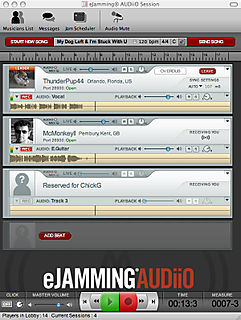
    TheNetStudio is a virtual recording studio through which artists can submit songs for collaboration. Somebody on an island in the South Pacific who has composed a great song can collaboratively create a finished product with musicians in Paris, New York or Los Angeles without ever sharing the same physical space. TheNetStudio, which uses a subscription model, currently enables asynchronous collaboration but will ultimately provide real-time music production as technology evolves to support ultra high quality EJamming synchronous sound over the Internet. Currently, sites including Ninjam, eJamming and Musigy offer real-time, online musical collaboration.

    In the film and video realm, Rootclip provides an initial “root” clip, one-to-two minutes of video that begins a story. Collaborators determine the path the visual story takes by submitting one-minute videos to move the story from one chapter to the next. The Rootclip community votes on which videos should be used for the next chapter. The creator of each winning video chapter receives $500 and acknowledgment in the credits. The winner of the final chapter round gets a trip to the Traverse City Film Festival in Michigan and a meeting with filmmaker, Michael Moore. Rootclip’s business model is advertising, and ironically big media (the E.W. Scripps Company) is supporting the startup through its venture capital arm.

    The big-picture impact of collaborative production is how the medium is changing the product. This phenomenon goes well beyond reproducing or approximating musical or video collaboration in which collaborators share the same physical space. As efforts like TheNetStudio and Rootclip proliferate, artistic endeavors will reflect the input of people from multiple cultures and regions. Finished works will increasingly reflect a broader and perhaps different perspective.

    Oh…as for the Urban Verbs, the band recently reunited for a show at the 9:30 Club in D.C.


  • Is Ford’s New Marketing Head a Star? Plus Keith Richards Provides Collaboration Insight

    James Farley is no star, but The New York Times would have us think otherwise. Farley is Ford Motor Company’s new group vice president of marketing and communications. He took the job after spending seventeen years at Toyota, most recently as group vice president and general manager of Lexus.

    Jim_farley_ford_2

    The Times ran as its business section lead last Sunday a story about Farley headlined “A Star at Toyota, A Believer at Ford.” There is little in the story that would suggest Farley is a star, but the Times nevertheless packaged the story in a way that perpetuates the Myth of the Single Cowboy. This is the notion that one self-sufficient, rugged individual can achieve smashing success without help from anybody. We turn athletes, chefs, surgeons, politicians, entrepreneurs and corporate leaders into stars. The media drives this myth into our living rooms, our organizations and into our consciousness.

    In the same edition as the Farley story, the Times travel section’s first page promoted a story on French chefs on page 7 as “The New Culinary Stars of Bordeaux.” What about the line cooks, the prep people, the servers and the expeditors? It takes more than a single, star chef to prepare a meal in an upscale restaurant. But the Times and many other media outlets would prefer that we believe one person makes it all happen.

    Toyota emphasizes collaboration over star culture. Farley clearly chalked up significant achievements at Toyota, because he collaborated across levels, functions and business units. Rather than practicing shoot-from-the-hip management, Toyota leaders practice nemawashi, which means literally “to prepare a tree’s roots for the soil.” Nemawashi is essentially about getting broad input into decisions and making decisions slowly by consensus. As a star, Farley could never have achieved much at Toyota. As a collaborator, Farley and his colleagues created considerable value.

    Over the weekend, I saw the awesome IMAX version of the new Rolling Stones movie, Shine a Light, directed by Martin Scorsese. In the film, Keith Richards discusses his guitar prowess as compared with that of Ron Wood, who shares with Richards the title co-lead guitarist of the Stones. “We’re both pretty lousy, but together we’re better than ten others,” Richards says. This sums up the value of collaboration over star culture.


  • Real-Time Collaboration Transforming Social Networking

    Many organizations think they’re collaborating by making internal social networking available. However, many minimally-collaborative people have personal sites. Enabling social networking with real-time functionality creates new possibilities for organizational collaboration.

    I gave a speech several months ago to U.S. government officials who are focused on getting agencies to collaborate. The agencies were using wikis and a sort of internal MySpace, and the culture was in the early stages of becoming collaborative. A central theme of my talk was how real-time collaboration is changing business models and how we work.

    Presence, I explained to the government audience, would soon transform social networking by letting us know who’s online and available for spontaneous interaction. For more on presence, see my March 7, 2007 post. With a single click from somebody’s MySpace page or the internal equivalent, a colleague could launch an instant messaging session. The collaborators could then escalate the chat into a web conference or videoconference.

    So…I was delighted to read a story in today’s New York Times headlined “Online Chat, As Inspired By Real Chat” in which Brad Stone nails the shortcomings of typical social networking. “It’s like an endless party where everybody shows up at a different time and slaps a yellow Post-it note on the refrigerator,” Stone writes. The story describes how several Silicon Valley companies are bringing “live socializing” to social networking. One company, Vivaty, lets users add 3-D virtual chat rooms to Web pages and social networking sites. Vivaty Scenes offers an immersive experience in which users choose avatars to represent them.  Another company featured in the Times story is Meebo, which lets users add instant messaging to blogs, Web sites and social networking pages.

    Real-time and asynchronous collaboration are no longer divorced modeds. This means that real-time collaboration will occur more easily, more often and more spontaneously. This impacts our collective culture in that we’ll be interacting more in real time through social networking sites like Facebook and MySpace. Within the enterprise, we can read somebody’s personal page or a team site and from there connect with people on the fly to resolve issues or make a decision. Nevertheless, improved tools are merely enablers. It takes a collaborative culture to create value through collaboration.


  • Is Coworking Collaborative?

    Researchers are studying it. The traditional media is reporting it. And bloggers, obviously, are writing about coworking. It’s the latest work style trend to emerge. Coworking typically involves renting a desk or paying for the right to plop down at a shared table in a communal workspace. It’s a growing option for home-based or freelance professionals seeking to curb isolation and build camaraderie.

    In a story in yesterday’s New York Times, Dan Fost describes the coworking movement. In Tuesday’s San Francisco Chronicle, Ilana DeBare reported on “Shared Work Spaces a Wave of the Future.” Clearly, there’s something happening here.

    Coworking Most coworking facilities look and feel much different from temporary or drop-in corporate office space (the image on the left is a coworking space called the Hat Factory in San Francisco). In fact, some coworking facilities remind me of my college radio station. The studios and communal areas of WCBN-FM in Ann Arbor, Michigan were usually messy, often chaotic, and almost always a creative outlet.

    Coworking is most effective for professionals who talk sparingly on phones, since people are expected to step outside the coworking space for phone calls. Imagine five people around a table on their phones simultaneously!

    So, is coworking collaborative? That depends. Undoubtedly, including people engaged in different enterprises under the same roof sparks synergies. And without offices or cubicles, interaction can happen on the fly. An entrepreneur working across from a web designer need only call across the table to get design input. A technical writer can engage a software developer with a tap on the shoulder. Relationships form, and trust may develop.

    Collaboration, however, requires many cultural elements including shared goals. In collaborative organizations, people come together across disciplines, departments, roles and regions to create value. The shared goal may involve slashing product development time or closing sales more effectively or curing a disease. Coworking invites input from others, but usually without shared goals. One person has a stake in the input, while the other provides advice as a friendly gesture or deposit in the favor bank. Coworking may lead to collaboration, but collaboration is by no means automatic. Of course, coworkers may discover they share some goals and then join forces to start a business or curb climate change or elect a candidate.

    The main connection between coworking and collaboration involves people from different disciplines interacting in an informal physical environment. This, in turn, encourages informal interaction which reinforces, but does not create, The Culture of Collaboration.


  • Kaltura and Wikimedia Enable Collaborative Video Creation

    Video is by no means a requirement for collaboration, but its role is expanding.

    When I reported for television stations early in my career, getting a story on the air was—at its best—a truly collaborative effort. Photographers, producers, assignment editors and reporters worked in concert to produce compelling stories. In the editing room, a photographer and I would sit elbow-to-elbow choosing shots, integrating natural sound, and basically creating a visual story.

    Now we’re in a global virtual editing room in which people can edit and produce videos collaboratively regardless of geography. Screenshot_videoeditor Kaltura is open sourcing its collaborative video making software and is partnering with the Wikimedia Foundation. The idea is to bring rich media collaboration to Wikipedia and other wiki web sites. You can check out the beta here. The move combines and extends two collaborative trends: sharing user-generated video and wiki-based collaborative text writing and editing.

    Think of the possibilities. People across the world can capture historic moments and shape history collaboratively through video. People can collaboratively create travel videos as an alterative to the tourism board videos. And in education, the opportunities are limitless. Students can co-create animated content and videos about everything from political science to parapsychology or from anatomy to anthropology.

    In the business realm, companies can generate brand excitement and customer interaction and input by inviting people to co-create videos on motorcycles, hot tubs, books, clothing, skiing…you name it. Within the enterprise, organizations can enhance wikis with rich media. Doing research on a previous product launch? View the collaborative video that your colleagues produced. Taking a business trip to the Mumbai office? View collaborative video on the facility, the local leadership and local events.

    As collaborative and compelling as video wikis (should we call them vikis?) are, how about taking them a step further? The next step would be the ability to collaborate in a real-time mode in which we can interact over voice or video over IP while simultaneously editing and producing videos? Leading digital effects companies in the film industry are already creating value through collaborative, real-time video production using telepresence and videoconferencing. But there are broader possibilities for real-time, consumer-generated video content. After a candidate holds a rally, political junkies who shot video could connect through instant messaging, escalate to VOIP interaction and produce a video on the fly. In the enterprise, people throughout an organization along with business partners could capture a product roll-out globally and produce and publish a video in real-time.

    Integrating Kaltura’s technology with wikis will immediately create broad-scale asynchronous collaborative video editing and production. And the move is a significant step towards real-time collaborative video creation. The possibilities are limitless in that anybody with Web access can participate.