Economy


  • New Expanded and Updated Edition of The Culture of Collaboration® Book

    How has collaboration evolved? What is the current state of collaboration at Toyota, Mayo Clinic, Industrial Light & Magic, Boeing and other companies profiled in the first edition of The Culture of Collaboration® book? What are the keys to long-term value creation through collaboration?

    These are questions I sought to answer as I went back inside collaborative companies to research and write the new, expanded and updated edition of The Culture of Collaboration® book.
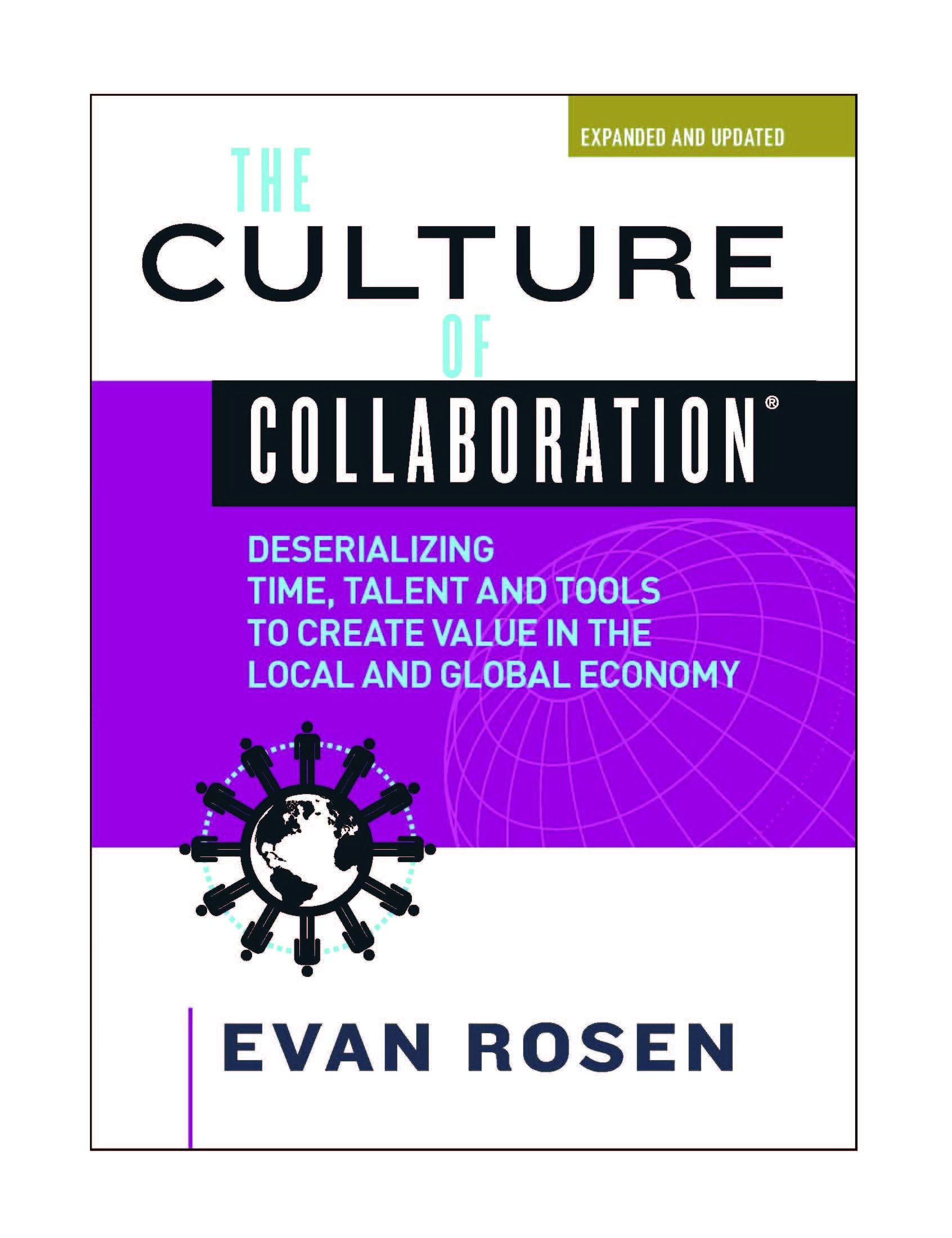
    Jacket with border CofC EU


    The expanded and updated edition has just been released, and I’m proud of the finished work. The 363-page business book includes 54 images and illustrations and a beefy index. By the way, 54 images and illustrations is no easy feat in 2024. Ever wonder why most business books lack pictures? It’s time-consuming to license even a single image from a large organization.

    One thing I’ve learned is that deserialization and collaboration go together like peanut butter and jelly. Deserialization means removing sequences from the lifecycle of products and services. The idea is to collapse outmoded sequential approaches and replace them with spontaneous, real-time processes.

    Deserialization also involves removing sequences from interaction. This means killing what’s left of the in-box culture. In short, deserialization is the key to long-term value creation through collaboration. That’s why the subtitle of the expanded and updated edition of The Culture of Collaboration® is: Deserializing Time, Talent and Tools to create Value in the Local and Global Economy.

    I’ve also learned that despite best efforts, collaboration can stall within highly-collaborative organizations. Paradoxically, collaboration happens in companies in which the dominant culture is command and control. Likewise, internal competition and command and control exist in mostly-collaborative organizations. Many factors, as I explain in the expanded and updated edition, influence both the evolution and regression of The Culture of Collaboration.

    More broadly… as I write in the preface, in some ways we’re less collaborative than we were in the early 2000s. Social media lets us broadcast opinions without refining ideas through real-time interaction. We join groups that make rules for how we should think. Videoconferencing enables interaction at a distance, but too often we’re wasting time in scheduled virtual meetings rather than creating value together spontaneously. While in the same room, we meet rather than collaborate. We leave meetings to work and then schedule follow-up meetings to review work. This serial process zaps value.

    My objective in revisiting this topic is to consider whether we have evolved or veered off track and to provide a new framework for unblocking collaboration and unlocking value.

    Let me know your thoughts about the new, expanded and updated edition of The Culture of Collaboration® book.



  • Common Sense Trumps Data

    I was in northwest Ohio this summer where Trump yard signs were everywhere and Clinton signs were practically nowhere.

    What changed? The increasing role of data.

    Most Clinton staffers apparently believed that targeted election canvassing and social media produce greater results than yard signs, campaign buttons and bumper stickers. And the data suggests that physical signs have only a slight impact on campaigns.

    Hillary Clinton online ad

    The Hillary Clinton campaign favored online ads like this one over yard signs.

    The lack of Ohio yard signs was a shock in that I covered presidential campaigns in Ohio during my early career as a reporter for WTOL-TV, the CBS affiliate in Toledo. Yard signs always dominated the landscape during election season. For voters looking around for clues of which way the wind is blowing among friends and neighbors, yard signs matter.

    Yard signs illustrate how data and common sense can diverge. Common sense suggests that campaign signs, particularly those on residential lawns, have a significant impact. Many people vote for the candidate their friends and neighbors support. And regardless of ads and chatter on social media, there’s nothing quite like the real-world visual reinforcement of a candidate’s signs dominating one’s street or neighborhood.

    And Ohio is by no means the only state that lacked Clinton yard signs.  Published reports indicate that Trump signs dominated rural Pennsylvania. Last January, Wired profiled Edward Kimmel, a part-time campaign photographer and Clinton supporter, who noticed the visual shift from previous presidential campaigns in Iowa. Kimmel voiced concerns about the impact a lack of signs might have on voter turnout. Kimmel was prescient.

    A tyranny of data short circuited the Hillary Clinton campaign and contributed to Donald Trump’s victory. From the bubble of its Brooklyn Heights headquarters, the Hillary Clinton campaign apparently viewed yard signs as obsolete in the age of targeted digital canvassing and social media.

    The Clinton campaign is just one example of how relying exclusively on data can compromise value. Wells Fargo emphasized measurement over common sense, and its reward system encouraged team members to cut corners and open unauthorized accounts for customers as I detailed in my September 13, 2016 post. The company is now paying the price in fines, lost business and compromised reputation.

    Donald Trump yard sign

    A Donald Trump for President campaign yard sign in West Des Moines, Iowa. Photo by Tony Webster. Licensed under CC BY 2.0

    Measurement mania and the tyranny of data are nothing new. In my most recent book The Bounty Effect: 7 Steps to The Culture of Collaboration , I write about the myopic approach dubbed “management by measurement” which dates back to the so-called Whiz Kids. In the 1940s, the Whiz Kids were junior faculty from Harvard Business School recruited by Charles “Tex” Thornton to run the Statistical Control unit of the Unites States Army. The group included Robert McNamara, who would later become president of Ford Motor Company, secretary of defense and president of the World Bank.

    The Whiz Kids applied statistical rigor in running the army, and later Henry Ford II hired the team to bring a similar data-driven focus to Ford. The Whiz Kids also introduced bureaucracy and hierarchy and developed rules requiring that, among other things, memos from vice presidents must appear on blue paper to highlight their importance.

    The Whiz Kids sacrificed long-term value for short-term targets by limiting investment in new equipment and R&D. Plus Ford’s products suffered when plant leaders failed to prove through numbers the necessity for new equipment. Ultimately, this myopic focus on data led to foreign competition from companies that focused as much on engineering and production as on finance.

    The Clinton campaign is by no means the only organization blinded by data. Organizations in every sector and industry suffer from measurement mania that impedes collaboration and value creation. In The Bounty Effect, I detail Five Measurement Counter-Measures to prevent data from short circuiting collaboration and compromising value. One of them is “perform a common sense reality check.”

    Had the Clinton campaign used common sense to check its data, yard signs might have sprouted in the industrial Midwest and, more broadly, the campaign might have adopted a message that would have resonated with swing-state voters.

    Regardless of level, role, region, organization or sector…never rely on data without a common sense reality check.


  • Clinton Foundation Collaborates to Improve Health

    Collaborating across sectors—government, private industry, non-governmental organizations (NGOs) and education—can solve some of the world’s greatest challenges. These challenges include global health, economic inequality, childhood obesity, climate change, and health and wellness—which, incidentally, are the five main areas in which the William J. Clinton Foundation works.


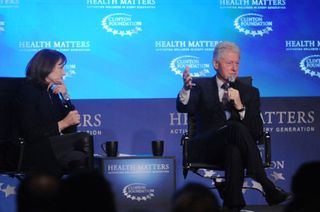
    Health and wellness was front and center last Tuesday as President Bill Clinton and his daughter, Chelsea, assembled a few hundred people in the California desert for the Clinton Foundation’s Health Matters conference. Despite the focus, themes are interrelated. So global health, economic inequality, and childhood obesity crept into the discussion. In his opening remarks, President Clinton noted that the rising cost of health insurance premiums often prevents employers from increasing wages. “We cannot ignore the link between health and the economy,” said President Clinton.

    Clinton Health Matters


    Invited guests and speakers at the La Quinta Resort in La Quinta, California included hospital and insurance executives, health policy experts, and veterans of government service including Dr. David Satcher, Surgeon General of the United States during the Clinton Administration. Others including Dr. Deepak Chopra, Dr. Dean Ornish, and actress Barbra Streisand are partnering with the Clinton Foundation to advance health and wellness agendas. Long-standing relationships among some participants coupled with the relaxed resort atmosphere sparked an exchange of actionable ideas. President Clinton and Chelsea seemed as comfortable sitting in the audience asking questions and refining ideas as they were on stage.

    “We’re moving into an era where the only way you can create enough jobs for people and generate enough wealth to have decently-rising wages is if you have creative networks of cooperation. I think the same thing is true of this health challenge,” President Clinton insisted during a discussion with NBC News Chief Medical Correspondent Nancy Snyderman, a friend of the former president for thirty years. “It’s the only thing that works. It works everywhere in the world.” This is another way of saying that collaboration creates value.

    I practically muttered “Amen” aloud when President Clinton cited a study that found that if you put a group of people with average IQs together and ask them to work on a problem for a year and you give the same problem to a genius, over the long run the group of people with average intelligence working together will do better than one genius acting alone.

    One of the most impactful ways that collaboration can improve healthcare is to remove the barriers that exist between front-line doctors and other health professionals. Too often primary care doctors practice in silos. Dr. Mark Weissman rose from the audience to insist that he and other primary care doctors are awash in patient data but lack regular access to other medical professionals who can collaborate with them on the data and on patient care. Pediatrician Donald Berwick, former administrator of the Centers for Medicare and Medicaid Services and a possible candidate for governor of Massachusetts, responded to Weissman that it’s necessary for doctors to learn that “I’m no longer the hero who saves the day, but I’m interdependent with others to give care. That’s what works.”

    I’ve written often in this space and in The Culture of Collaboration book about how engaged team members working in a collaborative culture create far more value than do team members working in a culture of fear and internal competition.  Dr. Deepak Chopra noted that employee disengagement costs the United States economy $300 billion a year. “If your supervisor ignores you, you start to get disengaged and within a few months you start to get ill,” Chopra explained. “If your supervisor doesn’t ignore you but criticizes you, you actually get better.” This is because we would rather be acknowledged than ignored even if we’re receiving criticism. “And if your supervisor notices a single strength that you have, your rate of disengagement goes down to 1 percent,” according to Chopra.

    The Health Matters conference is as much about taking action as about exchanging ideas. Corporations, government entities, non-profit organizations, and individuals pledged to take action in preventing disease and improving health. Financial pledges total over $100 million. One such pledge by entrepreneur and philanthropist Vinod Gupta will support a new Clinton Foundation program to address prescription drug abuse. Gupta’s son, Benjamin, died accidentally after taking prescription painkillers and consuming alcohol in December of 2011. Gupta and the Clinton Foundation will educate the public, particularly college students, about the dangers of prescription painkillers.

    As I was checking out of the La Quinta Resort, I noticed that Surgeon General Satcher was next to me in line. We chatted about his recent work guiding the Satcher Health Leadership Institute at the Morehouse School of Medicine in Atlanta. Dr. Satcher noted that at Morehouse he’s building on his work as surgeon general by collaboratively focusing on neglected diseases and underserved populations. Like so many other disciplines, improving health and wellness requires collaboration.


  • Cross-Sector Collaboration for Sustainable Development

    Accomplishing massive goals requires massive collaboration—far beyond collaborating within an organization or within an industry or among government agencies.

    Making meaningful progress on issues including eradicating global poverty and protecting the global ecosystem requires collaboration among governments, non-governmental organizations (NGO’s), private industry, farmers, indigenous peoples and unaffiliated individuals with ideas. This cross-sector collaboration is driving the agenda for the United Nations Conference on Sustainable Development which happens this June 20-22 in Rio de Janeiro, Brazil. The conference, dubbed Rio+20, marks the twentieth anniversary of the United Nations Conference on Environment and Development. The 1992 conference established the Rio Declaration, which includes 27 principles mostly addressing sustainable economic development.

    Last Friday, at the invitation of the United States Department of State, I attended a planning meeting for Rio+20 at the Center for Social Innovation at the Stanford Graduate School of Business. The purpose was to distill ideas from cross-sector collaborators on how to bridge connection technologies with sustainable development. In a brainstorming session on “sustainable economic growth,” we tackled wasted talent and connectivity.  Think of the many people in developing countries with talent and ideas who have no outlet to connect and collaborate. This is our collective loss as global citizens until we tap that talent.

    The world’s wasting of talent in developing countries is analogous to the command-and-control organization that pays “knowledge workers” to think and pays everybody else to carry out orders. See my January 11, 2011 column for BusinessWeek.com on this topic. Such an organization squanders talent. This is because people throughout the organization—from the loading dock to the call center—have knowledge to contribute.

    One participant noted that wasted connectivity involves using the Internet frivolously, perhaps for pirating movies and other content, rather than for working together to eradicate poverty, create new markets and protect the environment. Similarly, wasted connectivity within organizations involves using networks and tools for chatter rather than for developing and producing products and services.

    Since the 1992 Rio Declaration, the Internet has grown from less than 16 million users to over 2 billion users, according to internetworldstats.com. Mobile phone users have grown from less than 23 million in 1992 to more than 6 billion in 2011, according to nationmaster.com. The current level of connectivity creates an opportunity for a more distributed, peer-to-peer (read inclusive) approach in collaborating for sustainable development. 

    Old models of cross-sector collaboration were minimally effective, because they involved “decision makers” or “thought leaders” shaping ideas and developing solutions which they would hand down to people impacted by the decisions. Now people in developing countries without affiliations can shape ideas with ministers and private sector leaders globally. Well, at least this is technically possible.

    As important to cross-sector collaboration as global connectivity and enabling technologies is a cultural shift in which governments, NGO’s and private industry embrace input from people regardless of affiliation or location. This is analogous to organizations adopting more collaborative cultures and tools so that people far from the home office or from executive corridors can participate in making decisions. The State Department has chalked up success with an emerging collaborative culture and tools including Secretary Clinton’s Sounding Board. For more on this, see my September 14, 2010 post.

    One of the people hashing out ideas in the sustainable development brainstorming session was Rio+20 Secretary General Sha Zukang, who is also the UN Under Secretary General for Economic and Social Affairs. Zukang, who demonstrated particular talent at defining and outlining sustainable development issues, brushed against a live wire as the workshop concluded: intellectual property. The brainstorm was exactly three weeks after the collapse of U.S. House of Representatives support for the Stop Online Privacy Act and Senate support for the PROTECT IP Act backed by media and entertainment companies and opposed by Google and Wikipedia among other online interests.

    Zukang described the need to “find a balance” between protecting intellectual property and disseminating information. This balance impacts cross-sector collaboration in that people in developing countries often lack access to the same information accessible to their collaborators in developed countries. Providing affordable access will help level the playing field. Contrary to some viewpoints, collaboration—cross-sector or otherwise—by no means requires eliminating or dismantling intellectual property protection. IP protection creates incentives for people and organizations to collaboratively develop and produce products and services.

    Cross-sector collaboration takes collaboration beyond organizational and sector boundaries to create value on a global scale.


  • Non-Profit Collaboration Creating Value

    The cost of internal competition plagues almost every company. But the private sector is by no means the only sector that competes. With limited funding, particularly during the Great Recession and the fledgling Great Recovery, non-profit organizations have increasingly competed for shrinking grant dollars. And while the for-profit sector may regard the non-profit sector as populated by less-competitive do-gooders, competition in the non-profit arena can rival that of private industry.

    For private-sector companies, competing in the marketplace furthers objectives, namely to increase revenue and market share.  In contrast, non-profit organizations compromise their objectives when they compete with other non-profits that share their mission.  The cynical among us might believe that the first goal of some non-profits is preserving themselves to employ administrators and staff and that their service mission is secondary. Let’s assume, though, that the primary goal of most non-profits is to further their mission. In that case, collaboration among non-profits creates far greater value.

    Some foundations have developed programs to encourage non-profit organizations to collaborate. The Myelin Repair Foundation, which is working to cure multiple sclerosis, has recruited five principal investigators from different universities. With input from the researchers, MRF developed a Collaborative Research Process, which addresses everything from tools to incentives. You can read more about MRF in my July 16, 2009 post. The Bill and Melinda Gates Foundation has funded a collaborative research consortia comprising 165 investigators globally to accelerate HIV Vaccine Development. For both MRF and the Gates Foundation, collaboration is reducing time-to-a-cure.

    Foundations are by no means the only funders favoring and, in some cases, insisting on collaboration among non-profits that they support. In some cases, funders use a heavy hand in forcing organizations to share resources or join forces. But ordering people to collaborate misses the point. The most successful non-profit collaborations are those in which non-profits and their funders collaborate to achieve common goals.

    This is exactly what’s happening with San Francisco’s Tenderloin Technology Lab, which provides computer and Internet access plus instruction to disadvantaged people looking for jobs. Because most jobs require online applications, people struggling with keeping a roof over their heads are often shut out of the job market. The lab is a collaboration among St. Anthony Foundation, San Francisco Network Ministries and the University of San Francisco. Beginning in 2001, USF was providing computers and other support to the two organizations’ separate computer labs. As demand rose with the economic downturn in 2008, USF collaborated with the two organizations to open a combined Tenderloin Technology Lab. The lab now serves a hundred people a day.

    Last Thursday, I dropped into the Tenderloin Tech Lab as the collaborating organizations were unveiling 082410_59179 an updated space. Rev. Stephen Privett, a Jesuit priest and president of the University of San Francisco, described the collaboration among UCSF, St. Anthony Foundation and San Francisco Network Ministries as three legs of a stool. “Without the three legs, the stool doesn’t stand. We can get a lot more done together than we can separately.” I chatted with Craig Newmark, founder and customer service representative, of craigslist, which supports the lab. (Yes. Craig’s business card includes both titles.) Craig praised the lab for delivering real results to real people. “One thing you learn doing customer service is what’s real,” he insisted.

    Shifting from competing to collaborating can create substantial value for non-profits and the people they serve. “It involves putting down our egos and saying we can do this better,” according to Cissie Bonini, director of programs for St. Anthony Foundation, which began feeding San Francisco’s needy in 1950. And the private sector can take a cue from this non-profit collaboration. When we put our egos aside, we can share more, internally compete less—and create far greater value.


  • Collaborate to Fix Venture Capital and Innovation Ecosystem

    With a severe liquidity squeeze and a withered initial public offering (IPO) market, the venture capital industry and entrepreneurs face incredible challenges. The infrastructure to take companies public has nearly collapsed.


    “The ecosystem is broken,” Judy Estrin told an audience at the Tech Policy Summit this week in San Mateo, California. Judy, serial entrepreneur and former chief technology officer of Cisco, was referring to the ecosystem comprising venture capitalists, investment bankers, universities, entrepreneurs, scientists, customers and others that has launched scores of innovative and profitable companies including Intel, Apple, Cisco and Google over the last forty years.


    Judy has become a crusader for innovation, one of the Ten Cultural Elements of Collaboration that I identify in The Culture of Collaboration book. While there have been “exit” opportunities for venture-backed companies in recent years, those exits have been almost entirely mergers and acquisitions (M&A). “M&A is not enough to spur innovation,” Judy insists. Therefore, we must fix the innovation ecosystem and repair the IPO market to regain innovation leadership.


    In her book, Closing the Innovation Gap (McGraw-Hill, 2009), Judy chronicles the breakdown of the innovation ecosystem.  She argues that sustainable innovation never happens in a vacuum. “It is not just a flash of brilliance from a lone scientist, nor is it simply the result of a group going offsite to brainstorm and play team-building games.” Judy also quotes Danny Hillis, former vice president of research and development at Walt Disney Imagineering, as saying essentially that the key is not only to create the “soup” where people brainstorm, but also to develop a system that translates their ideas into something effective. Clearly, Judy believes that collaboration is key to innovation.


    Collaboration is also key to fixing the innovation ecosystem. Let’s face it. Greed-fueled star culture helped break the ecosystem. To fix it, we must recruit and promote collaborators throughout the ecosystem. This means funding entrepreneurial teams focused on the fundamentals of building great companies. It also means rebuilding the public trust that companies are rooted in innovation rather than hype. It also means changing expectations to embrace long-term growth over short-term returns.  


  • Collaboration at Fortune Brainstorm: Green

    I came away from the Fortune Brainstorm: Green summit in Laguna Niguel, California convinced that collaboration and sustainability are inextricably linked. Collaboration connects us with a broader ecosystem that creates value for our businesses and also—in a broader sense—for the planet.


    Fortune Managing Editor Andy Serwer, conference chair Marc Gunther and their colleagues created a thoughtful, compelling forum in which participants not only exchanged ideas but also developed solutions together on the fly. In other words, people were collaborating and creating value.  


    Informality is key to getting collaborative juices flowing, and the relaxed physical environment helped. The conference room at the Ritz Carlton featured Herman Miller Aeron chairs and coffee tables with small, sleek monitors on which participants could view close-ups of speakers.


    Here are some highlights of the conference:


    Traceability in the supply chain is good for business. That was the consensus of a break-out session in which Arlin Wasserman, vice president of corporate citizenship of Sodexo, Inc., the food service and facilities management company, noted that we need a “massive reinvention of traceability and transparency” in supply chains. Jill Dumain of Patagonia discussed how her company’s web site reveals both the good and the bad. Check out Patagonia’s Footprint Chronicles here. Now that’s transparency!


    Wal-Mart is collaborating with suppliers on a “360 scorecard” detailing social and environmental footprints of products. Leslie Dach, executive vice president of corporate affairs and government relations, insisted that this effort could affect thousands of products. He also indicated that Wal-Mart would build sustainability into every buyer’s job description.


    Fear of being accused of “green washing” has prevented Tiffany CEO Michael Kowalski from participating in any environmental conference until now. Kowalski described Tiffany & Co.’s efforts over the last decade to short-circuit the trade in “blood diamonds,” which are often mined by slaves controlled by militias and used to finance wars. Tiffany has reportedly removed blood diamonds from its supply chain by focusing on traceability and transparency. Tiffany can now identify the mined source of fifty percent of its products, according to Kowalski.


    Bill Ford, executive chairman of Ford Motor Company, noted that he has focused on protecting research and development dollars, despite the downturn. This is clearly a longer-term view that’s critical to creating value through collaboration. As I explained in my book, The Culture of Collaboration, Ford has highly-collaborative pockets. Its challenge is to leverage those collaborative pockets to adopt an enterprise-wide collaborative culture. When Bill Ford joined the Ford board in 1988, he was told that he needed to stop associating with “known environmentalists.” Guess he’s having the last laugh considering the growing realization that green initiatives create value.


    Peter Darbee, President and CEO of Pacific Gas and Electric Company, challenged the state and federal governments to collaborate with utilities in transforming the economy. At the onset of World War Two, the United States migrated from a peace to war-time economy within two years. “We need to do that,” Darbee insisted. “The government needs to get out of the way,” and streamline the permit process so that utilities can build transmission lines in two years instead of eight or ten.


    Jeffrey Hollender, president and “chief inspired protagonist” of Seventh Generation, challenged participants to create products and services that “restore the Earth rather than being less bad.” He insisted that manufacturers should consider the entire lifecycle of products.


    In an incredible story of collaborative leadership, Kevin Surace, CEO of Serious Materials, described how he reached out to union leaders after learning of a 6-day sit-in by workers at the shuddered Republic  Windows and Doors plant in Chicago. Rather than waiting to buy assets through the bankruptcy court, he proactively engaged the people who make windows and listened to their concerns. Serious Materials, which manufactures windows which Surace says are 400 percent more efficient than dual pane windows, ultimately bought the plant for $1.45 million and rehired the 250 laid-off workers.


    Former U.S. President Bill Clinton delivered the conference’s closing keynote with a call Clinton and Andy Serwer to action that federal and state governments and private industry move beyond policy talks and “operationalize” energy efficiency, carbon reduction and other green initiatives.  He mentioned two particularly interesting initiatives that the Clinton Global Initiative is enabling in collaboration with private industry.  


    Project 2 Degrees developed with Microsoft and others provides online tools that let cities establish a baseline for greenhouse gas emissions, create action plans, track successes for emissions reduction, and share experiences.  Cisco  is investing $15 million to reduce traffic congestion in cities through its Connected Urban Development Program, which uses information and communications technology to monitor emissions. 


     “What we don’t have is enough information sharing in real time,” President Clinton insisted.  Real-time information sharing is key to collaboration whether we’re reducing emissions or developing products. So the discussion of green initiatives comes full circle to spontaneous, on-the-fly collaboration.  I make the case in my book that the quest for value creation has forced the deserialization of work. The need for real-time information sharing is further evidence that sustainability and collaboration are joined at the hip.


  • Collaborating out of the Downturn Focus of Blog Talk Radio Interview

    I discussed collaboration with Zane Safrit yesterday morning on his hour-long Blog Talk Radio show. You can listen to the show here.


    When he was CEO of Conference Calls Unlimited, Zane masterfully used blogging as a marketing and business tool. His small company, based in a rural Iowa community, adopted collaborative culture and tools as an advantage in a marketplace saturated with large players. Zane is a super-capable, collaborative leader.


    Our conversation ranged from common denominators and motivators for companies wanting to adopt collaborative culture and the biggest mistakes companies make. We also discussed the need to replace star-oriented culture and the role of collaboration in an economic recovery.


    Zane asked me how companies can balance the need for collaboration with the need for consistency, routines and procedures. It’s a thoughtful question that organizations should consider. I explained that it’s necessary to include collaboration in policies and procedures, so that people are consistently collaborative J.


    Towards the end of the show, we focused more on the economy. Zane asked me about the biggest trends regarding collaborative culture over the next two years. Here’s what I said:


    People are going to realize what collaboration is and what it isn’t, and I absolutely believe that collaboration will help deliver us from the downturn. We need to abandon the herd mentality. I blogged about this on March 15, 2009 with a call to action. You can read the post here.


    There’s a misconception that collaboration is about running with the herd. Real collaboration involves constructive confrontation….coming together to hash out issues, make decisions, improve processes and develop products and services. And it’s much broader than companies. It’s about governments collaborating across agencies and departments, with citizens and with other governments. It’s about people working together to create value in our communities.


    It’s about changing education so that we’re developing collaborators. The more educated people are, the more competitive they are. Our educational system beats collaboration out of us. That’s changing.


    I’ve lived and worked in smaller communities where many people get jobs right out of high school. They’re used to working together to cook dinner at the VFW or help neighbors repair tornado damage. It’s this type of attitude that we need to nourish in our country, in higher education, in companies, in and among governments. Coming out of this downturn, star culture and internal competition are unaffordable. Collaboration will drive the recovery.


    “How will that change our economy, culture, country?” Zane asked me.

    I responded:


    It’ll be back to basics…working together to create real value. The mortgage mess, the financial collapse were rooted in artificial value. We gave the keys to the country and the economy to star competitors… the best and the brightest who went to top schools and competed for themselves without considering the bigger picture. Now we need to entrust our companies, governments and communities to collaborators. And we’re going to build long-term, sustainable value.


  • Abandon Herd Mentality to Avoid Post-Digital Dark Ages

    There’s a dangerous—and convenient—misconception that collaboration is about stampeding with the herd. The misconception is convenient, because often people in organizations and neighborhoods figure out which way everybody’s running, and they follow suit. This tendency leads to mediocrity at best and can poison teams, organizations, industries, the economy, and our collective culture.


    In contrast, collaboration often requires constructive confrontation, one of the Ten Cultural Elements of Collaboration that I identify in my book. Rather than running in a pack, we can—through collaboration—come together in real time and hash out issues, improve processes and create better products and services.


    Unlike collaboration, herd mentality is choking off innovation and ingenuity, two cornerstones of the collective culture and consciousness particularly in the United States. Running with the crowd created the dot com bubble, the real estate bubble, mortgage crisis, and arguably fed Bernie Madoff’s Ponzi scheme.


    In much the same way the herd embraced and artificially ran up dot com stocks and real estate and plunged the world into a deep recession, the herd is now embracing the downturn with abandon. Media, legislators, regulators and stakeholders that were complicit in the dot com and real estate bubbles are now condemning the behavior they embraced. It’s easy to pile on, but where were these voices during the run up and creation of these unsustainable bubbles?


    In San Francisco, every day I see a couple of more empty storefronts on my flight path. And it’s the same story in New York. I was walking up Madison Avenue several weeks ago, and shuttered stores lined many blocks. People I know who eight months ago insisted on following the herd to the latest trendy restaurant are now eating take-out tacos or microwaving macaroni and cheese, even though they can well afford to eat in restaurants. Being cheap now propels the herd, so the herd is feeding the recession rather than a recovery. John Maynard Keynes, the economist, called the tendency to hoard rather than spend the paradox of thrift. His point, while controversial, was that unnecessary savings during a recession ultimately lowers savings because of the decrease in economic growth.


    Businesses faced with a credit crunch are slashing research and development budgets, cutting the meat rather than just the fat, and jeopardizing their futures. With bad economic news monopolizing computer screens, the downturn is feeding on itself.


    The period between the fall of Rome in the fifth century and the early Middle Ages in the tenth century is often called the Dark Ages. It was an era marked by cultural decline, ignorance, lack of enlightenment and societal collapse. The course on which we are headed as we follow the herd to avoid risk, innovation and investment is towards what I call the Post-Digital Dark Ages. While fiscal prudence and frugality make good business sense even in boom times, many companies are sacrificing long-term opportunities for short-term concerns.


    A Chevron spokesperson recently told me that the company has a dearth of people in their 40’s, because Chevron imposed a hiring freeze for ten years in the 1980’s and early 1990’s. The idea was to cut costs, but that strategy provided short-term benefits with long-term repercussions.  The ultimate result is a talent and knowledge gap.  As experienced team members retire, there is a lack of people with long-term institutional knowledge to replace them. Chevron wants to avoid a similar situation in this downturn and will reportedly continue recruiting regardless of short-term economic concerns.


    Exigent circumstances provide an opportunity to collaborate, think creatively, innovate, and create incredible value. But opportunity must be seized! The downturn is undeniably an exigent circumstance. Rather than succumbing to the herd mentality, we must reject a Post-Digital Dark Ages and engage and challenge one another to define and refine common goals, innovate, reinvent, invest for the long-term, and pave a path towards economic recovery.


    We now have access to tools and technologies that we could only dream about during previous downturns. Our challenge is to use these tools to strengthen rather than undermine traditional values of innovation and ingenuity. We must harness a range of real-time and asynchronous collaborative tools plus same-room collaboration to enhance real relationships sustainable in person or at a distance. As we build trust, we must strive to improve shared ideas through constructive confrontation and broad input regardless of level, role or region.


    More broadly, we must change the conversation from doom and gloom to growth and recovery. Let’s change our approach from hibernation and indecision to collaborative action. People are hibernating, because of across-the-board cost cutting and management edicts banning many necessary business expenses. The result is that team members are lying low, unable or unwilling to perform necessary functions. Therefore, management’s attempt to improve balance sheets is actually leaching value out of companies.  Also, we must find and employ collaborative problem solvers who can rethink how we’re doing business.  


    If we continue stampeding with the herd, we risk the onset of a Post-Digital Dark Ages. Through collaboration, we can ultimately exit the downturn with a more sustainable, long-term focus throughout business, government and society.


  • Virtual Events Becoming Economic Necessity

    Companies in many industries are slashing conference, trade show and sales meeting budgets and replacing traditional events with virtual ones. Publishing is one such industry. According to a story in last Monday’s New York Times, Macmillan will hold two out of three of its 2009 sales conferences virtually via web conferencing. This contrasts sharply with the sales and marketing meeting Macmillan held at the Hotel del Coronado in San Diego last month during which participants participated in wine tastings and got massages. 


    However, it takes more than adopting tools for virtual events to become a collaborative organization. For many companies, true collaboration requires a wholesale shift. Exigent circumstances can raise consciousness for the shift even in otherwise intransigent cultures. Exigent circumstances include industry realignments, disruptive technology, new competition, and economic downturns.

    Facing market challenges in the current recession, many companies are getting a wake up call. 


    Sparked by reduced budgets, many companies are accelerating their adoption or use of real-time collaborative tools to transform their events and meetings into virtual encounters. These tools include virtual worlds, telepresence, web conferencing and videoconferencing.


    The right tool choice depends on situations and cultures. For external events such as trade shows and job fairs, it’s necessary to create an experience that will draw people to a brand. To recreate that experience virtually, the 3D immersive quality of virtual worlds like Second Life or Qwaq makes sense. Qwaq is geared to business users and combines an immersive experience with web conferencing functionality. So users can work together while sharing applications in a virtual auditorium or conference room. CNN recently ran an interesting story on virtual trade shows. You can view the story here.


    For leadership retreats, strategy sessions and board meetings, detecting subtleties such as eye movement is critical. Therefore, telepresence fits the bill, because of its quality visual experience and the feeling that participants are sharing the same space.  To replace a data-driven sales meeting, web conferencing makes sense because the focus is on the slides or spreadsheet more than people. For a cross-functional meeting that includes, say, sales and marketing people, relationship time is necessary before plunging into data. In that case, telepresence or videoconferencing is appropriate.


    For Macmillan and other organizations, creating value through collaboration requires more than holding two out of three sales conferences virtually. So, perhaps Macmillan is considering adopting collaboration more broadly. It’s time to move beyond sporadic, scheduled use of collaborative tools. Value-driven organizations are integrating collaborative practices and tools into work styles and collaborative culture into organizational DNA.


    In this downturn, the smart money is rethinking how we do business, reconsidering command-and-control approaches, and moving collaboration to the front burner. This will help organizations survive short term and thrive long term.