Global


  • New Expanded and Updated Edition of The Culture of Collaboration® Book

    How has collaboration evolved? What is the current state of collaboration at Toyota, Mayo Clinic, Industrial Light & Magic, Boeing and other companies profiled in the first edition of The Culture of Collaboration® book? What are the keys to long-term value creation through collaboration?

    These are questions I sought to answer as I went back inside collaborative companies to research and write the new, expanded and updated edition of The Culture of Collaboration® book.
    Jacket with border CofC EU


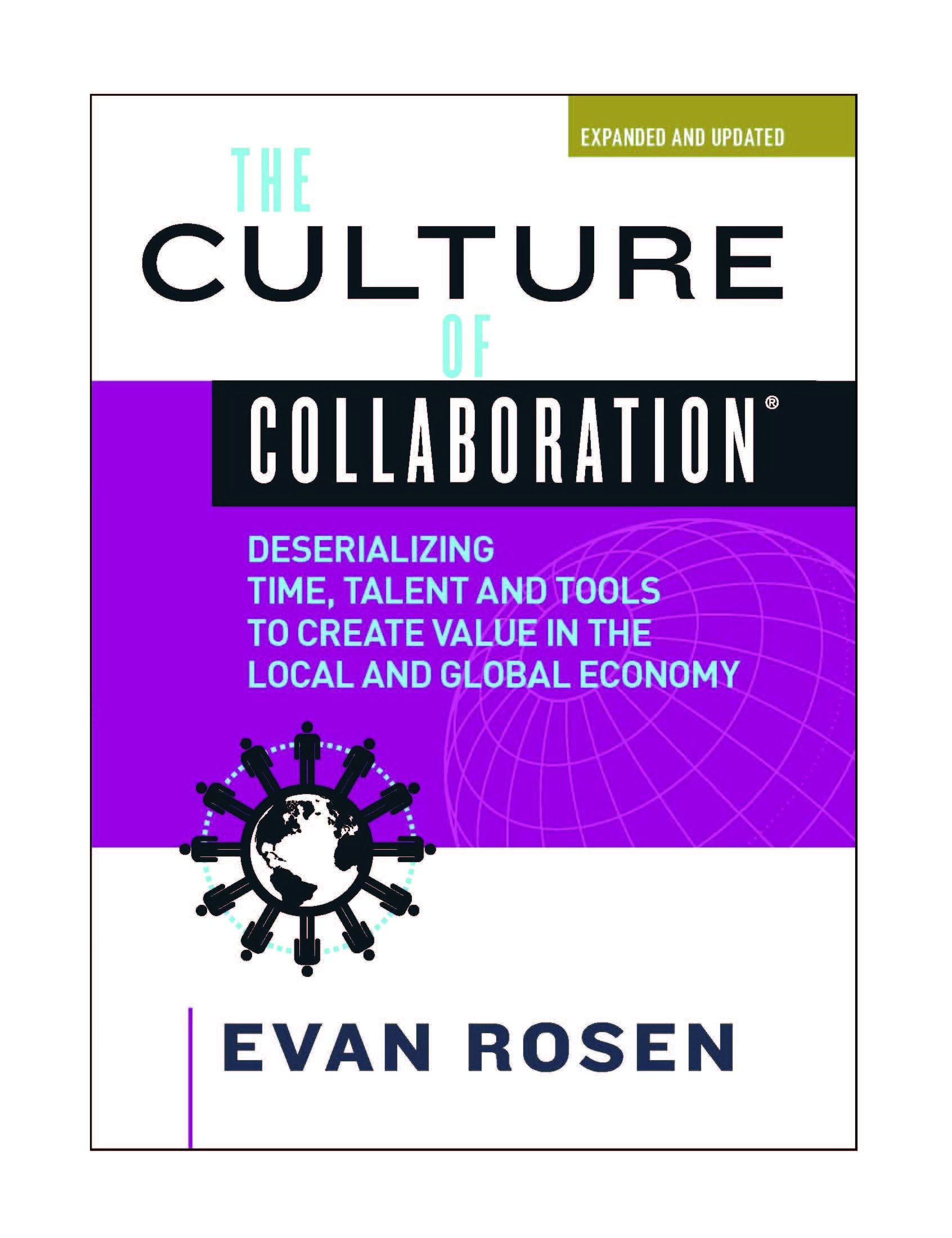
    The expanded and updated edition has just been released, and I’m proud of the finished work. The 363-page business book includes 54 images and illustrations and a beefy index. By the way, 54 images and illustrations is no easy feat in 2024. Ever wonder why most business books lack pictures? It’s time-consuming to license even a single image from a large organization.

    One thing I’ve learned is that deserialization and collaboration go together like peanut butter and jelly. Deserialization means removing sequences from the lifecycle of products and services. The idea is to collapse outmoded sequential approaches and replace them with spontaneous, real-time processes.

    Deserialization also involves removing sequences from interaction. This means killing what’s left of the in-box culture. In short, deserialization is the key to long-term value creation through collaboration. That’s why the subtitle of the expanded and updated edition of The Culture of Collaboration® is: Deserializing Time, Talent and Tools to create Value in the Local and Global Economy.

    I’ve also learned that despite best efforts, collaboration can stall within highly-collaborative organizations. Paradoxically, collaboration happens in companies in which the dominant culture is command and control. Likewise, internal competition and command and control exist in mostly-collaborative organizations. Many factors, as I explain in the expanded and updated edition, influence both the evolution and regression of The Culture of Collaboration.

    More broadly… as I write in the preface, in some ways we’re less collaborative than we were in the early 2000s. Social media lets us broadcast opinions without refining ideas through real-time interaction. We join groups that make rules for how we should think. Videoconferencing enables interaction at a distance, but too often we’re wasting time in scheduled virtual meetings rather than creating value together spontaneously. While in the same room, we meet rather than collaborate. We leave meetings to work and then schedule follow-up meetings to review work. This serial process zaps value.

    My objective in revisiting this topic is to consider whether we have evolved or veered off track and to provide a new framework for unblocking collaboration and unlocking value.

    Let me know your thoughts about the new, expanded and updated edition of The Culture of Collaboration® book.



  • Daimler Collaborates to Reinvent Trucks

    Karl Benz is often credited with inventing the first true car. In 1885, Benz built the Benz Patent-Motorwagen powered by an internal combustion gasoline engine.

    Did he act alone? Of course not. We collaborators know that nobody achieves great feats by themselves. Karl Benz had help. One collaborator was his wife, Bertha, who funded the project and took a later version of the Benz on its first long-distance journey. Benz’s company eventually merged with Daimler Motoren Gesselschaft.

    Now the company that invented the automobile is collaborating to reinvent the truck.  At the Tokyo Auto Show last Wednesday, Daimler announced a purely electric truck and bus brand called E-FUSO and pledged to electrify all vehicles produced by Daimler’s Mitsubishi Fuso Truck and Bus Corporation subsidiary. 

    Some hours later at the Mercedes-Benz Research and Development Center in Silicon Valley, journalists gathered for a briefing.  Before the event, Daimler leaders and I had a far-reaching discussion about how Daimler collaborates internally and with partners and governments. We also discussed how electric trucks and buses will change life particularly for those of us who live in cities.

    Daimler Fuso’s e-Canter all-electric light truck. Image copyright Daimler. All rights reserved.

    Daimler’s Fuso is currently selling the eCanter light truck which it assembles in Portugal for the North American market. 7-Eleven in Japan and UPS in Atlanta are using the eCanter which has a range of 60 miles between battery charges. The optimal use of the eCanter is for deliveries within cities.

    “We want to make the cities a better place to live. We want the world to change to the next level,” explained an energetic Marc Llistosella, president and CEO of Daimler’s Mitsubishi Fuso Truck and Bus Corporation. Marc, who is anything but a staid leader, was animated and clearly comfortable climbing aboard the concept E-Fuso Vision One truck and giving us a live tour via real-time, interactive video.  The concept truck, which is several years from production, has a 220-mile range between battery charges and carries a payload of eleven tons. This would enable metro and regional delivery routes.

    Benoit Tallec, head of design for Mitsubishi Fuso, noted that a central touch display replaces dials and switches on the Vision One so that the driver focuses on the road. He compared the evolution of Fuso trucks to the evolution of boats from sail to steam power in the early 19th Century. Fuso’s technological advances are “the result of a team effort across three continents,” he said.

    Daimler FUSO’s Vision One concept all-electric truck. Image copyright Daimler. All rights reserved.

    After the discussion and presentation, I hopped aboard the eCanter and drove the quietly-purring vehicle by some of Sunnyvale’s

    technology company parking lots as some curious engineers took notice.

    Daimler’s E-FUSO unit faces two big challenges: infrastructure for charging trucks and increasing battery range. Overcoming these challenges could one day make electric trucks economically viable for longer routes. While consumers may buy electric cars as much for novelty as economics, truck customers demand a business case that proves electric vehicles create value.  Making that case through technology advances and cost reduction will require continued collaboration within Daimler, with business partners and with governments.


  • The Collaborative Value of Getting Lost

    Remember when it was possible to get lost? Global positioning systems (GPS) and satellite-based navigation tools have rendered losing one’s way an anachronism. Something is lost, though, in the inability to get lost. And that something is serendipity.

    So what’s wrong with that? And what does this have to do with collaboration? Travel involves some structure. You may know approximate departure and arrival times. You may have an idea where you’re going and even some sort of a plan. Like travel, collaboration involves some structure. Balancing structure with serendipity is necessary to creating collaborative value.

    Adopting a structure that lets team members use creativity and collective brain power nets far better results than dictating their moves.  Instructing collaborators each step of the way as GPS instructs navigators falls flat. When people get lost, they may discover something new or find a different way to get back on course. They may also determine there are several paths and that options exist.

    Stopping and asking for directions lets us engage people rather than devices. Some months ago, a colleague who is a geographer and I tried an experiment while driving in France. We knew where we were going and we had some sense of how to get there. We skipped GPS and used no maps. Instead, when we veered off course, we stopped and asked directions. My colleague studied GPS in graduate school, but she realizes the technology’s limitations. She equates the “turn left, turn right” approach with command and control. Instead, she prefers to wander and discover new things. We lost our way a time or two with interesting results.

    In one case, a Frenchman retorted “Don’t you have GPS?” In another instance, we stopped at a small- town bar and asked the imbibers for directions. They motioned us to sit down and have a drink, which we did. And they engaged us in a conversation about the differences between small-town and urban culture in France before getting us back on course. This serendipitous encounter connected us with people and ideas in a way that using GPS could never have accomplished. Like collaboration, our encounter offered a richer experience as other perspectives entered the mix.

    The electronic mapping craze is now going indoors. I know a furrier in a mid-sized Midwestern city who keeps getting requests from Google to map the interior of his business. Security is a major concern considering the value of his inventory which includes exotic mink and other fur coats, and he has zero desire to publicize the layout of his store. Best I can tell, no banks have yet provided floor plans to Google.

    The downside of never needing to ask for directions is that our lives and our travels become overly planned and controlled with little room for chance. This mirrors the struggles of organizations striving to become collaborative while their structures hold them back. Enabling serendipity is a key element in adopting a collaborative organizational structure. In command-and-control organizations, formality eclipses serendipity. It’s as if everything is scripted. Organizations on a collaborative path design physical and virtual work spaces with chance encounters in mind, as The Bounty Effect: 7 Steps to The Culture of Collaboration book details.

    I live in San Francisco where many people ride company buses to work in Silicon Valley. In the morning, they board buses on which Wi-Fi and other amenities are provided. At work, food is available in free campus restaurants and canteens. Haircuts and dry cleaning services are also available. They ride the bus back in the evening. The idea is that without having to think about transportation, food and other services, team members can focus on innovation at work. The problem is that without having to deal with many of life’s necessities, people can become less resourceful. Work days become too scripted leaving little to chance. The lack of opportunity to “get lost” can interfere with progress.

    Spontaneity breaks down barriers and silos among levels, roles and regions. A chance encounter with a colleague in another function or business unit may spark an idea for a process improvement or a new product. If our time and movements throughout the work day are overly planned, we lose the opportunity to engage colleagues on the fly.

    GPS and satellite-based navigation technology have made the world smaller, but we must make sure that these tools and overly-controlled environments have not made our worlds smaller by preventing the serendipity and spontaneity necessary for travel and collaboration.


  • Pope Francis Promotes Collaborative Structure

    The least collaborative organization is changing its structure.

    Which organization? Well, here are some of its characteristics. This global enterprise pays a few people to make decisions while everybody else follows orders. The CEO’s direct reports act like a royal court and compete for face time. Senior leaders often live lavishly and consume conspicuously. Headquarters micromanages satellite offices. Bureaucracy and formality reduce efficiency.  Internal competition runs rampant. The command-and-control organizational structure quashes dissent.

    Sound familiar? This description fits many global corporations and government entities. This particular multinational spent $170 billion in the United States in 2010, according to The Economist. The organization is the Catholic Church and, more specifically, the Roman Curia, the church’s centralized administrative operation.

    Like many corporations, the Catholic Church suffers from an obsolete organizational structure that is compromising value. And like many corporations, reform-minded leaders have tried introducing a new approach. But entrenched interests and a centralized bureaucracy rife with intrigue, fiefdoms, and Machiavellian motivations has frequently derailed change.

    Enter Pope Francis setting the stage for change by wearing a simple white robe and black shoes rather than the regal vestments and ruby shoes of his predecessor. He has washed the feet of inmates and has Pope Francis smallopted to live in a guest quarters rather than the Vatican’s deluxe papal apartments in the Apostolic Palace. There are signs the Pope’s frugal tone is rippling across the Church. In March, the Pope accepted the resignation of Bishop Franz-Peter Tebartz-van Elst of Limburg, Germany who spent the equivalent of $43 million on a new house and office complex.  In April, the Atlanta Archdiocese announced that it would sell Archbishop Wilton Gregory’s $2.2 million mansion.

    Beyond Pope Francis’ rejection of the trappings of office, he is taking steps to adopt a more collaborative structure in the Roman Curia and in the global Catholic Church. The Pope has chosen a “working group” of eight cardinals from outside the Curia to collaborate with him on changing the structure.

    Cardinal Francesco Coccopalmerio heads the Vatican department that writes the church laws that will codify reforms. The Religion News Service quotes Cardinal Coccopalmerio as saying “The big change is the emphasis on collegiality, on collaboration.” Now Pope Francis, Cardinal Cocopalmerio and other new church leaders are focused on breaking down barriers among silos so that information flows around the organization rather than from top to bottom. Cardinal Cocopalmerio has proposed naming a “moderator of the Curia” to identify inefficiencies and cut through red tape.

    Pope Francis participates in meetings without dominating them and embraces broad input. Cardinal Donald Wuerl of Washington, D.C. recently attended one such meeting at the Vatican about appointing new bishops. Typically, popes never attend such meetings. Pope Francis reportedly stayed for three hours. “We’re all sitting around the table, and he comes in and pulls up a chair,” Cardinal Wuerl told Fox News.  At another similar meeting, a senior cardinal asked the Pope what he thought about the topic. “If I told you what I think, you would all agree,” Pope Francis responded according to Cardinal Wuerl. “I want to hear from you what you think.”

    Perhaps most significantly, according to Cardinal Wuerl, the Pope has repeatedly advocated a collaborative process through which “the Holy Spirit can be heard.”  And the Holy Spirit isn’t going to be heard if just one person speaks. “He wants all of us to be speaking with him so at the end of the day he can say this truly was the fruit of the work of the Spirit.”

    Hallelujah. Many corporations in multiple industries including United States government agencies can learn from the Pope’s example. It takes more than window dressing and a desire for change to create value through collaboration.  The only viable approach is changing the organizational structure which, in turn, shifts the culture. My research on collaboration indicates that changing the structure requires seven steps—plan, people, principles, practices, processes, planet and payoff. Pope Francis has demonstrated that making progress through these steps requires that a leader set the stage for change so that others feel comfortable participating.

    In essence, The Bounty Effect has hit the Catholic Church. The Bounty Effect happens when exigent circumstances compel companies, governments and organizations to change their structures from command-and-control to collaborative. For the Catholic Church, exigent circumstances range from sexual abuse scandals to corruption and cronyism at the Vatican. And it’s The Bounty Effect that led to the election of Pope Francis and the structural change now underway.


  • Multicultural Collaboration Produces Unique Spa

    Bridging cultures, particularly regional cultures, produces a broader perspective that gives collaborators an edge. In disciplines like aerospace engineering, team members trained in one country’s engineering tradition may view a creative challenge differently than their colleagues who were trained in a different country’s system. Drawing from their collective global knowledge, cross-cultural collaborators can spark synergies and create greater value. In The Culture of Collaboration book, I call this the Dynamic Dimension of Cross-Cultural Collaboration.

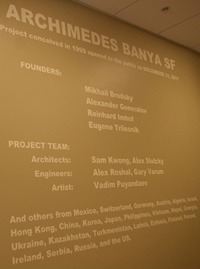
    This dimension is alive and well at Archimedes Banya, a spa complex that opened in San Francisco last New Year’s Eve after twelve years of development and construction. People from twenty different countries collaborated on the project. Managing partner Mikhail Brodsky of Russia had the original idea. Reinhard Imhof of Switzerland led the indoor construction. Architect Sam Kwong of China developed the plans. Other partners are from countries including Korea, Israel, Germany, Japan, and Mexico.

    The concept began when Brodsky, a mathematician, arrived in San Francisco from Moscow in 1989. A lBanya2over of Russian bath complexes or banyas, Brodsky was disappointed to find no such facilities in his adopted city. He longed to start a banya. In the summer of 1998, Brodsky, then a professor at the University of California at Berkeley, applied for a job as chair of the mathematics department at San Francisco State University. SFSU’s rejection sparked Brodsky’s interest in doing something significant in San Francisco while delivering on his banya dream.

    Brodsky, Imhof and two other partners formed a company, and in 1999 bought a lot in India Basin near San Francisco’s former Hunters Point Shipyard. Though in an obscure neighborhood, the lot provided sweeping views of San Francisco Bay. To construct the building, Brodsky and his partners would need to recruit more partners. Like many ethnic groups living in the United States, many Russians do business only within their community. Therefore, logic would dictate engaging Russians to finance, design and build the project. But some Russians who Brodsky approached had difficulty seeing past the many roadblocks to the project ranging from building permits and location to construction costs and customer base. So, Brodsky decided to broaden his reach, involving people from as many countries as possible. The common thread was a passion for the Banya project plus mutual trust and common goals, two of the Ten Cultural Elements of Collaboration I identify in The Culture of Collaboration book.

    In a departure from the command-and-control approach to business in which “stars” grab the credit, Archimedes Banya recognizes multiple contributions in much the same way Adobe Systems includes a Banya Wallcredit role in its software products. When I visited Archimedes Banya recently, the first thing I noticed was a wall near the entrance listing the names of the multicultural collaborators who turned the concept into reality. Also apparent was the amazing art ranging from mosaics depicting bathing traditions to murals and inlaid ceiling tiles. Including art in public bathing facilities is a tradition dating back to the Roman Empire.

    Artist Vadim Puyandaev of Kazakhstan collaborated with Brodsky to evoke the right atmosphere. “I
    wanted very simple, clear images of emotion,” says Brodsky. And the images also reflect action. “In a Russian banya, people move. It’s an active place. It’s not just sitting and sweating.” The complex is geared to socializing and offers facilities ranging from a rooftop sun deck with a San Francisco Bay view to private reception rooms replete with bars and kitchens.

    The Banya offers a spa experience reflecting the cultural melting pot. I checked out two Russian saunas, the Finish dry sauna, the steam room, warm soaking pools, cold plunge and relaxation room. After loosening up in the various saunas, I experienced a Russian venika platza treatment that involved a tall Moldovan fellow clad in a towel and sweat-soaked Banya hat brushing and lashing bunches of Latvian birch leaves on me to increase circulation.

    Following this, I laid on a table as an attendant scrubbed me with an exfoliating soap and then rinsed me with buckets of warm water. Then my muscles were relaxed enough for a massage from a masseuse from the United States. Afterwards, I headed to the café upstairs for pelmini or Russian dumplings, stuffed cabbage, hearty Russian beef soup, fresh-sqeezed juices spiked with kombucha, which is fermented tea and housemade kvass, a non-alcoholic beer made from fermented rye bread.

    An ambitious spa project that began as one person’s vision ultimately reflects the combined vision and execution of multiple people from many cultures. Collaboration involves marrying talents that are worth far more collectively than individually. Brodsky describes himself as a “starter.” But to make the project a reality, he collaborated with Imhof, a “finisher.” Because of the Swiss tradition of quality workmanship, Imhof shared Brodsky’s values of using the best materials and constructing a banya for the long term. The concept of “starters” and “finishers” has broad ramifications. A starter may have an incredible idea, but creating a company that produces substantial value may require collaborating with a finisher.

    As we collaborate, we can create awesome value by engaging and involving people with multiple talents and backrounds and, yes, from multiple cultures. The Dynamic Dimension of Cross-Cultural Collaboration delivers results otherwise unattainable.


  • Cross-Sector Collaboration for Sustainable Development

    Accomplishing massive goals requires massive collaboration—far beyond collaborating within an organization or within an industry or among government agencies.

    Making meaningful progress on issues including eradicating global poverty and protecting the global ecosystem requires collaboration among governments, non-governmental organizations (NGO’s), private industry, farmers, indigenous peoples and unaffiliated individuals with ideas. This cross-sector collaboration is driving the agenda for the United Nations Conference on Sustainable Development which happens this June 20-22 in Rio de Janeiro, Brazil. The conference, dubbed Rio+20, marks the twentieth anniversary of the United Nations Conference on Environment and Development. The 1992 conference established the Rio Declaration, which includes 27 principles mostly addressing sustainable economic development.

    Last Friday, at the invitation of the United States Department of State, I attended a planning meeting for Rio+20 at the Center for Social Innovation at the Stanford Graduate School of Business. The purpose was to distill ideas from cross-sector collaborators on how to bridge connection technologies with sustainable development. In a brainstorming session on “sustainable economic growth,” we tackled wasted talent and connectivity.  Think of the many people in developing countries with talent and ideas who have no outlet to connect and collaborate. This is our collective loss as global citizens until we tap that talent.

    The world’s wasting of talent in developing countries is analogous to the command-and-control organization that pays “knowledge workers” to think and pays everybody else to carry out orders. See my January 11, 2011 column for BusinessWeek.com on this topic. Such an organization squanders talent. This is because people throughout the organization—from the loading dock to the call center—have knowledge to contribute.

    One participant noted that wasted connectivity involves using the Internet frivolously, perhaps for pirating movies and other content, rather than for working together to eradicate poverty, create new markets and protect the environment. Similarly, wasted connectivity within organizations involves using networks and tools for chatter rather than for developing and producing products and services.

    Since the 1992 Rio Declaration, the Internet has grown from less than 16 million users to over 2 billion users, according to internetworldstats.com. Mobile phone users have grown from less than 23 million in 1992 to more than 6 billion in 2011, according to nationmaster.com. The current level of connectivity creates an opportunity for a more distributed, peer-to-peer (read inclusive) approach in collaborating for sustainable development. 

    Old models of cross-sector collaboration were minimally effective, because they involved “decision makers” or “thought leaders” shaping ideas and developing solutions which they would hand down to people impacted by the decisions. Now people in developing countries without affiliations can shape ideas with ministers and private sector leaders globally. Well, at least this is technically possible.

    As important to cross-sector collaboration as global connectivity and enabling technologies is a cultural shift in which governments, NGO’s and private industry embrace input from people regardless of affiliation or location. This is analogous to organizations adopting more collaborative cultures and tools so that people far from the home office or from executive corridors can participate in making decisions. The State Department has chalked up success with an emerging collaborative culture and tools including Secretary Clinton’s Sounding Board. For more on this, see my September 14, 2010 post.

    One of the people hashing out ideas in the sustainable development brainstorming session was Rio+20 Secretary General Sha Zukang, who is also the UN Under Secretary General for Economic and Social Affairs. Zukang, who demonstrated particular talent at defining and outlining sustainable development issues, brushed against a live wire as the workshop concluded: intellectual property. The brainstorm was exactly three weeks after the collapse of U.S. House of Representatives support for the Stop Online Privacy Act and Senate support for the PROTECT IP Act backed by media and entertainment companies and opposed by Google and Wikipedia among other online interests.

    Zukang described the need to “find a balance” between protecting intellectual property and disseminating information. This balance impacts cross-sector collaboration in that people in developing countries often lack access to the same information accessible to their collaborators in developed countries. Providing affordable access will help level the playing field. Contrary to some viewpoints, collaboration—cross-sector or otherwise—by no means requires eliminating or dismantling intellectual property protection. IP protection creates incentives for people and organizations to collaboratively develop and produce products and services.

    Cross-sector collaboration takes collaboration beyond organizational and sector boundaries to create value on a global scale.


  • BMW, Toyota and Collaborating with Competitors

    They compete in the marketplace, but now they’re also collaborating.

    BMW Toyota CollaborationBMW and Toyota have announced they will collaborate in two areas: the companies will share costs and knowledge for electric car battery research, and BMW will supply diesel engines to Toyota. Toyota owns the luxury brand, Lexus, and therefore BMW and Toyota directly compete in the luxury car segment. Both companies have a significant collaboration track record.

    In The Culture of Collaboration book, I describe how BMW and Toyota create value by collaborating internally and with business partners. The preface, which you can read here, reveals how my visit to the BMW design center in Munich some years ago sparked the book.

    So why would two competitors collaborate? Collaborating makes sense within enterprises and with partners, but the marketplace requires pure competition. Right?  Well, that depends.

    Collaborating among competitors makes sense when the collaboration:

    1. Creates value for both parties
    2. Begins with structure and clarity
    3. Involves non-differentiating processes

    Clearly, the BMW/Toyota collaboration nails number one. “We think that this collaboration will allow for development of next-generation batteries to be done faster and to a higher level,” Toyota Executive Vice President Takeshi Uchiyamada said at a news conference. Both companies will share the costs of battery development. 

    Toyota will reportedly use BMW’s 1.6 and 2-liter diesel engines for cars sold in Europe beginning in 2014. This is reportedly the first time Toyota has procured an engine from a competitor. According to a story by Yoshio Takahashi and Kenneth Maxwell in the December 2, 2011 edition of the Wall Street Journal, the collaboration will reduce BMW’s engine production costs per unit by increasing volume. So, value creation is at the heart of this collaboration.

    What about #2, structure and clarity? Based on what I know of BMW and Toyota and their approaches to collaboration, chances are this effort involves much of both. In any collaboration among competitors, both parties must establish boundaries for collaboration at the outset. Most importantly, the competing collaborators must determine use and ownership of existing and jointly-created intellectual property. Far fewer problems arise when business unit people, engineers, marketing folks, lawyers and others from both companies hash out these concerns rather than simply handing off the issues to lawyers to hash out in a vacuum.

    Regarding #3, I’ve found that collaboration among competitors works best when the effort involves eliminating redundancy in non-differentiating processes. These are typically under-the-hood processes that are not part of a company’s market or product perception.  Two companies that each make hot sauce might use the same bottling equipment. Two newspapers in the same market might use the same printing presses. Entire industries participate in consortiums for purchasing, saving each competing company substantial money. These shared, non-differentiating processes are invisible to the customer. 

    Engines are invisible to all but the most die-hard car enthusiasts, so collaborating on this process arguably fits the bill as non-differentiating. Typically, car batteries have nothing to do with the vehicle perception in the marketplace. In the case of electric cars, though, the jury is still out whether the battery is invisible to the consumer. The technology is in its infancy, and therefore the market consists primarily of early adopters. These consumers are more techno-savvy, realize the lithium-ion battery is intrinsic to the product’s technology and performance, and therefore may place a heavier emphasis on the battery in their purchase decisions.

    So, it remains to be seen whether battery research and development is non-differentiating for BMW and Toyota. Nevertheless, if both companies can save substantial money on development and bring vehicles to market sooner and customers perceive and actually get better electric vehicles, this collaboration will prove successful.


  • U.S. Embassy Vatican Gains Influence by Sharing

    After delivering a keynote speech for the Tagetik User Conference 2010 in Lucca, Italy late last month, I wanted to experience first-hand the collaborative movement in the United States Department of State.

    So, I visited the United States Embassy to the Holy See. With only six diplomats plus local staff, the embassy is undoubtedly one of America’s smallest. Unlike every other U.S. embassy, Embassy Vatican represents the U.S. government not just to a sovereign nation, but also to the largest single organization on Earth. That organization is the Catholic Church and its 1.2 billion Catholics globally.

    With a geographically-dispersed constituency, Embassy Vatican requires more than a physical location to accomplish U.S. policy objectives. That’s where virtual or eDiplomacy plays a role. Sure, there are often reasons for U.S. diplomats to press the flesh with Church officials, but Embassy Vatican need not be physically located in the Vatican. And, in fact, it’s not. The embassy is across the Tiber River in Rome, Italy.

    To reach the embassy, I made my way to Aventine Hill, an upscale neighborhood of Rome. What distinguishes the villa housing Embassy Vatican from the other mansions on the tree-lined block is the soldiers and small artillery across the street, security at the gate plus metal detectors at the entrance to the building. I waited in a converted living room decorated with portraits of former U.S. ambassadors and pictures of popes with U.S. presidents ranging from Reagan to Obama.

    Vatican Embassy - Julieta Valls Noyes In time, I was shown into an elegant office with a view of the embassy’s lush garden. Julieta Valls Noyes, Deputy Chief of Mission, extended her hand. She then introduced Mark Bakermans, Embassy Vatican’s point person on collaborative tools. After brief pleasantries, Julieta was ready to embrace the informality so necessary to collaboration. “I’ve already greeted you, so I can remove my jacket,” she smiled.

    Our conversation focused on the challenges of representing the United States to a global constituency. “We’re a small embassy, but what happens here has universal interest,” according to Julieta. To encourage information exchange and collaboration, Julieta had advocated building a Microsoft SharePoint portal for the embassy. However, according to Julieta, the tiny embassy lacked the necessary bandwidth. So, the State Department’s eDiplomacy team sent people to Rome. In May of 2009, a Diplopedia wiki-based internal site went live. For more on Diplopedia, see my September 14, 2010 post on “Taking Collaborative Risk at the State Department.”

    Clearly, Embassy Vatican’s use of Diplopedia is raising the embassy’s profile within the State Department. On an average month, the site gets 300 to 400 visitors. But that number spikes considerably when issues involving the Catholic Church hit the news. As the Catholic Church sex scandal bubbled up to banner headlines last February, Embassy Vatican’s Diplopedia site became a State Department clearinghouse for information on the scandal and the Church’s reaction to it. Most of the staff at Embassy Vatican contributes to the Diplopedia site, but Mark noted that the challenge is getting people across the State Department to comment on posts and share knowledge. For Diplopedia to enhance collaboration, consumers of information must also become contributors to information.

    I asked Julieta whether she would provide an inside view of the State Department’s internal ideation tool called Secretary Clinton’s Sounding Board, which is based on a blogging platform. For more on Secretary Clinton’s Sounding Board, see my September 14, 2010 post. Julieta invited me to sit on the edge of her desk (more informality!) as we viewed spirited debate from employees on topics ranging from recruitment of Hispanics to paying interns. Notably, one of the State Department’s most senior officials participated in the discussion and helped shape the ideas.

    The State Department has used Secretary Clinton’s Sounding Board to create workplace improvements. These range from installing showers for team members who ride bicycles to installing donation boxes so that employees can deposit left-over foreign currency from trips. The State Department then uses the money to aid families of Department people such as those who were Haiti earthquake victims. Ultimately, the State Department may use the ideation tool to craft diplomacy. Julieta insists that a separate ideation tool for diplomacy hosted on the Department’s classified site makes more sense than integrating diplomacy with workplace issues.

    Like so many organizations, the State Department still faces cultural issues that impede collaboration. These include rank-consciousness, unnecessary manifestations of hierarchy and silos among levels, teams and regions. Nevertheless, collaborative culture is starting to take hold—and tools like Diplopedia and Secretary Clinton’s Sounding Board are extending and enhancing that culture.


  • Breaking Corporate Rules to Collaborate

    What happens when team members want to collaborate, but command-and-control approaches and internal competition prevail in culture and processes? New research indicates team members are starting to “spoof the system” by flouting organizational guidelines and creating work-arounds so they can collaborate. The global study conducted by InsightExpress and funded by Cisco surveyed more than two thousand end users and a thousand information technology decision makers from ten countries. The study found that 52 percent of organizations prohibit the use of social media applications and 50 percent of end users admit to ignoring company policies at least once a week. “End users have started to take things into their own hands,” says Alan Cohen, Cisco’s vice president of enterprise solutions.


    The study found that users most willing to break company policies are those in the United Kingdom and France. Respondents in China were least likely to violate corporate rules. Still, the survey found that companies in China and India had significantly higher adoption rates of collaborative tools than companies in the United States or the United Kingdom. This is likely because companies in these growing economies are relatively new, and therefore their infrastructures are by no means set in stone.


    Ironically, the study found that 77 percent of IT decision makers plan to increase spending on collaboration tools this year, while team members say corporate policies are constraining collaboration. Investing in collaborative tools makes little sense if an organization lacks the culture and processes to support the tools. The result is a schizophrenic organization in which some team members break rules, others operate by the book, and most team members get confused by mixed messages. Considering the study results, a prime opportunity exists for leaders to think and act collaboratively and for organizations to adopt collaborative culture.


    Cisco will gladly sell you any and all of its more than 60 collaboration products. But buying these products or those of any other collaboration tools vendor will produce limited results unless your organization makes a fundamental commitment to collaboration. This shift includes moving away from command-and-control, internally-competitive culture and processes and replacing the pass-along, serial approach to work and decision-making with spontaneous, real-time models. I address this in the introduction to The Culture of Collaboration book.


    Intercompany Collaboration: Focus on Culture and Processes


    On another note…outmoded culture and processes can curb collaboration and compromise value—whether we’re talking about within a company or “outside the firewall.”  As vendors and standards groups resolve intercompany collaboration technology issues, there’s a temptation to conclude that intercompany collaboration is “good to go.”


    About three weeks ago, I participated in a discussion via TelePresence with Cisco senior vice presidents Tony Bates and Barry O’Sullivan. The company was discussing details of its new Intercompany Media Engine, which extends unified communications among companies. So, a supplier can easily view the availability or “presence status” of a customer, connect via instant messaging, and easily escalate the interaction to a voice call, web conference, or telepresence. You can view video of a demo call here. Meantime, the Internet Engineering Task Force (IETF) is working on an open standard for telepresence and unified communications so that people can interact regardless of technology vendor. This has particular relevance for business partners with different installed telepresence brands. Ultimately, the challenge for intercompany collaborators goes well beyond the technology. Organizations must focus on adopting collaborative culture and processes and integrating them across organizational boundaries.


  • Replacing ROI with Return on Collaboration?

    Yesterday I had a compelling discussion with Alla Reznik, director of global voice and collaboration for Verizon. Alla is from Russia, and she’s the only U.S.-based marketing professional I know who can provide input on the Russian language edition of The Culture of Collaboration book published by Ecom of Moscow. Alla and I chatted about regional cultural differences in how people collaborate—and differences in how they respond to surveys.


    It was a timely discussion, because today Verizon and Cisco are releasing a new study tackling return on investment (ROI) for collaboration expenditures. ROI has long frustrated collaboration tools vendors, because of the difficulty in quantifying “soft” benefits such as corporate reputation. The research, conducted by Frost & Sullivan, identifies a model for measuring what it calls return on collaboration (ROC).


    ROC measures the impact of collaboration on key functional areas. These include research and development, human resources, sales, marketing, investor relations, and public relations. Traditional ROI measures money gained or lost on an investment. In contrast, ROC tracks the amount of “improvement” derived from a financial investment in collaboration. The study identified research and development, sales and marketing as the functional areas with the highest ROC.


    The study called “Meetings Around the World 2: Charting the Course of Advanced Collaboration” is based on questionnaires completed by 3662 information technology and line-of-business decision makers in 10 countries. Respondents represented enterprises plus small and medium sized businesses. Nearly half the organizations are using unified communications and collaboration tools ranging from enterprise instant messaging to Cisco TelePresence. Among the study’s key findings is that collaboration is more than twice as important as strategic orientation and six times more important than market factors in determining business performance.


    “The world has changed quite a bit since 2006,” according to Alla, who was referring to the 2006 study dubbed “Meetings Around the World 1.” This earlier study determined that collaboration fuels business performance and that collaboration capability is based on technology, culture and structure. The new study indicates that culture and structure are even more important to collaboration than they were in the previous study conducted in 2006.  The point is that collaboration technology makes the most difference in organizations with collaborative cultures and structures. Similarly, the fundamental premise of The Culture of Collaboration book is that maximizing time, talent and tools to create value requires collaborative culture.


    The main purpose of the study is to convince business decision makers to invest in collaboration tools and technologies.  One conclusion is that a $1 million investment in collaboration tools and technologies will deliver a $4 million dollar “improvement.” However, this result apparently fails to consider whether the organization has adopted a collaborative culture. I would argue that a $1 million investment by an organization with a collaborative culture will produce greater results than the same investment by an organization with a command-and-control, internally-competitive culture. So while the study does highlight the role of culture and structure, more work is necessary in integrating these elements into measuring ROC.


    The big question for Verizon and Cisco is whether CFO’s, CIO’s and business decision makers will accept ROC. “We’re curious ourselves,” Alla told me. While there’s work to do in proving the value of collaboration, ROC is an important step towards evaluating the return on collaboration investment.