Government


  • Unlocking Collaboration through Deserialization

    Why does collaboration fail? The answer is often the lack of collaborative processes and culture. Less obvious is the lack of deserialization. From the private sector to education and from government to nonprofits, serialized processes impede collaboration.

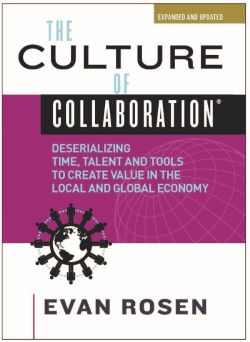
    Deserialization is both macro and micro. As I describe in the new, expanded and updated edition of The Culture of Collaboration® book, macro deserialization is the removal of sequences from the lifecycle of products and services. There are useful manifestations in multiple industries. In the aerospace industry, macro deserialization means simultaneously designing parts, plans, tools, processes, assembly, delivery, maintenance, and retirement of the plane. In the visual effects industry, post-production is becoming pre-production as artists design effects before and during the shoot with hybrid physical and virtual worlds.

    Micro deserialization is the removal of sequences from how we interact and get things done. The in-box culture is dead—and the in-box can include overflowing text, chat and messaging applications. Waiting for somebody else to provide input slows decisions and complicates resolution. So does making an appointment to collaborate! Instead, Do It Now Together! And instead of scheduling a meeting, let’s engage each other spontaneously in a collaborative group session—No Appointment Necessary. You’ll find more on replacing meetings in the book.

    Embracing deserialization unlocks the value that collaboration promises.


  • Star Culture Trips Up Venice

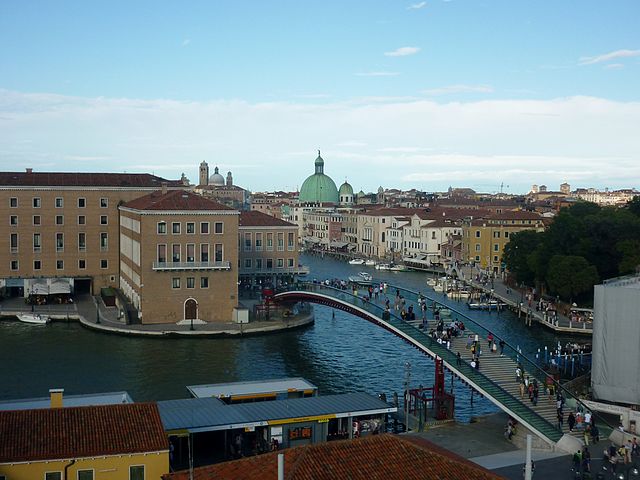
    It’s called Ponte della Costituzione, the fourth footbridge over Venice’s Grand Canal. The glass and steel structure has caused nothing but headaches—and some muscle aches—for  tourists, Venetians and the officials who run their city.

    When Venice commissioned an architect to build the new bridge in the late 1990s, the job went to Santiago Calatrava. Named by Time magazine to the Time 100, one of the hundred most influential people in 2005, Calatrava has chalked up dozens of awards and honorary doctorates. His celebrated projects range from the World Trade Center Transportation Hub in New York City to the Museum of Tomorrow in Rio de Janeiro, Brazil. And the New York Times calls Calatrava a “star architect.”

    Ponte della Costituzione
    Venice’s Ponte della Constituzione. Photo by Christoph Radtke. Licensed under CC BY 3.0. No changes made.

    The problem is that the Zurich, Switzerland based architect apparently failed to adequately consider practicalities impacting Venetians who cross the bridge regularly and tourists who cross when visiting one of Italy’s most visited cities. For starters, the bridge lacks disabled access. Also, the glass floor has caused many people to slip and fall. According to a story in Architectural Digest, some Venetians have cracked their chins and foreheads and others have reportedly broken bones. City officials have told media outlets that injuries occur almost daily.

    Because too many injured pedestrians have sued the City of Venice over the multimillion dollar bridge, the city has decided to allocate more than half a million dollars to replace the glass with trachyte stone. This expense comes after a failed 1.5 million Euro modification to install a cable car so that people could cross the bridge without injury.

    What has caused heartache, bone ache, lawsuits and wasted taxpayer dollars is star culture. Rather than designing a bridge for the practical needs of tourists and others who regularly cross the canal, Calatrava was apparently too focused on capturing and representing Venice’s “embrace of modernity” as the New York Times puts it. Rome’s Court of Auditors found that Calatrava was negligent in failing to account for the number of tourists dragging their bags across the bridge. Calatrava argued that bag dragging constitutes “incorrect use.”

    Stars tend to get swept up by things like symbolism, messaging and virtue signaling. Collaborative architects seek input from people who will use the structure they’re designing. In The Bounty Effect: 7 Steps to The Culture of Collaboration®, I describe how architect Renzo Piano made no sales presentation but rather pulled ideas from his clients in collaboratively conceptualizing and designing the California Academy of Sciences in San Francisco.

    Undoubtedly, Calatrava has chalked up major accomplishments, but accomplished professionals run the risk of buying their own hype. When people are made to believe they can do no wrong, they often make decisions in a vacuum and may work without adequate input from others. This feeds star culture for which the media has an insatiable appetite. Yet we must resist the temptation, because star culture sucks value out of companies, governments and communities.


  • COVID-19 Triggers The Bounty Effect

    We are living in a time of exigent circumstances. What do I mean by exigent circumstances? I mean a do-or-die challenge that raises the stakes for survival.

    Exigent circumstances ignite the structural change necessary to collaborate for governments, companies, non-profits, universities and just about every organization. This is The Bounty Effect which I describe in my book The Bounty Effect: 7 Steps to The Culture of Collaboration®. I call this The Bounty Effect using the metaphor of the mutiny that occurred on the H.M.S. Bounty more than two centuries ago. For Captain Bligh and his loyalists who were cast adrift on a small boat in stormy seas, surviving meant changing the structure and culture from command-and-control to collaborative.

    COVID-19 is an exigent circumstance. COVID-19 is The Bounty Effect.

    The pandemic is kick starting collaboration in myriad ways as command-and-control practices recede. Companies that weeks ago shunned telecommuting now embrace working from home. Organizations that paid a few people to think and paid everybody else to carry out orders want everybody thinking and contributing. It’s all hands on deck!

    Deficit hawks have voted for the largest stimulus in history as legislators of both parties collaborate in ways not seen for at least a decade. Companies are mobilizing and retooling to manufacture medical supplies. Toyota says it’s ready to produce face shields, face masks and respirators.

    Companies that preferred email and messaging are integrating rich, real-time collaboration tools such as videoconferencing into work processes and they’re rediscovering an age-old synchronous tool called the telephone. Companies with centralized decision making at “headquarters” are spreading decision making around the organization.

    Is this actually lasting structural change or just a temporary reaction to an imminent threat? COVID-19 is a watershed event in the modern history of the world, and many shifts in practices and processes will become permanent.

    We’ve seen The Bounty Effect before with pandemics. AIDS changed the structure of vaccine development from competing isolated labs to collaborating across organizational boundaries. Likewise, we will experience not only lasting structural change in organizations of all kinds but also more institutionalized cross-organizational and cross-sector collaboration.


  • Getting High on Collaboration

            Is collaboration or competition in our DNA?

            The answer is both, but we enter this world collaborative. We are naturally inclined to work together to create value. But competitive organizational cultures short circuit our collaborative instincts.

            Lux Narayan, CEO of the data analytics company Unmetric, analyzed two thousand New York Times non-paid obituaries. In a TED talk, he describes how he used natural language processing on the first paragraphs of these obituaries and found that the word help appeared more than almost any other word.

            The lesson is that people want to help. Our instincts are to work towards common goals. Psychologists including Sander van der Linden write about intrinsic and extrinsic motivation. When we are intrinsically motivated, we take action because we want to help or because it’s the right thing to do. In contrast, competition involves extrinsic motivation which is derived externally rather than internally. An incentive system that rewards sharp elbows in an organization is extrinsic motivation.

            The more educated people are, the more competitive they are. Our educational system has traditionally used extrinsic motivation to beat collaboration out of us. In high school, we compete to get into college. In college, we compete for admission to graduate school. In graduate school, we compete for grants and fellowships. We enter professions, careers and corporations conditioned to compete.

            In smaller communities where many people get jobs right out of high school, people are driven more by intrinsic motivation—and they’re used to working together. They organize fundraisers and cook together at the VFW, fire stations and churches. They help neighbors repair tornado or hurricane damage.

            It’s this type of attitude that we need to nourish in companies, higher education, government and in our communities. Aetna CEO Mark Bertolini lit a spark that is taking hold at Aetna. In a "corner office" interview in Sunday’s New York Times, Bertolini describes how drugs and Western medicine failed him after a serious ski accident. His success with alternative therapies propelled him to introduce yoga, meditation and an enlightened approach at Aetna. According to Bertolini, the CFO’s initial reaction was “We’re a profit-making entity. This isn’t about compassion and collaboration.”

            Nevertheless, leaders became more enlightened and began paying attention to the struggles of front-line team members some of whom were on Medicaid and food stamps. Aetna raised the minimum wage to $16 an hour and improved benefits. Next the company stopped giving quarterly guidance to investors and focused more on collaboratively creating long-term value.

            Studies show we feel good physically and psychologically when we help people. Psychologists calls this the “helper’s high.” There’s no research I know of yet, but I suspect there is also a “Collaborator’s high.”


  • Daimler Collaborates to Reinvent Trucks

    Karl Benz is often credited with inventing the first true car. In 1885, Benz built the Benz Patent-Motorwagen powered by an internal combustion gasoline engine.

    Did he act alone? Of course not. We collaborators know that nobody achieves great feats by themselves. Karl Benz had help. One collaborator was his wife, Bertha, who funded the project and took a later version of the Benz on its first long-distance journey. Benz’s company eventually merged with Daimler Motoren Gesselschaft.

    Now the company that invented the automobile is collaborating to reinvent the truck.  At the Tokyo Auto Show last Wednesday, Daimler announced a purely electric truck and bus brand called E-FUSO and pledged to electrify all vehicles produced by Daimler’s Mitsubishi Fuso Truck and Bus Corporation subsidiary. 

    Some hours later at the Mercedes-Benz Research and Development Center in Silicon Valley, journalists gathered for a briefing.  Before the event, Daimler leaders and I had a far-reaching discussion about how Daimler collaborates internally and with partners and governments. We also discussed how electric trucks and buses will change life particularly for those of us who live in cities.

    Daimler Fuso’s e-Canter all-electric light truck. Image copyright Daimler. All rights reserved.

    Daimler’s Fuso is currently selling the eCanter light truck which it assembles in Portugal for the North American market. 7-Eleven in Japan and UPS in Atlanta are using the eCanter which has a range of 60 miles between battery charges. The optimal use of the eCanter is for deliveries within cities.

    “We want to make the cities a better place to live. We want the world to change to the next level,” explained an energetic Marc Llistosella, president and CEO of Daimler’s Mitsubishi Fuso Truck and Bus Corporation. Marc, who is anything but a staid leader, was animated and clearly comfortable climbing aboard the concept E-Fuso Vision One truck and giving us a live tour via real-time, interactive video.  The concept truck, which is several years from production, has a 220-mile range between battery charges and carries a payload of eleven tons. This would enable metro and regional delivery routes.

    Benoit Tallec, head of design for Mitsubishi Fuso, noted that a central touch display replaces dials and switches on the Vision One so that the driver focuses on the road. He compared the evolution of Fuso trucks to the evolution of boats from sail to steam power in the early 19th Century. Fuso’s technological advances are “the result of a team effort across three continents,” he said.

    Daimler FUSO’s Vision One concept all-electric truck. Image copyright Daimler. All rights reserved.

    After the discussion and presentation, I hopped aboard the eCanter and drove the quietly-purring vehicle by some of Sunnyvale’s

    technology company parking lots as some curious engineers took notice.

    Daimler’s E-FUSO unit faces two big challenges: infrastructure for charging trucks and increasing battery range. Overcoming these challenges could one day make electric trucks economically viable for longer routes. While consumers may buy electric cars as much for novelty as economics, truck customers demand a business case that proves electric vehicles create value.  Making that case through technology advances and cost reduction will require continued collaboration within Daimler, with business partners and with governments.


  • Common Sense Trumps Data

    I was in northwest Ohio this summer where Trump yard signs were everywhere and Clinton signs were practically nowhere.

    What changed? The increasing role of data.

    Most Clinton staffers apparently believed that targeted election canvassing and social media produce greater results than yard signs, campaign buttons and bumper stickers. And the data suggests that physical signs have only a slight impact on campaigns.

    Hillary Clinton online ad

    The Hillary Clinton campaign favored online ads like this one over yard signs.

    The lack of Ohio yard signs was a shock in that I covered presidential campaigns in Ohio during my early career as a reporter for WTOL-TV, the CBS affiliate in Toledo. Yard signs always dominated the landscape during election season. For voters looking around for clues of which way the wind is blowing among friends and neighbors, yard signs matter.

    Yard signs illustrate how data and common sense can diverge. Common sense suggests that campaign signs, particularly those on residential lawns, have a significant impact. Many people vote for the candidate their friends and neighbors support. And regardless of ads and chatter on social media, there’s nothing quite like the real-world visual reinforcement of a candidate’s signs dominating one’s street or neighborhood.

    And Ohio is by no means the only state that lacked Clinton yard signs.  Published reports indicate that Trump signs dominated rural Pennsylvania. Last January, Wired profiled Edward Kimmel, a part-time campaign photographer and Clinton supporter, who noticed the visual shift from previous presidential campaigns in Iowa. Kimmel voiced concerns about the impact a lack of signs might have on voter turnout. Kimmel was prescient.

    A tyranny of data short circuited the Hillary Clinton campaign and contributed to Donald Trump’s victory. From the bubble of its Brooklyn Heights headquarters, the Hillary Clinton campaign apparently viewed yard signs as obsolete in the age of targeted digital canvassing and social media.

    The Clinton campaign is just one example of how relying exclusively on data can compromise value. Wells Fargo emphasized measurement over common sense, and its reward system encouraged team members to cut corners and open unauthorized accounts for customers as I detailed in my September 13, 2016 post. The company is now paying the price in fines, lost business and compromised reputation.

    Donald Trump yard sign

    A Donald Trump for President campaign yard sign in West Des Moines, Iowa. Photo by Tony Webster. Licensed under CC BY 2.0

    Measurement mania and the tyranny of data are nothing new. In my most recent book The Bounty Effect: 7 Steps to The Culture of Collaboration , I write about the myopic approach dubbed “management by measurement” which dates back to the so-called Whiz Kids. In the 1940s, the Whiz Kids were junior faculty from Harvard Business School recruited by Charles “Tex” Thornton to run the Statistical Control unit of the Unites States Army. The group included Robert McNamara, who would later become president of Ford Motor Company, secretary of defense and president of the World Bank.

    The Whiz Kids applied statistical rigor in running the army, and later Henry Ford II hired the team to bring a similar data-driven focus to Ford. The Whiz Kids also introduced bureaucracy and hierarchy and developed rules requiring that, among other things, memos from vice presidents must appear on blue paper to highlight their importance.

    The Whiz Kids sacrificed long-term value for short-term targets by limiting investment in new equipment and R&D. Plus Ford’s products suffered when plant leaders failed to prove through numbers the necessity for new equipment. Ultimately, this myopic focus on data led to foreign competition from companies that focused as much on engineering and production as on finance.

    The Clinton campaign is by no means the only organization blinded by data. Organizations in every sector and industry suffer from measurement mania that impedes collaboration and value creation. In The Bounty Effect, I detail Five Measurement Counter-Measures to prevent data from short circuiting collaboration and compromising value. One of them is “perform a common sense reality check.”

    Had the Clinton campaign used common sense to check its data, yard signs might have sprouted in the industrial Midwest and, more broadly, the campaign might have adopted a message that would have resonated with swing-state voters.

    Regardless of level, role, region, organization or sector…never rely on data without a common sense reality check.


  • Socrates and New York Mayor Bill de Blasio’s City Hall

    The in-box culture is dead, but that may be news to the mayor and officials in New York City.

    New York’s City Hall apparently never got the message about deserialization. What I mean by deserialization is curbing the in-box or pass-along approach to work and interaction that is critical for collaboration and value creation. But New York Mayor Bill de Blasio has sure received plenty of memos…decision memos, that is.


    New York City Hall
    New York City’s City Hall reportedly embraces the pass-along approach to work and interaction

    Before Mayor de Blasio makes many decisions, his staff prepares memos. And before these decision memos reach the Mayor, they reportedly require the signatures of at least eight officials including the first deputy mayor, the law department, the Mayor’s counsel, the budget director, the press secretary, the head of intergovernmental affairs and the deputy mayor with direct responsibility, according to a recent story by J. David Goodman in the New York Times. This is the antiquated pass-along approach.

    The Wall Street Journal reports that a memo on flight rules for helicopters took at least nine rounds of revisions. Nine rounds! This is pass-along times nine. And we wonder why citizens complain that government is mired in bureaucracy. The Times story quotes the Mayor’s chief of staff Tom Snyder as saying the Mayor’s decision-making process is “extremely granular, engaged, semi-Socratic.”

    Actually, Mayor de Blasio’s approach is anything but Socratic. Socrates believed that the way to the truth was through questioning and dialogue. Socrates rejected writing, because writing meant—quite literally in ancient Athens—that ideas were set in stone or wax and that the process of developing those ideas was dead.  Socrates also rejected scripted speeches, because these are essentially the recitation of written words. For organizations making decisions, one form of the truth is accurate information—which is dynamic rather than set in stone. As the situation changes, sometimes hour-to-hour, what can be considered accurate information also shifts.

    Using memos or email to make decisions compromises collaboration and disrupts value creation. This approach is a hallmark of command-and-control organizational structure and culture. By the time each department head or official has signed off on the course of action and passed the baton to the next official, the “truth” or facts have often changed. Socrates would roll over. Yet dialogue and questioning without a structure can also pose problems particularly for complex organizations such as New York City government and large, distributed enterprises. So what’s the alternative?

    My most recent book, The Bounty Effect: 7 Steps to The Culture of Collaboration, shows how to change the structure of organizations so that they can evolve from command and control to collaborative. And a fundamental element is creating an Open-Access Enterprise which enables the organization for spontaneous dialogue. In the Open-Access Enterprise, everybody has access to everybody else—and that access is immediate.

    Using unified communications, we can see who is available and connect instantly. We can bring key stakeholders into collaborative group sessions (CGS) so we can hash out issues in real time, make decisions and create a work product without getting mired in the pass-along approach of memos and meetings. A CGS can occur virtually using unified communications and related tools or the session can happen physically with all participants in the same room.

    Mayor De Blasio’s apparent goal of getting broad input into decisions makes sense. Embracing the Socratic method has merit. But the structure and processes of the Mayor’s office appear flawed and are short circuiting the goal. This is typical of many organizations that embrace collaboration as a concept but sabotage collaboration with a command-and-control structure that encourages bureaucracy and reinforces hidden agendas and internal competition. The solution is to adopt a collaborative organizational structure that leaves memos and traditional meetings in the dust. The in-box culture is dead.


  • Lagoons and Collaborative Development

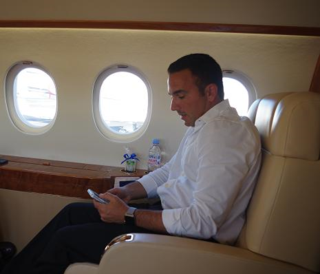
    As the Falcon 2000LX reaches 41,000 feet, Uri Man begins answering questions from real estate developers. “It’s not stagnant. It’s circulating,” Man, the CEO of Crystal Lagoons USA, tells one inquiring passenger.

    Soon we would see for ourselves. Man had chartered the plush jet and scooped up some developers and this author attending the Urban Land Institute’s Fall Meeting in San Francisco last Monday. Now we’re bound for Cabo San Lucas to tour a human-made lagoon.

    “We are a technology company collaborating with developers,” Man explains. This unique collaboration for large-scale real estate development projects had piqued my interest. Crystal Lagoons has 300 lagoon projects underway globally.  Man did a stint as a developer before Crystal Lagoons founder Fernando Fischmann recruited him to accelerate lagoon projects in the U.S. “Right now we’re going to Cabo, because I can’t show you one yet in the U.S.” That’s about to change. The first Crystal Lagoon in the U.S. will reportedly open next summer at Epperson Ranch in Pasco County, Florida.

    Meantime, we’re headed to the southern tip of Mexico’s Baja peninsula to see what a 10-acre salt water lagoon looks and feels like. As Man begins a slide presentation on his notebook computer, I begin

    Crystal Lagoons Diamante web
    A 10-acre Crystal Lagoon at Diamante Cabo San Lucas, Mexico. (Photo credit: K.R. Hirzel)

    visualizing the collaborative potential of lagoons. Resort developers need a new amenity to differentiate their projects. Coastal resorts can increase their waterfront, and inland resorts can gain a coastal experience. A Crystal Lagoons architect and project team collaborates with the developer’s planning team until they conceive a project with a lagoon as the centerpiece. The Crystal Lagoons technology uses disinfection “pulses” that reportedly allow using up to 100 times fewer chemicals than a swimming pool and an ultrasonic filtration system that allows using up to 50 times less energy than conventional filtration systems.

    The Crystal Lagoons business model has nothing to do with construction and everything to do with licensing. The company has a major stake in the success of development projects, because it receives roughly two percent of every condominium and house sale and a similar cut of each time share dollar. For developers, constructing lagoons costs an average of $100,000 to $200,000 per acre.

    The Falcon 2000X lands, and a greeting party boards the plane and passes out hand-blown shot glasses. After a ride through some dusty Cabo streets, we arrive at the Diamante development west of the city on the Pacific Ocean. After we tour the resort, I change into my swim suit and plunge into the salt water lagoon. As I swim laps in a life-guarded area near one of two beaches, kayaks explore the expanse of this man-made mini ocean.

    En route back to San Francisco, Uri Man talks about the future of Crystal Lagoons with the gusto of a bond trader (he used to be one) and the chutzpah of a guy who once hit on Fox News anchor Ainsley Earhardt on live TV (which he did). That future may involve cross-sector collaboration among industry and governments.

    Crystal Lagoons-Uri En Route to Cabo web
    Crystal Lagoons USA CEO Uri Man on board a Falcon 2000LX en route to Cabo San Lucas, Mexico. (Photo credit: K.R. Hirzel)

    “Parks are big money losers for states, cities and countries,” Man insists. So why not collaborate with governments to transform parks with lagoons? “Then it’s not just ten people showing up with their dogs,” says Man. “You could have hundreds of thousands showing up.”

    The licensing revenue business model, which the company would likely modify for government work, ties the success of Crystal Lagoons to the achievements of developers and their large-scale projects. Both parties share wins and losses. So Crystal Lagoons enters into collaborations carefully and works with developers to create mutual value. More broadly, business partners can achieve smashing success if incentives and business models foster symbiotic relationships and collaborative value creation.


  • Fixing General Motors and Curing Veterans Affairs

    General Motors chief executive Mary Barra has vowed to change the company’s culture and has testified
    GM Logo1before Congress that GM has taken steps to increase internal transparency and information sharing. This commitment follows a report exposing that GM discouraged raising or sharing safety concerns. The company commissioned the report, because GM failed to recall thousands of cars with defective ignition switches for eleven years.

    Similar calls for culture change have followed the Veterans Health Administration’s wait-for-care and numbers fudging scandal. President Obama has remarked that VA Image the VA needs a culture change so that “bad news gets surfaced quickly.” Not content to wait for culture change, House and Senate negotiators today announced a $17 billion plan that, among other provisions, provides money to lease clinics so that veterans can get treatment outside the VA’s system.

    Culture change emphasizes the result without a way to get there. It’s like telling a poor person to become rich. Culture change has become a common prescription from leaders, pundits and management gurus. The prescription often fails, because the shift originates with executives without detail, discussion or broad buy-in. Meantime, the organizational structure stays the same.

    The Bounty Effect has hit GM and the VA. As I describe in my new book, The Bounty Effect happens when exigent circumstances compel businesses, government and organizations to change their structures from command-and-control to collaborative. The solution for these organizations is to seize the opportunity The Bounty Effect provides and fundamentally change their structures so that people can spontaneously engage one another, share information and participate in decisions regardless of level, role or region. This will cost far less than $17 billion.

    Many organizations, including GM and the VA, still operate with a structure that has barely changed since the Industrial Age.  This obsolete structure based on command-and-control promotes hierarchy and internal competition plus rewards information hoarding, secrecy, and cutting corners. GM and the VA also share a need to go through channels. This inhibits the participation and information flow critical to Information Age organizations.

    Safety concerns apparently never reached GM’s chief executive, nor did problems with scheduling reporting systems apparently flow to former VA Secretary Eric Shinseki.  And both organizations apparently discouraged people from sharing concerns. VA supervisors often retaliated against workers who raised valid complaints, according to a White House report.

    GM chief executive Mary Barra has said that culture change must be leader-led. Barra has also promoted a program called “speak up for safety” plus three GM “core values.” These are “the customer is our compass, relationships matter, and individual excellence is crucial.” But a leader’s words have modest impact without structural change. Yes, GM has added safety investigators, increased safety data mining, and created a vice president of safety position. Nevertheless, none of these actions will reduce information hoarding and internal competition. None of these actions will change GM’s structure from command-and-control to collaborative. 

    When an organization rewards obsolete behavior, change dies on the vine despite a leader’s mandate. If hoarding and hiding information or failing to act on knowledge results in a raise or a promotion, people are unlikely to share information or take action. Pushing safety issues at GM was seemingly no path to promotion. VA managers reportedly kept patient names off the official waiting list, because bonuses depended on concealing information. Recognition and reward systems in obsolete organizational structures often reinforce bad behavior and the status quo regardless of culture change efforts. The same flawed practices and processes that encourage internal competition and information hoarding lead companies to compromise safety and fudge numbers.

    Changing the VA’s structure will enhance transparency and efficiency while saving money rather than costing the $17 billion Congress is authorizing. Changing GM’s structure will ensure that people across the organization share and act on critical information.  And changing the structure of GM and the VA will accomplish what many leaders and pundits are recommending: culture change.


  • Clinton Foundation Collaborates to Improve Health

    Collaborating across sectors—government, private industry, non-governmental organizations (NGOs) and education—can solve some of the world’s greatest challenges. These challenges include global health, economic inequality, childhood obesity, climate change, and health and wellness—which, incidentally, are the five main areas in which the William J. Clinton Foundation works.


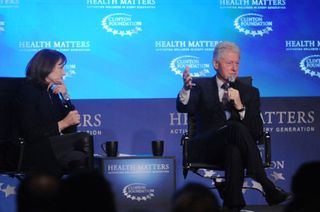
    Health and wellness was front and center last Tuesday as President Bill Clinton and his daughter, Chelsea, assembled a few hundred people in the California desert for the Clinton Foundation’s Health Matters conference. Despite the focus, themes are interrelated. So global health, economic inequality, and childhood obesity crept into the discussion. In his opening remarks, President Clinton noted that the rising cost of health insurance premiums often prevents employers from increasing wages. “We cannot ignore the link between health and the economy,” said President Clinton.

    Clinton Health Matters


    Invited guests and speakers at the La Quinta Resort in La Quinta, California included hospital and insurance executives, health policy experts, and veterans of government service including Dr. David Satcher, Surgeon General of the United States during the Clinton Administration. Others including Dr. Deepak Chopra, Dr. Dean Ornish, and actress Barbra Streisand are partnering with the Clinton Foundation to advance health and wellness agendas. Long-standing relationships among some participants coupled with the relaxed resort atmosphere sparked an exchange of actionable ideas. President Clinton and Chelsea seemed as comfortable sitting in the audience asking questions and refining ideas as they were on stage.

    “We’re moving into an era where the only way you can create enough jobs for people and generate enough wealth to have decently-rising wages is if you have creative networks of cooperation. I think the same thing is true of this health challenge,” President Clinton insisted during a discussion with NBC News Chief Medical Correspondent Nancy Snyderman, a friend of the former president for thirty years. “It’s the only thing that works. It works everywhere in the world.” This is another way of saying that collaboration creates value.

    I practically muttered “Amen” aloud when President Clinton cited a study that found that if you put a group of people with average IQs together and ask them to work on a problem for a year and you give the same problem to a genius, over the long run the group of people with average intelligence working together will do better than one genius acting alone.

    One of the most impactful ways that collaboration can improve healthcare is to remove the barriers that exist between front-line doctors and other health professionals. Too often primary care doctors practice in silos. Dr. Mark Weissman rose from the audience to insist that he and other primary care doctors are awash in patient data but lack regular access to other medical professionals who can collaborate with them on the data and on patient care. Pediatrician Donald Berwick, former administrator of the Centers for Medicare and Medicaid Services and a possible candidate for governor of Massachusetts, responded to Weissman that it’s necessary for doctors to learn that “I’m no longer the hero who saves the day, but I’m interdependent with others to give care. That’s what works.”

    I’ve written often in this space and in The Culture of Collaboration book about how engaged team members working in a collaborative culture create far more value than do team members working in a culture of fear and internal competition.  Dr. Deepak Chopra noted that employee disengagement costs the United States economy $300 billion a year. “If your supervisor ignores you, you start to get disengaged and within a few months you start to get ill,” Chopra explained. “If your supervisor doesn’t ignore you but criticizes you, you actually get better.” This is because we would rather be acknowledged than ignored even if we’re receiving criticism. “And if your supervisor notices a single strength that you have, your rate of disengagement goes down to 1 percent,” according to Chopra.

    The Health Matters conference is as much about taking action as about exchanging ideas. Corporations, government entities, non-profit organizations, and individuals pledged to take action in preventing disease and improving health. Financial pledges total over $100 million. One such pledge by entrepreneur and philanthropist Vinod Gupta will support a new Clinton Foundation program to address prescription drug abuse. Gupta’s son, Benjamin, died accidentally after taking prescription painkillers and consuming alcohol in December of 2011. Gupta and the Clinton Foundation will educate the public, particularly college students, about the dangers of prescription painkillers.

    As I was checking out of the La Quinta Resort, I noticed that Surgeon General Satcher was next to me in line. We chatted about his recent work guiding the Satcher Health Leadership Institute at the Morehouse School of Medicine in Atlanta. Dr. Satcher noted that at Morehouse he’s building on his work as surgeon general by collaboratively focusing on neglected diseases and underserved populations. Like so many other disciplines, improving health and wellness requires collaboration.