organizational structure


  • Big Data, Measurement Mania and Collaboration

    The world is drowning in data. The term “Big Data” appears in most technology trend articles in 2013 and reverberates at seemingly every conference regardless of industry. This reminds me of a quote attributed to Mark Twain that I used with my senior picture in the high school yearbook: “Collecting data is much like collecting garbage. You must know in advance what you are going to do with the stuff before you collect it.”

    Now companies and government agencies have an idea what they’re going to do with the data they collect. And a leading use of data is measurement. Measurement mania has spread throughout every function of seemingly every organization from government agencies and universities to public school systems and corporations. Organizations can now measure traits among applicants and team members ranging from emotional intelligence to flexibility. Plus companies can calculate transactional cost-per-hire.

    The relentless drive to measure people can reduce value creation and compromise collaboration. Measurement mania breeds fear and internal competition among team members and encourages leaders to focus on short-term results which create less sustainable value than achieving longer-term objectives. In a numbers-obsessed organization, leaders are more likely to cut corners by booking phantom sales or sacrificing safety in manufacturing plants. With hidden agendas running rampant, collaboration towards common goals becomes impossible.

    Media reports suggest that Zynga, the company that develops online games including FarmVille, has thrived on numbers. “Relentlessly aggregating performance data, from the upper ranks to the cafeteria staff,” is the way Evelyn M. Rusli of the New York Times describes the company in a November 27, 2011 story. According to a November 28, 2011 blog post by Ryan Fleming of Digital Trends, executives nurture “fierce competition both between the groups and within each department.”

    Apparent measurement mania is one of many structural and cultural issues that have plagued Zynga. A September 8, 2010 story in SF Weekly by Peter Jamison indicates that the company’s values are sub-optimal and that rather than focusing on innovation, Zynga has instead pushed team members to appropriate ideas from competitors. If these assessments are accurate, it appears that Zynga would benefit from changing the structure and culture of its organization. Principles is one step that I explain in my new book, The Bounty Effect: 7 Steps to The Culture of Collaboration.

    In perhaps the most sober indication of problems with Zynga’s focus, the company reported second quarter results last Thursday that contained few bragging rights. While the results exceeded analyst expectations, the number of daily active users declined 45 percent in the quarter from the same period last year. In the three months ending June 30, Zynga’s sales fell 31 percent to $231 million. According to the Wall Street Journal, Zynga CEO Don Mattrick indicated that “getting a business back on track isn’t quick, and isn’t easy.” Mattrick recently replaced founder Mark Pincus as CEO.

    While Zynga clearly faces challenges on many fronts, the company’s structure and culture are likely factors in Zynga’s woes. The company is by no means alone in the issues it faces and the possible structure and culture elements. Organizations of all kinds face exigent circumstances ranging from new competitors and disruptive market forces to natural disasters and terrorist attacks. These storms that blow through businesses provide opportunities to change.

    In The Bounty Effect, I discuss how to replace command-and-control remnants including measurement mania and how to adopt collaborative principles, practices and processes among other steps. Creating value through collaboration happens only when organizations change their structures and cultures from Industrial Age command-and-control to Information Age collaborative.


  • Seven Steps to The Culture of Collaboration

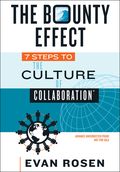
    My new book, The Bounty Effect: 7 Steps to The Culture of Collaboration, has received two favorable reviews: one in Publishers Weekly and the other in Library Journal. Both reviews focus on the 7 Steps: Plan, People, Principles, Practices, Processes, Planet and Payoff.

    I’m delighted that both reviewers understood the book’s premise that businesses must abandon obsolete organizational structures designed for the Industrial Age and replace them with infinitely more valuable collaborative structures suitable for the Information Age. Leigh Mihlrad of the National Institutes of Health reviewed The Bounty Effect for Library Journal. “Rosen declares that while the control method might have worked in the Industrial Age, it does not work in today’s Information Age,” according to the review. Mihlrad concludes with the Library Journal's verdict: “For those in positions to bring about organizational change, this book provides many useful examples.”

    The Publishers Weekly review highlights my point that The Bounty Effect is by no means limited to corporations. “Rosen argues that collaboration moves well beyond organizational boundaries, as it applies to neighborhoods, communities, and government,” according to Publishers Weekly.  “Collaboration creates greater value, enhances achievement, and produces sustainable business models; the question then becomes how quickly can an organization free itself from the Industrial Age and operate to its maximum capacity in the Information Age.” The sooner an organization starts the seven steps, the faster it can migrate from command-and-control and maximize value through collaboration


  • Changing Organizational Structures for Collaboration

    My new book entitled The Bounty Effect: 7 Steps to The Culture of Collaboration® is now available. It’s the second book in a series which includes The Culture of Collaboration®: Maximizing Time, Talent and Tools to Create Value in the Global Economy. The Bounty Effect shows how to change the structure of organizations for collaboration.

    Why do organizations need to change their structures? The Industrial Age was command and control. The Information Age is collaboration. Yet Industrial Age structures render collaboration dead on arrival in the Bounty Effect Jacket JPGInformation Age. Remnants of these structures—including organization charts, performance reviews, meetings and mission statements—inhibit organizations from using new collaborative methods and tools that spark innovation. Now we’re at the point where many organizations—from corporations and small businesses to universities and government agencies—have a desire to collaborate.  Some have taken action to instill collaborative culture. But what’s holding back collaboration is obsolete organizational structures, which we must change.

    The Bounty Effect gets its name from the mutiny that occurred on the H.M.S Bounty in 1789. Before the mutiny, Captain William Bligh used a well-worn management technique: command-and-control. The mutiny forced the structure and culture to change as Bligh became a collaborative leader and his loyalists participated in decisions as they struggled for survival aboard a small boat. The mutiny was an exigent circumstance, one that compels immediate action.

    The Bounty Effect happens when exigent circumstances compel businesses, governments and organizations to change their structures from command and control to collaborative. Triggers include disruptive market forces, new competitors, regional slowdowns, natural disasters, terrorist attacks and global downturns.

    The book is about how to seize the opportunity that The Bounty Effect provides and change the organizational structure in seven steps.  My objective in writing the book is to provide a framework for structural change necessary to transform organizations into collaborative enterprises. And The Bounty Effect demonstrates how collaborative enterprises create far more value than command-and-control organizations. Using the framework, people and organizations can determine how to redesign and adopt a collaborative structure that fits. I welcome your input.