People


  • Multicultural Collaboration Produces Unique Spa

    Bridging cultures, particularly regional cultures, produces a broader perspective that gives collaborators an edge. In disciplines like aerospace engineering, team members trained in one country’s engineering tradition may view a creative challenge differently than their colleagues who were trained in a different country’s system. Drawing from their collective global knowledge, cross-cultural collaborators can spark synergies and create greater value. In The Culture of Collaboration book, I call this the Dynamic Dimension of Cross-Cultural Collaboration.

    This dimension is alive and well at Archimedes Banya, a spa complex that opened in San Francisco last New Year’s Eve after twelve years of development and construction. People from twenty different countries collaborated on the project. Managing partner Mikhail Brodsky of Russia had the original idea. Reinhard Imhof of Switzerland led the indoor construction. Architect Sam Kwong of China developed the plans. Other partners are from countries including Korea, Israel, Germany, Japan, and Mexico.

    The concept began when Brodsky, a mathematician, arrived in San Francisco from Moscow in 1989. A lBanya2over of Russian bath complexes or banyas, Brodsky was disappointed to find no such facilities in his adopted city. He longed to start a banya. In the summer of 1998, Brodsky, then a professor at the University of California at Berkeley, applied for a job as chair of the mathematics department at San Francisco State University. SFSU’s rejection sparked Brodsky’s interest in doing something significant in San Francisco while delivering on his banya dream.

    Brodsky, Imhof and two other partners formed a company, and in 1999 bought a lot in India Basin near San Francisco’s former Hunters Point Shipyard. Though in an obscure neighborhood, the lot provided sweeping views of San Francisco Bay. To construct the building, Brodsky and his partners would need to recruit more partners. Like many ethnic groups living in the United States, many Russians do business only within their community. Therefore, logic would dictate engaging Russians to finance, design and build the project. But some Russians who Brodsky approached had difficulty seeing past the many roadblocks to the project ranging from building permits and location to construction costs and customer base. So, Brodsky decided to broaden his reach, involving people from as many countries as possible. The common thread was a passion for the Banya project plus mutual trust and common goals, two of the Ten Cultural Elements of Collaboration I identify in The Culture of Collaboration book.

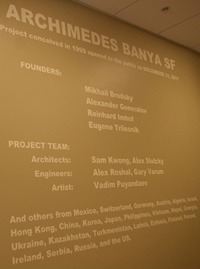
    In a departure from the command-and-control approach to business in which “stars” grab the credit, Archimedes Banya recognizes multiple contributions in much the same way Adobe Systems includes a Banya Wallcredit role in its software products. When I visited Archimedes Banya recently, the first thing I noticed was a wall near the entrance listing the names of the multicultural collaborators who turned the concept into reality. Also apparent was the amazing art ranging from mosaics depicting bathing traditions to murals and inlaid ceiling tiles. Including art in public bathing facilities is a tradition dating back to the Roman Empire.
    Artist Vadim Puyandaev of Kazakhstan collaborated with Brodsky to evoke the right atmosphere. “I
    wanted very simple, clear images of emotion,” says Brodsky. And the images also reflect action. “In a Russian banya, people move. It’s an active place. It’s not just sitting and sweating.” The complex is geared to socializing and offers facilities ranging from a rooftop sun deck with a San Francisco Bay view to private reception rooms replete with bars and kitchens.

    The Banya offers a spa experience reflecting the cultural melting pot. I checked out two Russian saunas, the Finish dry sauna, the steam room, warm soaking pools, cold plunge and relaxation room. After loosening up in the various saunas, I experienced a Russian venika platza treatment that involved a tall Moldovan fellow clad in a towel and sweat-soaked Banya hat brushing and lashing bunches of Latvian birch leaves on me to increase circulation.

    Following this, I laid on a table as an attendant scrubbed me with an exfoliating soap and then rinsed me with buckets of warm water. Then my muscles were relaxed enough for a massage from a masseuse from the United States. Afterwards, I headed to the café upstairs for pelmini or Russian dumplings, stuffed cabbage, hearty Russian beef soup, fresh-sqeezed juices spiked with kombucha, which is fermented tea and housemade kvass, a non-alcoholic beer made from fermented rye bread.

    An ambitious spa project that began as one person’s vision ultimately reflects the combined vision and execution of multiple people from many cultures. Collaboration involves marrying talents that are worth far more collectively than individually. Brodsky describes himself as a “starter.” But to make the project a reality, he collaborated with Imhof, a “finisher.” Because of the Swiss tradition of quality workmanship, Imhof shared Brodsky’s values of using the best materials and constructing a banya for the long term. The concept of “starters” and “finishers” has broad ramifications. A starter may have an incredible idea, but creating a company that produces substantial value may require collaborating with a finisher.

    As we collaborate, we can create awesome value by engaging and involving people with multiple talents and backrounds and, yes, from multiple cultures. The Dynamic Dimension of Cross-Cultural Collaboration delivers results otherwise unattainable.


  • How Bean Counting Compromised Value at General Motors

    Too often companies emphasize numbers over products and forecasting over customers. Such firms typically focus on short-term results over long-term value. This creates greater internal competition and encourages shorter-term supplier relationships rather than enhancing collaboration internally among functions and externally with business partners.

    The relentless focus on numbers at the expense of domain expertise figures prominently in the book, Car Guys vs. Bean Counters (Portfolio, 2011) by Bob Lutz, former vice chairman of General Motors. Fifty years ago, GM products were the epitome of design. Over the last half century, though, the company’s products have steadily lost traction with customers. This decline culminated in the company’s reorganization under Chapter 11 in June of 2009. While many factors contributed to GM’s bankruptcy, short-sighted bean counting was undoubtedly one of them.

    “It’s time to stop the dominance of the number crunchers, living in their perfect, predictable, financially projected world,” writes Bob, who specializes in getting people’s attention. I first encountered Bob early in my career when I was reporting on the auto industry and attending the introduction of the Jeep Grand Cherokee at the 1992 North American International Auto Show in Detroit. Bob exuded machismo as he drove the SUV through a plate-glass window into the hall, shocking me and other journalists awaiting the usual dull presentations. At the time, Bob was president of Chrysler.

    Bob’s detractors consider him an old-school, shoot-from-the-hip executive who makes decisions based on his gut with little analysis. In reality, Bob understands the need for left brain and right brain driven people to collaborate regardless of their titles or functions. And he encourages more junior people to challenge him. In short, he values constructive confrontation, one of the ten cultural elements of collaboration I introduce in my book, The Culture of Collaboration

    The former Marine Corps pilot insists that “car guys” should run auto companies, “supermarket guys” should run supermarkets, and “software guys” should run software companies. He concedes that these “guys” can be of either sex. Too often, as I noted in The Culture of Collaboration book, boards of directors and senior leaders believe that if they hire “star players” these supposed stars can and will achieve results regardless of their domain knowledge or industry experience. Some prominent management consulting firms reinforce this skewed logic. The so-called star players are typically numbers-driven MBA’s interested more in units rather than in products and in forecasting rather than in customers. The organization promotes these internally-competitive numbers crunchers and sidelines others who focus on improving products and interacting with customers.

    Of course, quantitative analysis is critical to any business. The problem arises when quantitative analysis dominates and pervades every aspect of a business while designing awesome products and creating market stickiness take a back seat. As Lutz chronicles in his entertaining and informative Chevrolet 1957 book, once upon a time design dominated the auto industry. Think of the tail fin era of the late 1950’s which gave rise to cars including the 1957 Chevrolet and the 1959 Cadillac (see images, Chevy image courtesy Trekphiler). Designers originated products. By the 1970’s, General Motors had reigned in designers, made design “part of the system,” and assigned product origination to a department called Product Planning staffed by former finance people.

    Neither the old design-driven General Motors nor the newer numbers-driven organization is a model of collaboration. In the 1960’s, when design and the designers were at their pinnacle, Lutz writes thatCadillac 1959  chief designers in well-tailored suits graced magazine covers. Essentially, designers had become stars and expected star status and treatment within GM and in society. Chief designers often silenced and sidelined people in other functions.

    When GM reduced the role of designers, the organization empowered product planning to originate products in a vacuum. Handing plans off to designers with the instruction “go design this” hardly enhances collaboration. Ideally, designers would lead a design process with input from, engineering, manufacturing, marketing, sales and dealers. In a collaborative organization, people come together across departmental and functional barriers to share ideas and develop products and services in concert.

    At least among senior leaders, GM more recently came closer to this ideal when it hatched the Chevrolet Volt, a hybrid electric/gas car introduced in December, 2010. Lutz, who had advocated an all-electric vehicle, describes how he sat across from Jon Lauckner, former GM vice president of product planning, as Lauckner sketched out the first drawing depicting the “sequential” hybrid technology of the Volt. This differs from the “parallel” hybrid technology of the Toyota Prius (The Volt is designed to go forty miles without using gasoline unlike the Prius which alternates between electric and gas). And almost immediately people Lutz dubs “unconventional thinkers” in design and product planning began collaborating.

    Whether it’s skimping on ingredients in restaurant kitchens or using inferior paint in automobile assembly plants, focusing on numbers over products and forecasting over customers reinforces the wrong organizational values. In time, team members become comfortable sacrificing products and shortchanging customers. Ultimately, value evaporates.  More collaborative organizations use quantitative analysis as a tool rather than as the primary organizational focus.


  • Collaborative Chaos at the New York Times

    Journalism, at its best, involves constant collaboration.

    In television newsrooms, reporters, producers and assignment editors engage in a continuous conversation about stories and often edit scripts together in real time. While real-time group writing is a relatively new phenomenon in education and business, reporters and producers frequently write story introductions and “teases” together. This traditionally involves no electronic screen-sharing or web conferencing, but rather colleagues shouting to one another across the newsroom or two people hunched over a single terminal. In newspaper newsrooms, a similar continuous dialogue occurs among reporters and editors. Some colleagues get to know one another so well that they even finish each other’s sentences.

    All of this newsroom interaction requires informality. Corporations and government agencies are increasingly embracing informality, because of a growing realization that formality compromises value creation. But informality is nothing new in newsrooms. The informality of journalism dates back at least to the early 20th Century when few reporters got “formal” higher education and the socialization that accompanies it. Newsrooms then felt more like police stations in which colleagues sat in an open room exchanging sarcastic, irreverent banter. And though most journalists (and many police) now graduate from college and the journalistic culture has evolved, newsrooms have nevertheless retained much of their informality.

    Films about journalism have captured this informality. Examples include the 1931 and 1974 versions of The Front Page, written by Ben Hecht and Charles MacArthur, about newspaper reporting in Chicago. Also, the 1976 film, All the President’s Men, directed by Alan Pakula, about Washington Post reporters Bob Woodward and Carl Bernstein’s investigative reporting on the Watergate scandal, reveals the constant conversation among all the players in the Post newsroom. The conversation continues down corridors and into the elevator where executive editor Ben Bradlee (played by Jason Robards), in a dramatic moment, instructs Woodward (played by Robert Redford) and Bernstein (played by Dustin Hoffman) to “print it” meaning to run a story about Watergate.

    Fast forward to 2011. Traditional journalism is under siege, in part because of the Great Recession’s 
    Page One ravages but mostly because of systemic shifts in the media industry. These include shrinking audiences and advertising dollars flowing to Web-based alternatives including social media. Against this backdrop comes Page One: Inside the New York Times, a documentary directed by Andrew Rossi, which attempts to capture a leading newspaper and its people at a pivotal point. (Photo of Times newsroom above courtesy of Magnolia Pictures)

    The reviews have been mixed, a charitable adjective for Michael Kinsley’s take on the film that ran in—of all outlets—the New York Times itself. Kinsley takes the documentary to task for flitting “from topic to topic, character to character, explaining almost nothing.” Kinsley suggests that the movie is disjointed and confusing. The film does take up a series of topics: WikiLeaks, the Pentagon Papers, the Times survival, Comcast’s purchase of NBC Universal, Twitter’s impact, the Times’ plagiarism scandal involving former reporter Jayson Blair, Iraq, the Apple iPad, and the ups and downs of the Tribune Company, among others.

    And all of this comes in the form of a continuous conversation upon which we as the audience eavesdrop. “Like a shopper at the supermarket without a shopping list, “Page One” careens around the aisles picking up this item and that one, ultimately coming home with three jars of peanut butter and no 2-percent milk,” Kinsley writes. Yes, but the collaborative process is rarely pretty.

    In The Culture of Collaboration book, I identify the Ten Cultural Elements of Collaboration that are typically present when collaboration works. One of these elements is collaborative chaos, which is exactly what Page One reveals. Collaborative chaos, the unstructured exchange of ideas to create value, lets the unexpected happen and generate rich returns. In the film, we see former cocaine addict and current Times media columnist David Carr sharing ideas with his sources, his colleagues and his editor, Bruce Headlam. These exchanges culminate in value creation, Carr’s columns. And the film invites us into the Times daily story conferences during which editors jostle over which articles should appear on the front page.

    Kinsley, no stranger to journalism as the former editor of the New Republic and Slate, would undoubtedly argue that while confusion may prevail in newsrooms, it’s the job of the filmmaker to present a more organized picture. But attempting to sanitize or beat the collaborative chaos out of the Times or any news operation would present a distorted view. It would be like eating street food in an upscale setting, a current trend in the restaurant business incidentally.

    Journalism, and collaboration itself, involves a continuous conversation during which collaborative chaos prevails, recedes, only to prevail again all the while creating value.


  • Recasting Knowledge Management

    Collaboration is shaking up the once-staid field of Knowledge Management (KM) as enterprise social media and interaction play an increasing role. The premise of KM is that an organization’s intellectual capital or “intangible” assets comprise its greatest value and that therefore the organization must manage these assets.  Through the 1990’s, KM gained traction with the growth of data networks, the evolution of database technology and the increasing premium placed on information.

    KM has traditionally supported command-and-control organizational cultures and structures in which the organization seeks to gather, retain, unlock and control its resources. And often believing that data drives knowledge, organizations have pushed to populate data repositories. Enterprise blogs and wikis have added an unstructured element to creating and capturing knowledge. As social media takes hold in organizations, KM practitioners are rethinking their craft, integrating social media and collaborative tools into their frameworks, and recasting KM as embodying collaboration. The goal is to broaden KM’s appeal and, in particular, engage younger team members.

    “I define knowledge management as information management and collaboration,” insists Katrina B.  Pugh, author of Sharing Hidden Know-How (Jossey-Bass, 2011). Kate, a KM consultant and former vice president of knowledge management at Fidelity Investments, believes gathering data should take a back seat to sharing information. “It’s much more about improving those interactions than populating those repositories,” she explained during a compelling conversation recently.

    People often use the terms social media and collaboration interchangeably. Social media describes a category of tools that can be used to collaborate. In The Culture of Collaboration book, I define collaboration as “working together to create value while sharing virtual or physical space.” It’s quite possible to create no value while using social media. It’s also possible to create substantial value. And considering the current excitement over these tools, I asked Kate whether there’s a downside to social media when it comes to KM. “It’s losing the person-to-person interaction,” she quickly responded. By person-to-person, Kate means voice, video and face-to-face encounters. I suggested these real-time encounters have a more “three-dimensional” quality. Kate agreed. “The best social media interactions are the ones that follow a conversation,” she noted.

    Conversation, in fact, is at the heart of Kate’s approach to KM outlined in her book. She calls the approach "Knowledge Jam." The idea is to transfer knowledge from “knowledge originators” to “knowledge brokers” through facilitation, conversation and translation. A facilitator, either an outside consultant or internal team member, jump starts the Knowledge Jam during a series of structured 90-minute sessions.

    I raised two issues with Kate:

    1. Many knowledge originators are “go-to” people who hoard information
    2. Is a facilitator necessary?

    Absolutely, Kate agrees, knowledge originators may hoard. That’s why “there must be something in it for them [to share knowledge],” Kate explains. And that something is that “in a shifting environment, they need to learn the new playing field.” In other words, to remain relevant and keep their jobs, Kate believes knowledge originators will trade their knowledge for new context and skills. What about the need for a facilitator? Yes, Kate says, getting the conversation going between knowledge originators and knowledge brokers requires a facilitator.

    I get that a facilitator can jump start Knowledge Jam, but ultimately organizations must share knowledge and collaborate naturally. The problem with consultants as facilitators (full disclosure: I’m a consultant) is that when they step aside, the organization can easily revert to previous behaviors. The problem with internal facilitators is their perceived and, at times, actual lack of neutrality. For collaborative organizations, sharing must become part of DNA. And KM is part of that equation.

    As KM evolves to fit with more collaborative organizational cultures and structures, the term knowledge management also needs updating. Management suggests hierarchy and command-and-control. How about knowledge collaboration (KC)?


  • Changing Education

    Businesses face challenges in becoming collaborative partly because traditional education systems often discourage collaboration. These systems condition workforces and organizations to operate in command-and-control mode. Now there are promising signs of an educational upheaval that mirrors shifts in business and government. Many universities are seeking to reinvent themselves to preserve their relevance.

    In The Culture of Collaboration book, I write about the shift in the role of the professor from “sage on the stage” to “guide on the side.”  Driving the shift is the decline in credibility of professors. In an era of rapidly changing information,  students can search online for ideas more quickly than teachers and professors lecture about them. “Students don’t really believe their professors,” is the way David Edwards put it during our conversation last week.

    David Edwards, who’s the Gordon McKay professor of the practice of biomedical engineering at Harvard, has collaborated with colleagues to update his university’s role in educating students. David shares my view that both universities and businesses must provide physical and cultural space to spark and collaboratively develop ideas.

    David is the author of The Lab (Harvard University Press, 2010). This compelling book chronicles the growth of Artscience Labs, an international network of idea labs David and his colleagues have developed. The labs spark “idea translation,” a process of repeated experimentation, exhibition, prototype critique and team evolution. The book delves deep into emerging approaches to innovation growing out of these interconnected labs which include Le Laboratoire in Paris, The Lab at Harvard, and similar labs at other universities and high schools. Many ideas incumbated and nourished in the labs have become commercial products. These include everything from edible bottles to inhalable chocolate.

    The growing Artscience movement draws inspiration from the Bauhaus school that flourished in Germany during the Weimar period after World War One. The Bauhaus concept was a “total work of art” bringing together all arts including design and architecture. Bauhaus emphasized “rationality, functionality” and the need to free art from Bourgeois influences.  The labs break down boundaries between arts and sciences to accelerate learning. This mirrors silo busting and curing Silo Syndrome in business and government that I write about frequently here and in The Culture of Collaboration book. Results of Artscience efforts range from new designs and art to new companies and humanitarian organizations.

    Edwards believes institutional boundaries have hampered education at Harvard and elsewhere, and he agrees that similar boundaries plague businesses. Technology and culture shifts have curbed “our ability to curate information and give it any meaning,” David notes. He compares overly-curated art with overly-curated information. Why is it, Edwards wonders, that there are thousands of works in a museum like the Louvre, but that art “experts” and books focus on only a handful of “important” works? Not to mention, I was thinking, all of the art–some of it excellent– that never makes it into the collections of the Louvre and other museums.

    So, a new cultural model is necessary. And guess what this model involves? “Nothing gets done without intense collaboration. We can no longer ignore it,” David insists. Amen. Some design firms advocate a formal process for brainstorming and ideation. In contrast, the approach to collaboration, innovation and ideation practiced in Artscience Labs is decidedly less formal. “I’m very skeptical about rules for ideation or idea development,” David says. Freedom to take risks and make mistakes is key, and so is the ability to realize mistakes and quickly develop a new idea or approach.


  • Incenting the Intelligence Community to Collaborate

    Instilling collaborative organizational culture often requires changing the recognition and reward system. But internally-competitive entrenched interests will undoubtedly resist changes to how the organization pays and promotes people. Also expect resistance from people who believe there’s no reason to incent people, because they should do as they’re told.


    James Clapper Tuesday, during James Clapper’s confirmation hearing as director of national intelligence, Senator Carl Levin (D-Michigan) asked Clapper why it’s necessary to incent the intelligence community to collaborate. Levin was referring to Clapper’s pre-hearing questionnaire in which he apparently wrote that, if confirmed, he would achieve progress in information sharing by the “disciplined application” of incentives—both rewards and consequences. “Why do we need incentives,” Levin asked “Why don’t we just need a directive from the President by executive order, for instance? Otherwise, why do we need incentives, rewards and consequences?”


    Clapper responded, “One way of inducing change in culture is to provide rewards for those who collaborate and, I suppose, penalties for those who don’t.” He added, “And obviously directives are effective too.” You can watch Levin’s questions and Clapper’s testimony before the Senate Intelligence Community on C-SPAN here (counter 1:37:06). Incidentally, collaborative organizations achieve more with the carrot than the stick. Penalties for failure to collaborate are anti-collaborative in that they spread fear. Instead, reward and recognize collaborators; then others will get the message and start changing their behavior.


    Since the 9/11 terrorist attacks, the intelligence community has struggled to shift from a culture of competition and information hoarding among agencies to a collaborative culture in which people share data and information. For background on this, see my December 30, 2009 post. I have advised senior leaders of the intelligence community about the transition. On the sixth anniversary of the terrorist attacks, I gave a speech to the community sponsored by the Office of the Director of National Intelligence (ODNI).


    In the speech, I highlighted four areas. One was aligning recognition and reward systems to encourage collaboration. ODNI, the entity formed after September 11, has been driving collaboration among the sixteen agencies that comprise the intelligence community. Some agencies have balked, ostensibly for security reasons, about sharing their data across the community. While security concerns are valid, perceived loss of control and inter-agency rivalry also play a role.


    The leaders whom I’ve advised implicitly understand the value of collaboration in developing better intelligence and thwarting terrorists. They also understand institutional resistance. James Clapper currently serves as Under Secretary of Defense for Intelligence and formerly served as the director of the National Geospatial-Intelligence Agency (NGA) and the Defense Intelligence Agency (DIA). This multi-agency intelligence background gives Clapper an advantage in guiding the shift in the intelligence community’s culture in that an insider committed to change has more credibility than an outsider does. Clapper must draw on his alliances and relationships across the community to help break down barriers among agencies and adopt collaborative culture.  


  • The Much-Maligned Meeting and Collaboration

    The “M” word creates more outbursts of opinion than practically any other word in business.


    I’m referring to the word meeting. Almost everybody has a—usually negative—gut reaction to the notion of meetings. Plenty of people would prefer being stuck on a tarmac than stuck in a meeting. Even though water and snacks are often available at meetings, our time belongs to others. On the tarmac, there’s no guarantee of refreshments, but at least our time is our own. In fact, meeting-bashing has become welcome break-room conversation.


    Nevertheless, technology vendors have invested huge resources in meetings. So, it’s not just employers who want to load up our schedules with meetings. There are vendors with vested interests in making meetings even more integral to our work than they are now.


    Last night on CNN’s “Larry King Live,” Larry asked Microsoft founder Bill Gates his opinion of the Apple iPad. Gates responded, “We’re all trying to get to something that you just have to take to a meeting and use.” He added, “It still isn’t the device that I would take to a meeting, because it just has no input.” You can view the video clip here. So, one way Bill gauges the effectiveness of the iPad and similar devices is whether we will want to take them to a meeting. Bill—and by inference, Microsoft—apparently remains focused on keeping us in meetings. In reality, it’s more important whether the iPad and any similar device fits into our lifestyles and work styles than whether we’ll want to bring it to meetings.


    Are meetings collaborative? There’s nothing inherently collaborative about an in-person or virtual meeting. That’s right. Using virtual meeting tools is no guarantee that we’re collaborating. Joining a web conference, using telepresence or IMing the day away creates little value unless these tools fit into collaborative organizational culture and practices.


    If we compete with colleagues and our teams and organizations reflect “star culture”, do the tools we use make us collaborative? No. It takes more than tools to make collaboration happen. If we fill our ranks with millennials and send them to meetings with devices loaded with collaborative capabilities, will those meetings automatically become collaborative? Don’t bet on it.


    The biggest beef about meetings is that they’re a waste of time. In other words, they fail to create value. If we come together as a group and we’re working together to create value, we’re collaborating. So, we’ve essentially transcended the notion of a meeting and instead we’re in a collaborative session. Organizations and vendors should seek to remake meetings as collaborative sessions.


    In the final chapter of The Culture of Collaboration book, I note that “Today we struggle to collaborate as effectively at a distance as we do in the same room. Tomorrow the challenge becomes the reverse.” As collaborating in the same room starts seeming awkward, that’s the new frontier. But organizations and technology vendors take note: it’s about creating more value through collaboration rather than better meetings.


  • It Takes More Than Sharing Information to Prevent Terrorist Attacks

    More than eight years after lack of collaboration among intelligence agencies contributed to the September 11, 2001 terrorist attacks on the United States, the Central Intelligence Agency is facing new allegations that it failed to share vital information that could have thwarted last week’s attempted bomb attack on Northwest flight 253.  

    ODNI Logo President Obama yesterday scolded the United States Intelligence Community for “a systemic failure” because intelligence agencies apparently never shared all of their information about the suspect before he boarded the plane and was ultimately subdued by passengers. The National Security Agency reportedly had information that Al Qaeda operatives in Yemen were preparing a Nigerian to commit a terrorist attack against the United States. And the Central Intelligence Agency had reportedly met with the father of Umar Farouk Abdulmutallab , the suspect, at the U.S. Embassy in Nigeria. The suspect’s father apparently informed the CIA of his son’s radicalization. Had there been greater collaboration among agencies, President Obama has said that the suspect’s name would have appeared on the so-called No Fly List, which likely would have prevented him from boarding the Northwest plane.


    According to the lead story in today’s Wall Street Journal, officials of the National Counterterrorism Center which acts as a clearinghouse for terrorism data, have indicated that the CIA failed to share all of its information with other agencies.


    The problem is that terrorists are often highly collaborative, but the Intelligence Community has lagged behind in embracing collaboration. The 911 Commission Report recommended a reorganization of the 16-agency Intelligence Community under a Director of National Intelligence. The report also recommended increased information sharing among agencies to thwart future attacks. Subsequently, President Bush signed the Intelligence Reform and Terrorism Prevention Act of 2004 which established the Office of the Director of National Intelligence (ODNI), the National Counterterrorism Center, and called for “open-source intelligence.” In 2007, ODNI implemented a 100-day plan and a 500-day plan for Integration and Collaboration among agencies.


    As part of the new commitment to collaboration, the Intelligence Community adopted A-Space, modeled after MySpace and Facebook, so that analysts could share information across agencies. The community has also adopted Intellipedia, a cross-agency wiki.


    On the sixth anniversary of the terrorist attacks, I gave a speech to the Intelligence Community. The speech was sponsored and hosted by ODNI. In the speech and during subsequent meetings with senior intelligence officials, I insisted that it would take much more than tools and a top-down collaboration initiative for the Intelligence Community to actually collaborate. Our research at The Culture of Collaboration® Institute indicates that in any organization, people may buy into collaboration as a concept, but in practice it’s a totally different story. Therefore, reducing fear of collaboration and changing behavior are crucial to cultural shift.


    Clearly, intelligence requires protecting classified information just as corporations must protect trade secrets. But aside from keeping outsiders from obtaining information, many career intelligence officers have been conditioned to embrace secrecy within their community. This fosters information hoarding, intra-agency rivalry and intelligence failures. It takes more than new tools and technologies and more than even an act of Congress to abandon this deeply-engrained conditioning.


    Sharing information among agencies is undoubtedly necessary, but thwarting attacks requires much more. Even if agencies make information available to one another, people need to know how to act on that information.  Therefore, I will reiterate here two major points on which I’ve counseled senior intelligence officials:


    1) Favor on-the-fly decisions over chain-of-command decisions.

    2) Encourage spontaneous interaction over scheduled encounters and meetings


    The White House and intelligence officials can talk ad nauseam about sharing information. If, however, analysts and other intelligence personnel are expected to run decisions “up the flagpole” and are inclined to schedule meetings rather than connect with colleagues and hash out issues on the fly, it will remain difficult to thwart attacks.


    As I noted in The Culture of Collaboration book, "the in-box culture is dead." And if asynchronous information sharing persists without the necessary real-time cultural components, intelligence failures will continue. The cultural shift necessary to prevent security lapses like the one aboard Northwest flight 253 involves moving beyond information and data sharing—and embracing real-time collaboration.


  • Cisco’s John Chambers: the Hardest Part is the Culture

    I was watching Cisco CEO John Chambers do his trademark walk-and-talk style keynote yesterday at the Hilton San Francisco Union Square as Cisco was kicking off its Collaboration Summit when suddenly John interrupted his pitch for collaboration.


    “Do you know what the hardest change is in this?” he queried the audience rhetorically. “As any CEO will tell you, it’s the culture.”


    John’s observation resonated with me in that the fundamental premise of The Culture of Collaboration book is that “without a culture of collaboration, the best processes, systems, tools and leadership strategies fall flat.” In the book, I also note that “the overwhelming reason why collaboration eludes organizations involves culture.”


    Understanding the role of culture in creating a collaborative enterprise is paramount, particularly as Cisco introduces 61 collaboration products. Collaboration tools are key enablers, but they are far more effective in enabling collaboration in enterprises with collaborative cultures and processes.  Cisco has been focusing on collaboration more than any other initiative as an organizational imperitive and in product efforts. Now the company is fixated on persuading customers that it has reached a milestone in innovating collaboration. With that in mind, Cisco vice president of enterprise solutions Alan Cohen, a history buff and blogger, noted that Cisco was announcing its slew of products on the 20th anniversary of the Berlin Wall’s fall and observed that it was one of the “biggest transitions in our history.”


    As Tony Bates, Senior Vice President and General Manager of the Enterprise Group, highlighted Cisco’s major product introductions, he emphasized the increasing role of video in collaboration—from Flip Video camcorders to WebEx web conferencing to telepresence—and the interactivity of these tools. You can read details of the product announcements here.


    At a cocktail party following the keynotes, Tony and I had an engaging conversation about how the role of video has evolved. I mentioned that when I was researching my first book, Personal Videoconferencing, in the mid-1990’s, there was considerable push back against real-time video as a viable business tool. People were scared of the camera, and there was a pervasive view that one needed to have highly-honed presentation skills to use videoconferencing. Tony observed that people are increasingly accepting that the way they conduct themselves in meetings and in one-on-one workplace interactions is good enough for many video interactions.


    Currently, most telepresence and web conferencing interactions are scheduled. As organizational cultures evolve to support more real-time collaboration, video interaction will become more spontaneous. Then real-time video will transcend communications and become part-and-parcel of collaboration. 


  • Empathy and Collaboration: What’s the Link?

    Are empathic people more likely to collaborate? Or are collaborators more likely to empathize?


    Dev Patnaik Dev Patnaik, author of Wired to Care, and I tossed around these and other questions during an engaging discussion this afternoon. “Collaboration allows for empathy and creativity to occur” is Dev’s view. We can argue this chicken-or-egg question either way, but the point is that empathy and collaboration are fellow travelers. While I argue in The Culture of Collaboration book that collaborating creates value, Dev argues that empathy makes money for companies.


    Almost everything in business has become data-driven. The thinking is…if you can’t measure it, it doesn’t matter. Even traditionally less data driven disciplines such as public relations have become more numbers-oriented. Data certainly provides valuable insight, but it doesn’t tell the whole story. After all, the road is littered with businesses that have used numbers—real or manufactured—to hide destructive practices. Bernie Madoff, who’s not exactly a poster boy for empathy, comes to mind.


    I’ve been noticing recently some cracks developing in this data-obsessed foundation on which we build and grow businesses. Clearly, Dev’s antenna is up, and he’s noticing something similar. Dev likens the shift to the change in painting (canvases, not houses) that occurred after the adoption of the camera. Expressionism replaced realism.


    According to Dev, we’re moving into the “abstract expressionist phase of management.” It’s no longer enough to be a great numbers person. We’re now expecting more of our leaders, and empathy and collaboration are among those qualities. Because a collaborative organization creates greater value, there’s an increasing role for collaborative leaders. And the same is true for empathy.


    Understanding the feelings of others is good behavior, but empathy particularly pays off when companies—that is the people who work for companies– understand what their customers are feeling. And in Wired to Care, Dev deftly weaves into his narrative numerous examples—ranging from Harley-Davidson to Nike—of companies that have achieved impressive results through empathy.


    Dev asked me about the relationship between empathy and collaboration, and I’ve been thinking more about it since we talked. The strongest link is that both qualities involve focusing less on self and more on others. The opposite of collaborative behavior is internally-competitive, command-and-control behavior. This is a form of self absorption. Another form of self absorption is lack of understanding how others feel.


    While reading Dev’s book, I wondered whether its author is empathetic. So I asked him. “I’m not a very empathic person,” Dev insisted.  That struggle with empathy, though drives Dev’s interest in the topic. He points to the reputation of Apple CEO Steve Jobs as technologically-challenged. Jobs and Apple are ideally suited to sort out usability, Dev argues, because of this struggle. It’s not exactly analogous, but I take Dev’s point. And at the risk of treading into blurb-like territory, Wired to Care will make you think and act differently.