Work Styles


  • New Expanded and Updated Edition of The Culture of Collaboration® Book

    How has collaboration evolved? What is the current state of collaboration at Toyota, Mayo Clinic, Industrial Light & Magic, Boeing and other companies profiled in the first edition of The Culture of Collaboration® book? What are the keys to long-term value creation through collaboration?

    These are questions I sought to answer as I went back inside collaborative companies to research and write the new, expanded and updated edition of The Culture of Collaboration® book.
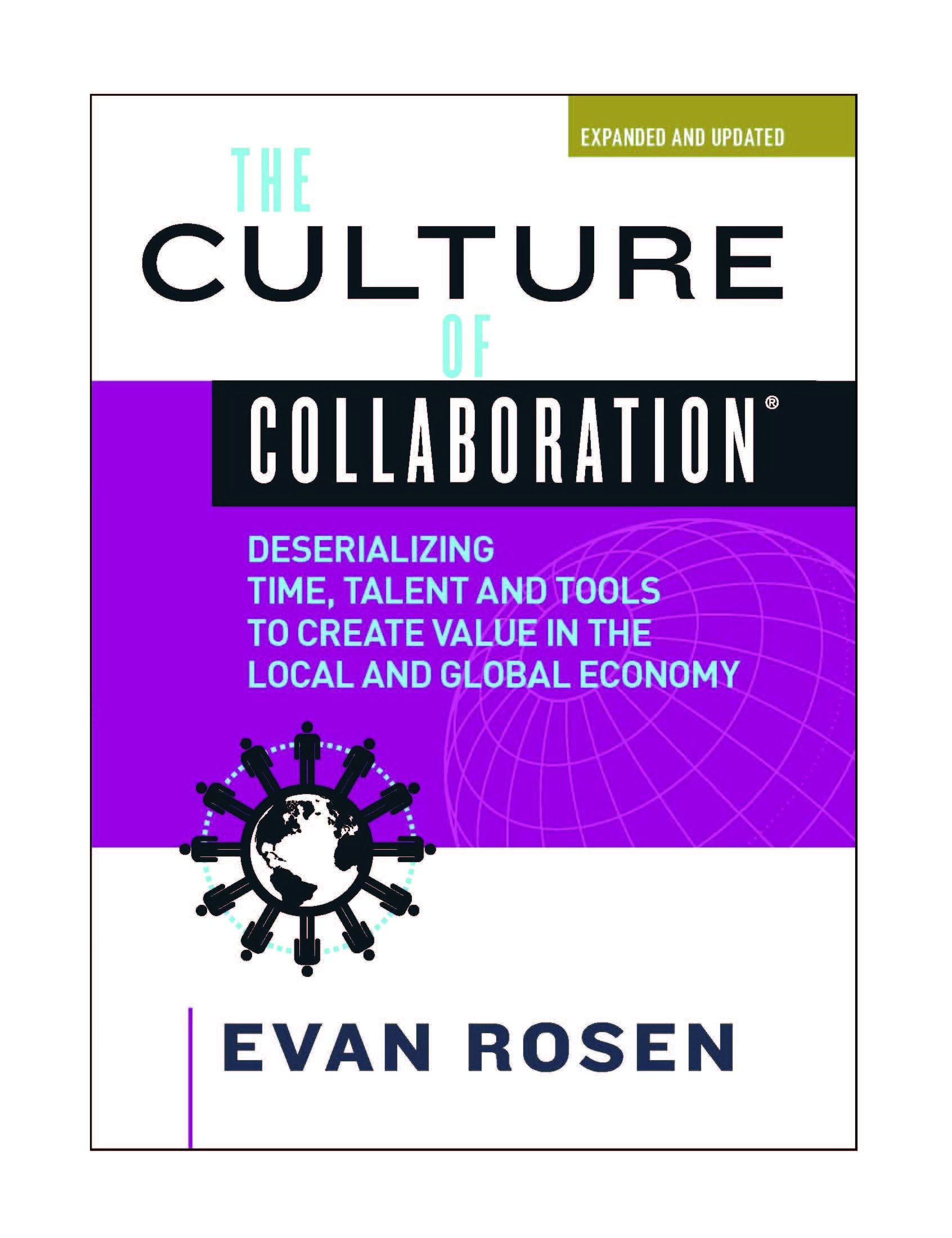
    Jacket with border CofC EU


    The expanded and updated edition has just been released, and I’m proud of the finished work. The 363-page business book includes 54 images and illustrations and a beefy index. By the way, 54 images and illustrations is no easy feat in 2024. Ever wonder why most business books lack pictures? It’s time-consuming to license even a single image from a large organization.

    One thing I’ve learned is that deserialization and collaboration go together like peanut butter and jelly. Deserialization means removing sequences from the lifecycle of products and services. The idea is to collapse outmoded sequential approaches and replace them with spontaneous, real-time processes.

    Deserialization also involves removing sequences from interaction. This means killing what’s left of the in-box culture. In short, deserialization is the key to long-term value creation through collaboration. That’s why the subtitle of the expanded and updated edition of The Culture of Collaboration® is: Deserializing Time, Talent and Tools to create Value in the Local and Global Economy.

    I’ve also learned that despite best efforts, collaboration can stall within highly-collaborative organizations. Paradoxically, collaboration happens in companies in which the dominant culture is command and control. Likewise, internal competition and command and control exist in mostly-collaborative organizations. Many factors, as I explain in the expanded and updated edition, influence both the evolution and regression of The Culture of Collaboration.

    More broadly… as I write in the preface, in some ways we’re less collaborative than we were in the early 2000s. Social media lets us broadcast opinions without refining ideas through real-time interaction. We join groups that make rules for how we should think. Videoconferencing enables interaction at a distance, but too often we’re wasting time in scheduled virtual meetings rather than creating value together spontaneously. While in the same room, we meet rather than collaborate. We leave meetings to work and then schedule follow-up meetings to review work. This serial process zaps value.

    My objective in revisiting this topic is to consider whether we have evolved or veered off track and to provide a new framework for unblocking collaboration and unlocking value.

    Let me know your thoughts about the new, expanded and updated edition of The Culture of Collaboration® book.



  • The Amazing, Disappearing (and Collaborative) Phone Call

    Texting and instant messaging (IM) have rapidly supplanted voice calls as our preferred communication mode. When we say “I spoke with him” or “I had a conversation with her” often we’re referring to text chat rather than voice. This lack of real talking adversely impacts collaboration.

    In many organizations, people never bother to set up their voice mail. And we increasingly view voice calls as intrusive. Yet companies have redesigned their physical spaces ostensibly to encourage intrusions such as on-the-fly and chance encounters which can spark collaboration.


    Telephone advertisement
    1910 Advertisement for the automatic (dial) telephone service of the Illinois Tunnel Company in Chicago

    When I wrote the first edition of The Culture of Collaboration book in 2006, I summed up the deserialization of work and interaction as the “in-box culture is dead.” The idea was that something called presence would allow us to see who’s available and that we could connect with anybody in the organization via instant messaging. Then—and this is the important point—we could escalate that instant messaging session into a spontaneous voice or video call with the simultaneous capability of collaboratively working on documents, spreadsheets, presentations or in any application. So there was no longer a need to schedule voice and video calls. Through real-time collaboration, we could create far greater value.

    Somehow IM took hold in companies but escalation to voice and video calls has seemingly stalled. And use of voice on mobile devices has plummeted. At one time speakerphone quality was a key attribute of devices, but Apple iPhone and Samsung Galaxy marketing barely mention voice.

    IM has the advantage over email in that it’s nearly real-time and there’s an expectation of immediate response. So it’s easy to find people and connect with them. The problem is that like email IM and texting are one dimensional. It can be difficult to determine the real meaning and the emotion behind the words. If we talk with each other on a voice call, we can often understand each other better, cut to the chase and resolve issues more quickly than through IM. If the issues are more involved, a video call fits the bill.

    Also, people feel less isolated when using real-time voice and video. In fact, there are signs that we are desperate for real connection and interaction that IM and texting can’t deliver. The New York Times recently ran a story on how people are using calls to customer service representatives as therapy sessions. Increasingly, companies are training representatives to show compassion and focus on the emotional needs of the customer rather than rush them off the line.

    This phenomenon cuts both ways. Increasingly, customer service representatives are anxious for a real connection. I experienced this first hand when I called a credit card company recently to discuss my airline co-branded card. The representative told me about her background as a former flight attendant and a singer with a band. I also learned that she had a degree in advertising, likes to roller blade and moved from California to Florida. At the end of the call, she arranged a mileage bonus and said “thanks for letting me be me.” We both felt connected in a way that an IM session with the card company could never deliver.

    I’m currently writing a new edition of The Culture of Collaboration book and assessing where we’ve gone wrong and how we can get collaboration back on track. When it comes to tools, we’re half way there. Rather than getting stalled with texting and IM (not to mention social media), our challenge is to maximize our ability to find and connect with people. This means turning some of those texting and IM sessions into voice and video calls so that together we can create value.


  • Fidelity’s Amazing, Disappearing Star Fund Manager?

    The era of the star fund manager is waning.

    Fidelity Investments may replace a star-oriented fund management system with a collaborative approach after a consultant's report. As is so often the case when organizations suddenly consider—and often embrace— a more collaborative structure and culture, exigent circumstances precipitated the potential move. I call this phenomenon The Bounty Effect, and I’ve written extensively about it in the book by the same name. The Bounty Effect occurs when an event or circumstance creates a fundamental shift, changes the game and accelerates collaboration.

    The Bounty Effect for Fidelity occurred because of two exigent circumstances:

    Last year Fidelity reportedly fired Gavin Baker, manager of Fidelity OTC Portfolio, for allegedly sexually harassing a junior female staff member though Baker denies the allegations. This happened against the backdrop of the #MeToo movement. The apparent firing prompted Fidelity to conduct a “cultural review” of its stock picking unit.

    The other exigent circumstance is the reported outflow of $40 billion from Fidelity’s actively-managed funds in 2017, according to Morningstar, as investors have increasingly embraced exchange-traded funds (ETFs) and passively managed index mutual funds meaning those linked to the performance of a particular index such as the S&P 500. Active fund management essentially means one star manager with a supporting cast of analysts attempts to beat a particular index. Fidelity built its reputation in the 1980s around successful active managers including Peter Lynch who managed the Fidelity Magellan Fund.

    The decline of the “star” fund manager mirrors trends in other industries and throughout workplaces. Before the rise of human resources as a valued discipline, swashbuckling managers made hiring and tactical decisions based on gut and sometimes whim. Executives often made strategy decisions in a vacuum.  As HR has become more data driven, the era of the swashbuckling manager has ebbed. Leaders make few decisions without input or at least without consulting HR, finance, IT, communications or some other function. Companies measure everything and everybody which, incidentally, can short circuit collaboration.

    Fidelity would likely argue that “star” managers never made decisions in a vacuum but rather consulted Fidelity’s extensive research team and worked with analysts assigned to each fund. Nevertheless the funds industry—including Fidelity—has historically embraced star culture. And so have such industries as sports, food and beverage, medicine, journalism, the film industry and so many others. The media still goes to bizarre lengths to reinforce star culture, because media decision makers believe that personalities sell newspapers and drive viewership and eyeballs translating into advertising dollars. I’ve even read stories on “star” butchers. And while I appreciate the skill involved in selecting and cutting meat, putting certain butchers on a pedestal feeds a misleading perception that the vast majority of butchers fail to measure up to the so-called stars.

    When we turn athletes, chefs, doctors, television hosts, movie producers and others into stars, these so-called “stars” start believing the rules that apply to everybody else never apply to them. This breeds bad behavior. Star culture has also diminished the contributions of people who work with “stars” which makes these people feel sidelined and less likely to provide valuable input. In short, star culture costs organizations dearly. In contrast, embracing a collaborative culture and structure creates value.

    If Fidelity abandons its “star” manager system, the question is whether the move is window dressing or real structural change. We may learn that one person never really “managed” Fidelity’s actively-managed funds and that fund management was always an inherently-collaborative process among colleagues despite Fidelity’s marketing so-called “star” managers.


  • Does Remote Work Reduce Collaboration?

    Some companies are eliminating remote work or “telecommuting” because they believe their people must share the same physical space to collaborate.

    I define collaboration as “working together to create value while sharing virtual or physical space.” But apparently some organizations want to get more physical rather than virtual.

    According to a recent Wall Street Journal story, companies including IBM, Aetna, Bank of America, Best Buy and Reddit have ended or reduced remote-work arrangements as managers “demand more collaboration, closer contact with customers—and more control over the workday.”

    Companies facing challenges are often the first to scrap or reduce remote work programs. In 2013, as Yahoo was struggling, then CEO Marissa Mayer defended her decision to eliminate work from home. Speaking at the Great Place to Work conference in Los Angeles, Mayer reportedly said “People are more productive when they’re alone, but they’re more collaborative and innovative when they’re together.”

    No question people are more collaborative and innovative when they’re together, but the point is people can be together virtually as well as physically. Many tools and technologies support high-impact virtual collaboration. Forcing people to endure a daily commute and interfering with their life/work balance reinforces command and control and disrupts collaboration and innovation. Also, remote work lets companies tap expertise regardless of geography. And teams are often comprised of people in multiple regions, so forcing people to work from a company location is unlikely to enhance collaboration within a team. It does make sense to encourage remote workers to spend some time at company locations to spark chance encounters in cafeterias, corridors and break rooms with people outside their teams.

    Command and control culture is the opposite of collaborative culture so an organization trying to control team members by keeping them at the workplace short circuits collaboration. Ironically, my research interest in collaboration began in the mid-1990s when I was writing a book on personal videoconferencing. Early telecommuting programs experimented with PC-based videoconferencing so that remote workers could look each other in the eye and talk with colleagues while they were collaboratively working on spreadsheets, documents, design plans and other work. The issue then was whether we could collaborate as effectively at a distance as we could in the same room.

    By the time I wrote The Culture of Collaboration book, the tools and technologies supporting remote work had become pervasive and the culture supporting virtual collaboration had become widespread. People at many organizations were becoming accustomed to collaborating spontaneously from almost anywhere. So the challenge was changing. I wrote:

    “Today we struggle to collaborate as effectively at a distance as we do in the same room. Tomorrow the challenge becomes the reverse.”

    This is because same-room collaboration tools were lagging behind those used at a distance and people were becoming more accustomed to collaborating from applications on their notebook and laptop computers. Also, “presence” technology provided the capability to find colleagues, check their availability and begin collaborating with them on the fly from anywhere.

    Spontaneity and organizational culture supporting ad hoc encounters is critical to creating value collaboratively. In some cultures, this means it’s okay to grab people out of meetings or interrupt their work for on-the-fly collaboration. But in mature companies walking back remote work, often this level of spontaneity is a cultural faux pas. So the most effective way to spontaneously connect in these cultures is often through online chat which can escalate into a collaborative group session (CGS). Organizations create far greater value by moving away from command and control and instead enabling team members to connect and collaborate spontaneously regardless of physical location.

    As I demonstrate in my book The Bounty Effect, exigent circumstances including disruptive market forces, new competitors, or a regional slowdown are opportunities to accelerate collaboration and emerge stronger from the challenge. Eliminating remote work because of a difficult environment rarely enhances collaboration and instead increases command and control. The more effective approach is to seize the opportunity exigent circumstances provide and adopt a more collaborative organizational structure and culture which transcend physical location.


  • Millennial Malarkey

    “The people under 30 get it. It’s second nature to them.”

     “We have a bifurcated workforce.”

     “Let’s just turn the keys over to the Millennials. They get it. We don’t.”

    These are some snippets of conversation from well-intentioned change agents who overemphasize generational differences while attempting to transform their organizations into collaborative enterprises. In The Bounty Effect: 7 Steps to The Culture of Collaboration®, I identify this scenario as the Generation Gap Trap. It’s a trap, because overemphasizing generational differences reinforces fear and internal competition which short circuit collaboration.

    Undoubtedly, younger team members who are so-called “digital natives” are accustomed to using tools such as texting, instant messaging, and social media. It takes more than using tools, though, to collaborate. In The Culture of Collaboration® book, I define collaboration as working together to create value. And it’s quite possible to text, IM, or use social media without creating any value.

    The point is that age is by no means a predictor of collaborative behavior.  Some people right out of college or graduate school internally compete while they use “collaborative” tools and technologies. Meantime, collaboration is baked into the behavior of some team members in their fifties and sixties. Some disciplines like aerospace engineering or animation are inherently collaborative, and therefore experience in these fields is a better predictor of collaborative behavior than age. I have worked with some “boring” industrial companies in which people work together to create value far more easily and often than team members in supposedly collaborative Silicon Valley companies.

    After seemingly endless media reports describing how millennials demand a collaborative workplace, a new CEB study indicates that millennnials—those born between 1980 and 2000—are the most competitive generation in today’s workplace. Among CEB’s findings are that millennials are more driven by performance relative to others than by absolute performance and that millennials are less likely to trust peers and their peers’ input. Trust, incidentally, is one of the 10 Cultural Elements of Collaboration that my colleagues and I have identified. Without trust, collaboration is dead on arrival.

    In an August 1, 2015 “Schumpeter” column in The Economist, the unidentified columnist explores some of these millennial myths and cites the CEB study. The columnist incorrectly concludes from the research that to motivate young team members, organizations should put less emphasis on collaboration. The real take-away regarding the CEB study is that emphasizing generational differences is folly.

    De-emphasizing collaboration because millennials are less motivated by it would pander to a generation without guiding it. Instead, doubling down on adopting collaborative organizational structures and cultures will ultimately motivate team members regardless of generation and create far more value than command-and-control and internal competition.


  • Pope Francis Promotes Collaborative Structure

    The least collaborative organization is changing its structure.

    Which organization? Well, here are some of its characteristics. This global enterprise pays a few people to make decisions while everybody else follows orders. The CEO’s direct reports act like a royal court and compete for face time. Senior leaders often live lavishly and consume conspicuously. Headquarters micromanages satellite offices. Bureaucracy and formality reduce efficiency.  Internal competition runs rampant. The command-and-control organizational structure quashes dissent.

    Sound familiar? This description fits many global corporations and government entities. This particular multinational spent $170 billion in the United States in 2010, according to The Economist. The organization is the Catholic Church and, more specifically, the Roman Curia, the church’s centralized administrative operation.

    Like many corporations, the Catholic Church suffers from an obsolete organizational structure that is compromising value. And like many corporations, reform-minded leaders have tried introducing a new approach. But entrenched interests and a centralized bureaucracy rife with intrigue, fiefdoms, and Machiavellian motivations has frequently derailed change.

    Enter Pope Francis setting the stage for change by wearing a simple white robe and black shoes rather than the regal vestments and ruby shoes of his predecessor. He has washed the feet of inmates and has Pope Francis smallopted to live in a guest quarters rather than the Vatican’s deluxe papal apartments in the Apostolic Palace. There are signs the Pope’s frugal tone is rippling across the Church. In March, the Pope accepted the resignation of Bishop Franz-Peter Tebartz-van Elst of Limburg, Germany who spent the equivalent of $43 million on a new house and office complex.  In April, the Atlanta Archdiocese announced that it would sell Archbishop Wilton Gregory’s $2.2 million mansion.

    Beyond Pope Francis’ rejection of the trappings of office, he is taking steps to adopt a more collaborative structure in the Roman Curia and in the global Catholic Church. The Pope has chosen a “working group” of eight cardinals from outside the Curia to collaborate with him on changing the structure.

    Cardinal Francesco Coccopalmerio heads the Vatican department that writes the church laws that will codify reforms. The Religion News Service quotes Cardinal Coccopalmerio as saying “The big change is the emphasis on collegiality, on collaboration.” Now Pope Francis, Cardinal Cocopalmerio and other new church leaders are focused on breaking down barriers among silos so that information flows around the organization rather than from top to bottom. Cardinal Cocopalmerio has proposed naming a “moderator of the Curia” to identify inefficiencies and cut through red tape.

    Pope Francis participates in meetings without dominating them and embraces broad input. Cardinal Donald Wuerl of Washington, D.C. recently attended one such meeting at the Vatican about appointing new bishops. Typically, popes never attend such meetings. Pope Francis reportedly stayed for three hours. “We’re all sitting around the table, and he comes in and pulls up a chair,” Cardinal Wuerl told Fox News.  At another similar meeting, a senior cardinal asked the Pope what he thought about the topic. “If I told you what I think, you would all agree,” Pope Francis responded according to Cardinal Wuerl. “I want to hear from you what you think.”

    Perhaps most significantly, according to Cardinal Wuerl, the Pope has repeatedly advocated a collaborative process through which “the Holy Spirit can be heard.”  And the Holy Spirit isn’t going to be heard if just one person speaks. “He wants all of us to be speaking with him so at the end of the day he can say this truly was the fruit of the work of the Spirit.”

    Hallelujah. Many corporations in multiple industries including United States government agencies can learn from the Pope’s example. It takes more than window dressing and a desire for change to create value through collaboration.  The only viable approach is changing the organizational structure which, in turn, shifts the culture. My research on collaboration indicates that changing the structure requires seven steps—plan, people, principles, practices, processes, planet and payoff. Pope Francis has demonstrated that making progress through these steps requires that a leader set the stage for change so that others feel comfortable participating.

    In essence, The Bounty Effect has hit the Catholic Church. The Bounty Effect happens when exigent circumstances compel companies, governments and organizations to change their structures from command-and-control to collaborative. For the Catholic Church, exigent circumstances range from sexual abuse scandals to corruption and cronyism at the Vatican. And it’s The Bounty Effect that led to the election of Pope Francis and the structural change now underway.


  • Taking Collaborative Risk at The State Department

    Shifting from command-and-control to collaborative culture involves what might be termed collaborative risk, but some organizations are realizing that there’s greater risk in clinging to old ways of working.


    State Department Logo One organization that is recognizing the need for taking collaborative risk is the United States Department of State. “We’re a very risk-averse culture,” notes Duncan MacInnes, principal deputy coordinator for the Bureau of International Information Programs. State Department professionals fear that misstating policy or saying the wrong thing could become a diplomatic crisis. This parallels the fear in companies that trade secrets or market-moving information could leak. Nevertheless, the State Department has determined that the benefits of collaborating internally and externally outweigh the risks of resisting work style change.


    Change agents across the State Department are guiding the culture towards embracing collaboration. These change agents have wisely realized that eliminating disincentives to collaboration is as important as creating incentives. Therefore, the Department has updated its policies to eliminate disincentives to taking collaborative risk. “People will make mistakes, and those who have made too many mistakes have not been dinged for it,” according to MacInnes. This approach is critical to shifting the culture, because people must feel that the organization values collaborative risk and will provide the cover for them to try new ways of working.


    Externally, the State Department enables embassies to broadcast their own events including speeches by ambassadors on the Web with input from the public. The State Department uses ConnectSolutions Podium high-definition webcasting, which lets users ask live text questions, text chat with each other about the event, and leave video comments. The ConnectSolutions Real-Time Collaboration Platform enhances and extends Adobe Connect web conferencing. Embassies are also using the tool to collaborate internally. At first, embassy staff resisted the shift. “We’re showing them a new way to work, and we’re meeting in the middle,” says Tim Receveur, a foreign affairs officer coordinating global use of the tool.


    Aside from real-time collaboration, the State Department is also chalking up results in collaborating asynchronously. Over 3500 State Department team members have contributed some 12,000 articles to Diplopedia, an internal online encyclopedia based on Wikipedia. You can view an amusing video on Diplopedia here. The Department has also seen compelling growth in the use of an ideation tool. Ideation means developing and refining ideas so that people can make their organization better. The tool, dubbed Secretary Clinton’s Sounding Board, is based on a blogging platform. The tool lets people across embassies, bureaus, regions and levels of leadership brainstorm, make process improvements and create value collaboratively.


    In the last eighteen months, people have contributed 1800 ideas. “What in the past would have been water-cooler conversation that went nowhere is now [getting results], because the person who can make it happen is part of the conversation,” explains Richard Boly, director of e-Diplomacy. The ideation tool lets a person hired locally who’s working in a small West African consulate to collaborate, brainstorm and develop communities of interest with counterparts globally.


    One success factor for Richard and his team as they guide the work style shift is focusing on “the how rather than the what” for starters and saving the “thorniest issues” for last. By thorniest issues, Richard means U.S. policy and diplomacy. Meantime, he and his colleagues are encouraging culture shift and emphasizing use of collaborative tools for brainstorming improvements in “how” policy can be crafted. As the culture warms to the new way of working, the change agents believe diplomats will more collaboratively create policy itself.  


    Private industry is now looking to the State Department for clues regarding how to engage people effectively through corporate ideation tools. Increasingly, companies collaborate through ideation tools with their customers, but lag in collaborating internally. A big factor is fear. Companies often fail to give people cover so that they take collaborative risks. In this case, the Federal government may clear a path for business.


  • Collaborative Law

    Competition, arguing, and maneuvering defines law as it’s traditionally practiced. Now, though, a collaborative law movement is gaining traction globally. I had a compelling conversation the other day with J. Kim Wright, a collaborative law practitioner who runs the site CuttingEdgeLaw.com. We discussed Kim’s new book, Lawyers as Peacemakers: Practicing Holistic, Problem-Solving Law (American Bar Association, 2010).


    “We have not in recent history been very collaborative folks. We are the people to avoid in society,” Kim began. I knew instantly this conversation was going to be interesting. Kim was referring to lawyers who, she says, graduate from law school with “no heart and no soul.” Kim had read “Smashing Silos,” a column I wrote for Bloomberg BusinessWeek. And she insisted that law is all about silos. “We are taught to compartmentalize everything.” These silos include specialties and sub-specialties of law.


    Collaborative law begins with the premise that people work out their differences towards the common goal of resolution rather than compete and fight through litigation. This is different from the various forms of court-ordered and pre-court alternative dispute resolution (ADR) such as mediation, because ADR often begins with the premise that if the parties are unable to resolve their differences, the case will proceed to trial. Mediation, for instance, often involves “shuttle diplomacy” in which the mediator runs back and forth between both parties and points out the weakness of each side’s case in hopes of avoiding a trial.


    In contrast, collaborative law involves an acknowledgment from both parties that litigation constitutes failure to achieve goals and places a premium on preservation of relationships. Divorce and family law practice has been faster to adopt the shift to collaboration than many other specialties. In such cases, collaborative divorce and family lawyers sign contracts committing to resolve cases rather than litigate. If they fail to settle, the contracts require that the lawyers withdraw from the case.


    Collaborative law grew out of a movement in Minneapolis developed by Stu Webb and others during the late 1980’s and quickly spread to northern California and beyond. The International Academy of Collaborative Professionals based in Phoenix brings together lawyers, mental health professionals, and financial professionals to resolve divorce and other conflicts.


    One barrier to collaborative law is that many lawyers embrace tradition. “Lawyers hate to be on the fringe. They’d prefer to die than be weird,” Kim explained, adding that her goal is to embrace the fringe. Kim focuses on spreading collaborative law across specialties including corporate law. Too often, corporate agreements encourage conflict and ultimate litigation.  In her practice, Kim abandons “boilerplate” or standard contract language and instead writes agreements in plain language designed to anticipate and prevent conflict. “When a conflict comes up, we’ve actually already talked about what to do if there’s a conflict,” she notes.


    Like corporations, lawyers are waking up to the value collaboration creates both for practitioners and customers.


  • The Much-Maligned Meeting and Collaboration

    The “M” word creates more outbursts of opinion than practically any other word in business.


    I’m referring to the word meeting. Almost everybody has a—usually negative—gut reaction to the notion of meetings. Plenty of people would prefer being stuck on a tarmac than stuck in a meeting. Even though water and snacks are often available at meetings, our time belongs to others. On the tarmac, there’s no guarantee of refreshments, but at least our time is our own. In fact, meeting-bashing has become welcome break-room conversation.


    Nevertheless, technology vendors have invested huge resources in meetings. So, it’s not just employers who want to load up our schedules with meetings. There are vendors with vested interests in making meetings even more integral to our work than they are now.


    Last night on CNN’s “Larry King Live,” Larry asked Microsoft founder Bill Gates his opinion of the Apple iPad. Gates responded, “We’re all trying to get to something that you just have to take to a meeting and use.” He added, “It still isn’t the device that I would take to a meeting, because it just has no input.” You can view the video clip here. So, one way Bill gauges the effectiveness of the iPad and similar devices is whether we will want to take them to a meeting. Bill—and by inference, Microsoft—apparently remains focused on keeping us in meetings. In reality, it’s more important whether the iPad and any similar device fits into our lifestyles and work styles than whether we’ll want to bring it to meetings.


    Are meetings collaborative? There’s nothing inherently collaborative about an in-person or virtual meeting. That’s right. Using virtual meeting tools is no guarantee that we’re collaborating. Joining a web conference, using telepresence or IMing the day away creates little value unless these tools fit into collaborative organizational culture and practices.


    If we compete with colleagues and our teams and organizations reflect “star culture”, do the tools we use make us collaborative? No. It takes more than tools to make collaboration happen. If we fill our ranks with millennials and send them to meetings with devices loaded with collaborative capabilities, will those meetings automatically become collaborative? Don’t bet on it.


    The biggest beef about meetings is that they’re a waste of time. In other words, they fail to create value. If we come together as a group and we’re working together to create value, we’re collaborating. So, we’ve essentially transcended the notion of a meeting and instead we’re in a collaborative session. Organizations and vendors should seek to remake meetings as collaborative sessions.


    In the final chapter of The Culture of Collaboration book, I note that “Today we struggle to collaborate as effectively at a distance as we do in the same room. Tomorrow the challenge becomes the reverse.” As collaborating in the same room starts seeming awkward, that’s the new frontier. But organizations and technology vendors take note: it’s about creating more value through collaboration rather than better meetings.


  • Breaking Corporate Rules to Collaborate

    What happens when team members want to collaborate, but command-and-control approaches and internal competition prevail in culture and processes? New research indicates team members are starting to “spoof the system” by flouting organizational guidelines and creating work-arounds so they can collaborate. The global study conducted by InsightExpress and funded by Cisco surveyed more than two thousand end users and a thousand information technology decision makers from ten countries. The study found that 52 percent of organizations prohibit the use of social media applications and 50 percent of end users admit to ignoring company policies at least once a week. “End users have started to take things into their own hands,” says Alan Cohen, Cisco’s vice president of enterprise solutions.


    The study found that users most willing to break company policies are those in the United Kingdom and France. Respondents in China were least likely to violate corporate rules. Still, the survey found that companies in China and India had significantly higher adoption rates of collaborative tools than companies in the United States or the United Kingdom. This is likely because companies in these growing economies are relatively new, and therefore their infrastructures are by no means set in stone.


    Ironically, the study found that 77 percent of IT decision makers plan to increase spending on collaboration tools this year, while team members say corporate policies are constraining collaboration. Investing in collaborative tools makes little sense if an organization lacks the culture and processes to support the tools. The result is a schizophrenic organization in which some team members break rules, others operate by the book, and most team members get confused by mixed messages. Considering the study results, a prime opportunity exists for leaders to think and act collaboratively and for organizations to adopt collaborative culture.


    Cisco will gladly sell you any and all of its more than 60 collaboration products. But buying these products or those of any other collaboration tools vendor will produce limited results unless your organization makes a fundamental commitment to collaboration. This shift includes moving away from command-and-control, internally-competitive culture and processes and replacing the pass-along, serial approach to work and decision-making with spontaneous, real-time models. I address this in the introduction to The Culture of Collaboration book.


    Intercompany Collaboration: Focus on Culture and Processes


    On another note…outmoded culture and processes can curb collaboration and compromise value—whether we’re talking about within a company or “outside the firewall.”  As vendors and standards groups resolve intercompany collaboration technology issues, there’s a temptation to conclude that intercompany collaboration is “good to go.”


    About three weeks ago, I participated in a discussion via TelePresence with Cisco senior vice presidents Tony Bates and Barry O’Sullivan. The company was discussing details of its new Intercompany Media Engine, which extends unified communications among companies. So, a supplier can easily view the availability or “presence status” of a customer, connect via instant messaging, and easily escalate the interaction to a voice call, web conference, or telepresence. You can view video of a demo call here. Meantime, the Internet Engineering Task Force (IETF) is working on an open standard for telepresence and unified communications so that people can interact regardless of technology vendor. This has particular relevance for business partners with different installed telepresence brands. Ultimately, the challenge for intercompany collaborators goes well beyond the technology. Organizations must focus on adopting collaborative culture and processes and integrating them across organizational boundaries.