Why does collaboration fail? The answer is often the lack of collaborative processes and culture. Less obvious is the lack of deserialization. From the private sector to education and from government to nonprofits, serialized processes impede collaboration.
Deserialization is both macro and micro. As I describe in the new, expanded and updated edition of The Culture of Collaboration® book, macro deserialization is the removal of sequences from the lifecycle of products and services. There are useful manifestations in multiple industries. In the aerospace industry, macro deserialization means simultaneously designing parts, plans, tools, processes, assembly, delivery, maintenance, and retirement of the plane. In the visual effects industry, post-production is becoming pre-production as artists design effects before and during the shoot with hybrid physical and virtual worlds.
Micro deserialization is the removal of sequences from how we interact and get things done. The in-box culture is dead—and the in-box can include overflowing text, chat and messaging applications. Waiting for somebody else to provide input slows decisions and complicates resolution. So does making an appointment to collaborate! Instead, Do It Now Together! And instead of scheduling a meeting, let’s engage each other spontaneously in a collaborative group session—No Appointment Necessary. You’ll find more on replacing meetings in the book.
Embracing deserialization unlocks the value that collaboration promises.
It’s called Ponte della Costituzione, the fourth footbridge over Venice’s Grand Canal. The glass and steel structure has caused nothing but headaches—and some muscle aches—for tourists, Venetians and the officials who run their city.
When Venice commissioned an architect to build the new bridge in the late 1990s, the job went to Santiago Calatrava. Named by Time magazine to the Time 100, one of the hundred most influential people in 2005, Calatrava has chalked up dozens of awards and honorary doctorates. His celebrated projects range from the World Trade Center Transportation Hub in New York City to the Museum of Tomorrow in Rio de Janeiro, Brazil. And the New York Times calls Calatrava a “star architect.”
Venice’s Ponte della Constituzione. Photo by Christoph Radtke. Licensed under CC BY 3.0. No changes made.
The problem is that the Zurich, Switzerland based architect apparently failed to adequately consider practicalities impacting Venetians who cross the bridge regularly and tourists who cross when visiting one of Italy’s most visited cities. For starters, the bridge lacks disabled access. Also, the glass floor has caused many people to slip and fall. According to a story in Architectural Digest, some Venetians have cracked their chins and foreheads and others have reportedly broken bones. City officials have told media outlets that injuries occur almost daily.
Because too many injured pedestrians have sued the City of Venice over the multimillion dollar bridge, the city has decided to allocate more than half a million dollars to replace the glass with trachyte stone. This expense comes after a failed 1.5 million Euro modification to install a cable car so that people could cross the bridge without injury.
What has caused heartache, bone ache, lawsuits and wasted taxpayer dollars is star culture. Rather than designing a bridge for the practical needs of tourists and others who regularly cross the canal, Calatrava was apparently too focused on capturing and representing Venice’s “embrace of modernity” as the New York Times puts it. Rome’s Court of Auditors found that Calatrava was negligent in failing to account for the number of tourists dragging their bags across the bridge. Calatrava argued that bag dragging constitutes “incorrect use.”
Stars tend to get swept up by things like symbolism, messaging and virtue signaling. Collaborative architects seek input from people who will use the structure they’re designing. In The Bounty Effect: 7 Steps to The Culture of Collaboration®, I describe how architect Renzo Piano made no sales presentation but rather pulled ideas from his clients in collaboratively conceptualizing and designing the California Academy of Sciences in San Francisco.
Undoubtedly, Calatrava has chalked up major accomplishments, but accomplished professionals run the risk of buying their own hype. When people are made to believe they can do no wrong, they often make decisions in a vacuum and may work without adequate input from others. This feeds star culture for which the media has an insatiable appetite. Yet we must resist the temptation, because star culture sucks value out of companies, governments and communities.
COVID-19 has taught us that the only thing worse than a meeting is a virtual meeting. And the buzz lately is about the relative merits of video calls vs. in-person work gatherings. I had dinner recently with a former colleague, now a communications professor, who has concluded that videoconferencing is best for meetings people want to avoid while in-person gatherings work better for meetings people want to attend. No question it’s easier to multitask and disengage during virtual meetings.
Because of my work in this arena—including a book on videoconferencing in the 90s and two subsequent books on collaboration—outlets have been asking me for my take post-COVID on how to improve meetings in the “hybrid” work environment. Since my focus is on completing a new book for release next year, I have been quiet here and elsewhere. Yet I feel compelled to inform those who have yet to read my books about my view of meetings.
Meetings are a waste of time. That’s true whether we’re talking about same-room or virtual meetings. When I wrote the book Personal Videoconferencing in the mid-90s, I concluded that the benefit of then emerging PC-based videoconferencing was that we could work together screen-to-screen while seeing one another. We could jointly create a work product. In many scenarios, this involved minimizing the video while we shared applications and together produced something.
Virtual meetings were by no means the killer app for personal videoconferencing. The killer app was co-creation. That’s still true. Yet during COVID, many of us grew to hate videoconferencing because we misused the tool for something we dislike: meetings.
So how do we fix meetings? We don’t. Instead, we replace them with collaborative group sessions. I write about this in my bookThe Bounty Effect: 7 Steps to The Culture of Collaboration®. In a nutshell, meetings—whether physical or virtual—are a remnant of command-and-control culture. Often, the highest-ranking or highest-status person sets the agenda and conducts the proceedings. Meetings involve presentation and discussion. Then participants leave to do follow up work, often in isolation. Then this work is reviewed or discussed at yet another meeting. Meetings produce no work product and therefore create no value.
In contrast, a collaborative group (CGS) session produces a work product. Participants co-create documents, drawings, slideshows, animation, 3D models, spreadsheets—you name it. A CGS creates value and is infinitely more collaborative than a meeting. Goodbye meetings. Hello collaborative group sessions.
Texting and instant messaging (IM) have rapidly supplanted voice calls as our preferred communication mode. When we say “I spoke with him” or “I had a conversation with her” often we’re referring to text chat rather than voice. This lack of real talking adversely impacts collaboration.
In many organizations, people never bother to set up their voice mail. And we increasingly view voice calls as intrusive. Yet companies have redesigned their physical spaces ostensibly to encourage intrusions such as on-the-fly and chance encounters which can spark collaboration.
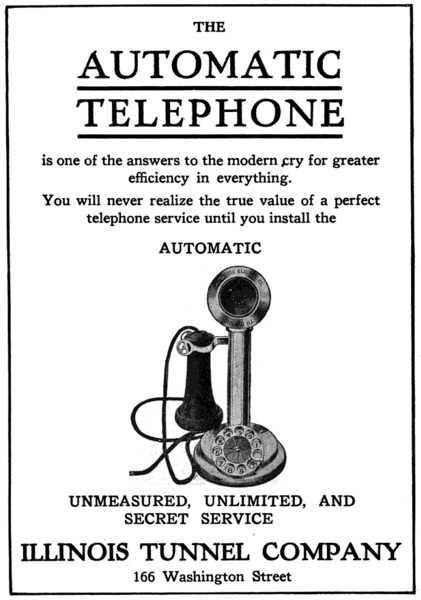
1910 Advertisement for the automatic (dial) telephone service of the Illinois Tunnel Company in Chicago
When I wrote the first edition of The Culture of Collaborationbook in 2006, I summed up the deserialization of work and interaction as the “in-box culture is dead.” The idea was that something called presence would allow us to see who’s available and that we could connect with anybody in the organization via instant messaging. Then—and this is the important point—we could escalate that instant messaging session into a spontaneous voice or video call with the simultaneous capability of collaboratively working on documents, spreadsheets, presentations or in any application. So there was no longer a need to schedule voice and video calls. Through real-time collaboration, we could create far greater value.
Somehow IM took hold in companies but escalation to voice and video calls has seemingly stalled. And use of voice on mobile devices has plummeted. At one time speakerphone quality was a key attribute of devices, but Apple iPhone and Samsung Galaxy marketing barely mention voice.
IM has the advantage over email in that it’s nearly real-time and there’s an expectation of immediate response. So it’s easy to find people and connect with them. The problem is that like email IM and texting are one dimensional. It can be difficult to determine the real meaning and the emotion behind the words. If we talk with each other on a voice call, we can often understand each other better, cut to the chase and resolve issues more quickly than through IM. If the issues are more involved, a video call fits the bill.
Also, people feel less isolated when using real-time voice and video. In fact, there are signs that we are desperate for real connection and interaction that IM and texting can’t deliver. The New York Times recently ran a story on how people are using calls to customer service representatives as therapy sessions. Increasingly, companies are training representatives to show compassion and focus on the emotional needs of the customer rather than rush them off the line.
This phenomenon cuts both ways. Increasingly, customer service representatives are anxious for a real connection. I experienced this first hand when I called a credit card company recently to discuss my airline co-branded card. The representative told me about her background as a former flight attendant and a singer with a band. I also learned that she had a degree in advertising, likes to roller blade and moved from California to Florida. At the end of the call, she arranged a mileage bonus and said “thanks for letting me be me.” We both felt connected in a way that an IM session with the card company could never deliver.
I’m currently writing a new edition of The Culture of Collaboration book and assessing where we’ve gone wrong and how we can get collaboration back on track. When it comes to tools, we’re half way there. Rather than getting stalled with texting and IM (not to mention social media), our challenge is to maximize our ability to find and connect with people. This means turning some of those texting and IM sessions into voice and video calls so that together we can create value.
My college housemate, an early and frequent Facebook user, recently announced that he’s pulling the plug on his Facebook account. This decision is apparently based on the perception that Facebook has deceived users about how it shares and profits from personal data. Facebook users are essentially its business partners.
Meantime, the City and County of Los Angeles is suing the business unit of IBM that includes the Weather Channel app. According to the complaint filed in Los Angeles County Superior Court, the IBM unit has “deceptively used its users’ private, personal geolocation data.” The app reportedly has 45 million users monthly.
The tide is turning against social media services and various apps that fail to adequately protect user’s data and privacy. Both Facebook and the IBM weather unit also serve business customers. “We want to be the place where work happens,” Facebook VP of Workplace Julien Cordorniou has reportedly told ZDNet. In an interview on Weather.com, Michael Rodriguez, head of mobile apps for The Weather Company, an IBM Business, says “the app has your back.”
These pronouncements sound great but fall flat. The problem is deterioration of trust. Trust is one of the Ten Cultural Elements of Collaboration that are critical to collaboration. I identify these in The Culture of Collaborationbook. Both Facebook and the Weather Company are essentially asking us to trust them with our data so that we can collaborate with other users and with the companies themselves.
Sneaky language, allegedly deceptive practices and hidden agendas destroy trust and therefore inhibit collaboration. Say a firm wants to collaborate with a business partner. Before partnering companies can effectively collaborate, they must establish the rules of engagement which, among other things, spell out the ownership and use of jointly-created intellectual property. If one partner has a hidden agenda, what are the chances trust will flourish and the collaboration will create value? Practically zero.
Similarly, when we input data into social media and other apps, we are essentially partnering with the app owner. When the word gets out about allegedly deceptive practices and sneaky language in the terms of service, which is the contract between vendor and user, hidden agendas are no longer hidden. Trust vanishes and with it collaboration. Instead of creating value through collaboration, the deception costs a company plenty in reputation, litigation and revenue.
Because only the vendor writes the rules of engagement or terms of service, there can be no real collaboration or partnering with the user. While negotiating the terms with each user is impossible, companies would do well to seek input into privacy guidelines and other terms from, say, a panel of user representatives. Then something closer to collaboration with user/partners could occur.
If Facebook had not lost the trust of many users, my college housemate would undoubtedly continue to partner with Facebook by inputting his data. Companies seeking to truly collaborate with customers and business partners seek clarity and transparency.
Once a method used primarily by coders, the hackathon has moved beyond the boundaries of software development. From government agencies and universities to start-ups and Fortune 500 companies, organizations are embracing collaboration hackathons or what we might call collabathons to spark innovation, develop products and services, and improve processes for everything from quality control to recognition and reward.
Collaboration hackathons inspire team members to step away from their day-to-day roles and solve a big problem or brainstorm a new direction with a tangible take-away. The structure of a successful collaboration hackathon mirrors that of a collaborative organization. We’re talking about an ad hoc team that forms for a specific purpose, collaborates, and then disbands. The 7 Success Factors for Collaboration Hackathons mirror the 7 steps in my bookThe Bounty Effect: 7 Steps to The Culture of Collaboration. These are:
1) Plan
2) People
3) Principles
4) Practices
5) Processes
6) Planet
7) Payoff
In the context of collaboration hackathons:
Plan is a problem to be solved, product/service to be developed, process to be created or improved or key question to be answered
People means broad participation in cross-functional collaboration hackathons regardless of level, role or region
Principles are the collaboration hackathon’s value system, the guidelines in solving the problem
Practices put principles into action through everything from a physical environment that fosters brainstorming to tools for capturing and refining ideas and putting them into action. Practices ensure that the hackathon is a collaborative group session (CGS) rather than a meeting.
Processes let hackers rapidly prototype and test ideas.
Planet puts communities in the center of the hackathons and inspires hackers to address how their ideas impact the communities in which the organization does business. The Planet step may consider everything from carbon footprint to privacy.
Payoff is the work product of the hackathon which must create value
These 7 steps prevent collaboration hackathons or collabathons from degenerating into meandering “bull sessions” at one extreme or turning into formal meetings at the opposite extreme. With The Bounty Effect’s 7 Steps, collaboration hackathons or collabathons succeed in solving big problems, answering key questions, developing products and services, improving processes, refining ideas and putting concepts into action.
Collabathons can help shift the structure of the entire organization from competitive, command-and-control to collaborative. The possibilities are endless.
The Apple iPod began as a music player and became a video player in part because consumers discovered a new use for the device. The brand perception then shifted. Lego Mindstorms began as company-provided software and hardware to create small robots. Then consumers hacked the code, changed the products together and Lego ultimately began providing the source code and collaborating with its customers on new products. In time, consumers began perceiving Mindstorms as a collaborative activity.
As in these cases, sometimes consumers collaborate to alter a product or its use and this ultimately changes the brand perception. In other cases, companies can collaborate with partners to discover new uses for products and change how consumers perceive the brand.
Gin has traditionally involved martinis or gin and tonic—and at least one gin producer is collaborating with partners to change this use and brand perception. When Bombay Sapphire East
The LUCKYRICE festival’s “custom tonic bar”: bartenders mix flavor extracts with Bombay Sapphire East gin and club soda
emerged in test markets as the first product line extension of Bombay Sapphire gin in 2011, reviews described the gin as spicy. That’s because Bombay Sapphire East adds two new botanicals to Bombay Sapphire: lemongrass and black pepper. This “flavor profile” may seem a bit assertive to accompany typical cocktail fare like cheese and crackers. Therefore, it’s necessary for this brand to gain traction in a different culinary arena, namely Asian food.
This past Friday evening, Bombay Sapphire East sponsored the 6th Annual LUCKYRICE feast at the Bently Reserve venue in San Francisco’s financial district. As I entered the event, an Asian woman handed me one of many varieties of exotic drinks bartenders were mixing with Bombay Sapphire East. A who’s who roster of upscale Asian restaurants with tables scattered around the event were cranking out specialties to accompany Bombay Sapphire East. The brand was clearly collaborating with chefs to create the perception that the gin goes well with Asian food. This is by no means a stretch.
I sampled a drink called Piman which includes Bombay Sapphire East, yellow pepper puree and Kalamansi (an orange/kumquat hybrid) syrup. I also checked out the Bombay Sapphire East “custom tonic” bar at which bartenders combined such flavor extracts as bergamot and elderflower with club soda and gin (see above image). These drinks complimented available dishes including Dosa restaurant’s Hyderabad chicken biryani, M.Y. China’s black pepper beef with mushrooms and Brussels sprouts, and Asian Box’s lamb meatballs in coconut curry.
Collaborating with Asian chefs, the people behind Bombay Sapphire East are not only changing consumer perceptions about their gin. They’re also working with Asian restaurants to co-create and sell cocktails using a gin accented with botanicals that compliment Asian food. This creates value for the restaurants and for Bacardi Limited, which owns Bombay Sapphire East.
Whether the product is booze, blenders, toothpaste or technology, collaborating with partners to change brand use and perception can transform a sleeper product into a sales leader.
Collaborating across sectors—government, private industry, non-governmental organizations (NGOs) and education—can solve some of the world’s greatest challenges. These challenges include global health, economic inequality, childhood obesity, climate change, and health and wellness—which, incidentally, are the five main areas in which the William J. Clinton Foundation works.
Health and wellness was front and center last Tuesday as President Bill Clinton and his daughter, Chelsea, assembled a few hundred people in the California desert for the Clinton Foundation’s Health Matters conference. Despite the focus, themes are interrelated. So global health, economic inequality, and childhood obesity crept into the discussion. In his opening remarks, President Clinton noted that the rising cost of health insurance premiums often prevents employers from increasing wages. “We cannot ignore the link between health and the economy,” said President Clinton.
Invited guests and speakers at the La Quinta Resort in La Quinta, California included hospital and insurance executives, health policy experts, and veterans of government service including Dr. David Satcher, Surgeon General of the United States during the Clinton Administration. Others including Dr. Deepak Chopra, Dr. Dean Ornish, and actress Barbra Streisand are partnering with the Clinton Foundation to advance health and wellness agendas. Long-standing relationships among some participants coupled with the relaxed resort atmosphere sparked an exchange of actionable ideas. President Clinton and Chelsea seemed as comfortable sitting in the audience asking questions and refining ideas as they were on stage.
“We’re moving into an era where the only way you can create enough jobs for people and generate enough wealth to have decently-rising wages is if you have creative networks of cooperation. I think the same thing is true of this health challenge,” President Clinton insisted during a discussion with NBC News Chief Medical Correspondent Nancy Snyderman, a friend of the former president for thirty years. “It’s the only thing that works. It works everywhere in the world.” This is another way of saying that collaboration creates value.
I practically muttered “Amen” aloud when President Clinton cited a study that found that if you put a group of people with average IQs together and ask them to work on a problem for a year and you give the same problem to a genius, over the long run the group of people with average intelligence working together will do better than one genius acting alone.
One of the most impactful ways that collaboration can improve healthcare is to remove the barriers that exist between front-line doctors and other health professionals. Too often primary care doctors practice in silos. Dr. Mark Weissman rose from the audience to insist that he and other primary care doctors are awash in patient data but lack regular access to other medical professionals who can collaborate with them on the data and on patient care. Pediatrician Donald Berwick, former administrator of the Centers for Medicare and Medicaid Services and a possible candidate for governor of Massachusetts, responded to Weissman that it’s necessary for doctors to learn that “I’m no longer the hero who saves the day, but I’m interdependent with others to give care. That’s what works.”
I’ve written often in this space and in The Culture of Collaborationbook about how engaged team members working in a collaborative culture create far more value than do team members working in a culture of fear and internal competition. Dr. Deepak Chopra noted that employee disengagement costs the United States economy $300 billion a year. “If your supervisor ignores you, you start to get disengaged and within a few months you start to get ill,” Chopra explained. “If your supervisor doesn’t ignore you but criticizes you, you actually get better.” This is because we would rather be acknowledged than ignored even if we’re receiving criticism. “And if your supervisor notices a single strength that you have, your rate of disengagement goes down to 1 percent,” according to Chopra.
The Health Matters conference is as much about taking action as about exchanging ideas. Corporations, government entities, non-profit organizations, and individuals pledged to take action in preventing disease and improving health. Financial pledges total over $100 million. One such pledge by entrepreneur and philanthropist Vinod Gupta will support a new Clinton Foundation program to address prescription drug abuse. Gupta’s son, Benjamin, died accidentally after taking prescription painkillers and consuming alcohol in December of 2011. Gupta and the Clinton Foundation will educate the public, particularly college students, about the dangers of prescription painkillers.
As I was checking out of the La Quinta Resort, I noticed that Surgeon General Satcher was next to me in line. We chatted about his recent work guiding the Satcher Health Leadership Institute at the Morehouse School of Medicine in Atlanta. Dr. Satcher noted that at Morehouse he’s building on his work as surgeon general by collaboratively focusing on neglected diseases and underserved populations. Like so many other disciplines, improving health and wellness requires collaboration.
Decision makers often think collaborative tools will create collaboration, and they're perplexed when results elude the organization. Technology extends and enhances–but rarely creates–collaboration. My current column for BusinessWeek.com describes what organizations need besides technology to make collaboration happen. You can read the column here.
Collaboration requires long-term thinking. That’s where universities, libraries, museums, and research organizations often eclipse for-profit companies. Pressure to generate quarterly returns can compromise long-term value, particularly at publicly-held companies. With less pressure to deliver immediate results, research-driven, non-profit organizations can focus more on creating long-term value. Maybe it’s a new take on history or a scientific discovery. Regardless, the work product may remain relevant hundreds of years from now.
That said, competition internally and within fields of study can prove more ferocious in the research arena than in corporations—whether it’s competing for limited grant dollars or for publishing articles in academic journals. Like corporations, the best research organizations mitigate unhealthful competition by thinking and acting towards creating long-term value. In this realm, long-term value can extend into eternity.
Knowing the collaborative mindset of the California Academy of Sciences, I accepted an invitation to attend a briefing and preview tour last Thursday of the Academy’s new Extreme Mammals exhibit, which runs through September 12, 2010. For background on architectural collaboration in the Academy’s building design, see my February 17, 2009 post.
San Francisco is the Extreme Mammals exhibit’s second stop after opening at the American Museum of Natural History in New York. Over tea and cupcakes, I had a compelling pre-tour conversation with Greg Farrington, the self-proclaimed “chief penguin” or executive director of the Academy. Farrington, a chemist, is the former president of Lehigh University. “You might think everything in the world has been discovered at least twice, but it hasn’t,” Farrington noted. Touring the exhibit confirmed Farrington’s point.
The exhibit features extinct, living and recently-discovered mammals including the striped rabbit identified as a new species in 1999 and the gray faced sengi or giant elephant shrew discovered in 2008. Galen Rathbun, a behavioral biologist at the Academy and Francesco Rovero of the Trento Museum of Sciences in Italy and other collaborators discovered the gray-faced sengi in the Ndundulu Forest in Tanzania’s Udzungwa Mountains. It was the first new species of giant elephant shrew discovered in 126 years.
Rathbun accompanied us on the tour and later took a small group behind several locked doors to view a collection of shrew specimens shelved inside fireproof cabinets in the Academy’s research collections. The collections include 26 million specimens of animals, insects, reptiles, birds, plants, fish and gems. Rathbun noted that several collaborating research institutions had loaned shrew specimens to the Academy for research.
One participant asked birds and mammals curator Jack Dumbacher if we could look inside the special cabinet that contains extinct animals and so-called “type specimens” of newly-discovered mammals. Dumbacher obliged, and we walked down the aisle past many rows of cabinets until we reached a shorter cabinet set apart from the others. As Jack unlocked the cabinet, he unleashed a ripe odor along with a feast for the eyes of preserved birds, rodents, and bats. The treasures also include the largest egg in the world from the elephant bird of Madagascar. A model of the egg is on display in the Academy’s public area.
Back to the public galleries and the Extreme Mammals exhibit. Scientists and administrators from global institutions have collaborated on the show, which the American Museum of Natural History organized. Collaborators shared knowledge, pieced together skeletons and gathered skulls, fossils and taxidermy specimens for Extreme Mammals. The result is a compelling experience for visitors who gain insight into the extreme variety of mammals and the awesome biodiversity of our planet.






 The Culture of Collaboration Blog