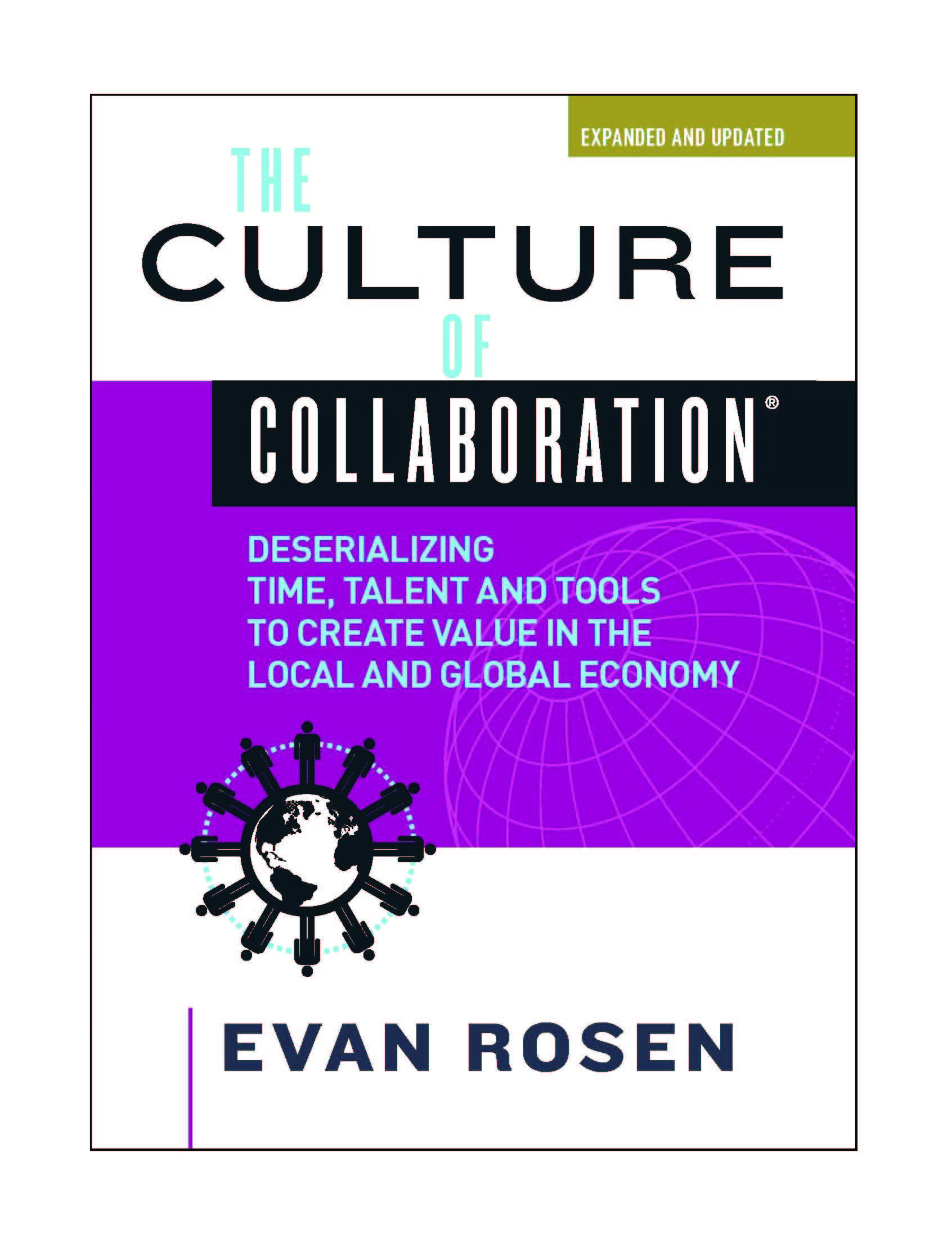
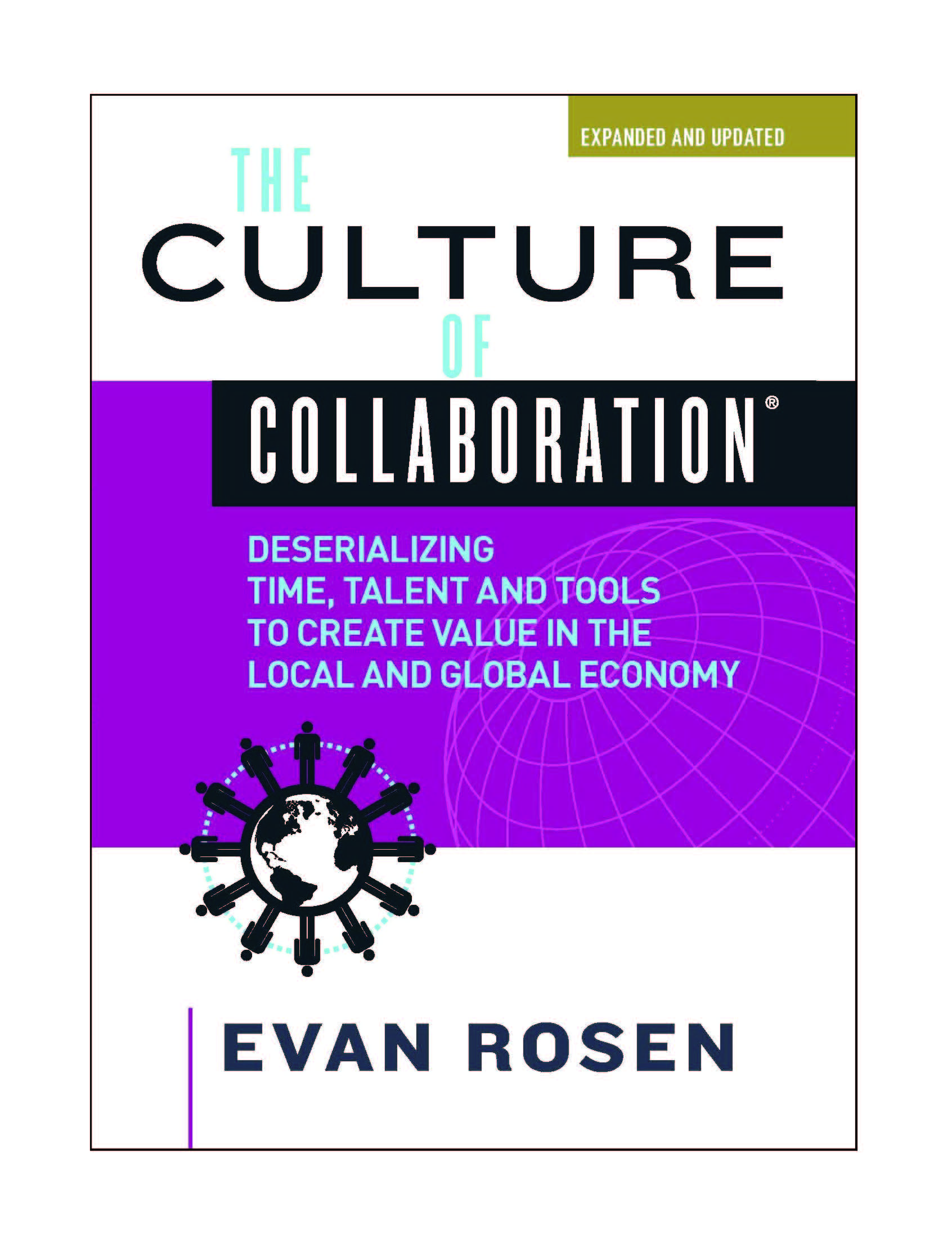
Why does collaboration fail? The answer is often the lack of collaborative processes and culture. Less obvious is the lack of deserialization. From the private sector to education and from government to nonprofits, serialized processes impede collaboration.
Deserialization is both macro and micro. As I describe in the new, expanded and updated edition of The Culture of Collaboration® book, macro deserialization is the removal of sequences from the lifecycle of products and services. There are useful manifestations in multiple industries. In the aerospace industry, macro deserialization means simultaneously designing parts, plans, tools, processes, assembly, delivery, maintenance, and retirement of the plane. In the visual effects industry, post-production is becoming pre-production as artists design effects before and during the shoot with hybrid physical and virtual worlds.
Micro deserialization is the removal of sequences from how we interact and get things done. The in-box culture is dead—and the in-box can include overflowing text, chat and messaging applications. Waiting for somebody else to provide input slows decisions and complicates resolution. So does making an appointment to collaborate! Instead, Do It Now Together! And instead of scheduling a meeting, let’s engage each other spontaneously in a collaborative group session—No Appointment Necessary. You’ll find more on replacing meetings in the book.
Embracing deserialization unlocks the value that collaboration promises.
How has collaboration evolved? What is the current state of collaboration at Toyota, Mayo Clinic, Industrial Light & Magic, Boeing and other companies profiled in the first edition of The Culture of Collaboration® book? What are the keys to long-term value creation through collaboration?
These are questions I sought to answer as I went back inside collaborative companies to research and write the new, expanded and updated edition of The Culture of Collaboration® book.
The expanded and updated edition has just been released, and I’m proud of the finished work. The 363-page business book includes 54 images and illustrations and a beefy index. By the way, 54 images and illustrations is no easy feat in 2024. Ever wonder why most business books lack pictures? It’s time-consuming to license even a single image from a large organization.
One thing I’ve learned is that deserialization and collaboration go together like peanut butter and jelly. Deserialization means removing sequences from the lifecycle of products and services. The idea is to collapse outmoded sequential approaches and replace them with spontaneous, real-time processes.
Deserialization also involves removing sequences from interaction. This means killing what’s left of the in-box culture. In short, deserialization is the key to long-term value creation through collaboration. That’s why the subtitle of the expanded and updated edition of The Culture of Collaboration® is: Deserializing Time, Talent and Tools to create Value in the Local and Global Economy.
I’ve also learned that despite best efforts, collaboration can stall within highly-collaborative organizations. Paradoxically, collaboration happens in companies in which the dominant culture is command and control. Likewise, internal competition and command and control exist in mostly-collaborative organizations. Many factors, as I explain in the expanded and updated edition, influence both the evolution and regression of The Culture of Collaboration.
More broadly… as I write in the preface, in some ways we’re less collaborative than we were in the early 2000s. Social media lets us broadcast opinions without refining ideas through real-time interaction. We join groups that make rules for how we should think. Videoconferencing enables interaction at a distance, but too often we’re wasting time in scheduled virtual meetings rather than creating value together spontaneously. While in the same room, we meet rather than collaborate. We leave meetings to work and then schedule follow-up meetings to review work. This serial process zaps value.
My objective in revisiting this topic is to consider whether we have evolved or veered off track and to provide a new framework for unblocking collaboration and unlocking value.
Texting and instant messaging (IM) have rapidly supplanted voice calls as our preferred communication mode. When we say “I spoke with him” or “I had a conversation with her” often we’re referring to text chat rather than voice. This lack of real talking adversely impacts collaboration.
In many organizations, people never bother to set up their voice mail. And we increasingly view voice calls as intrusive. Yet companies have redesigned their physical spaces ostensibly to encourage intrusions such as on-the-fly and chance encounters which can spark collaboration.
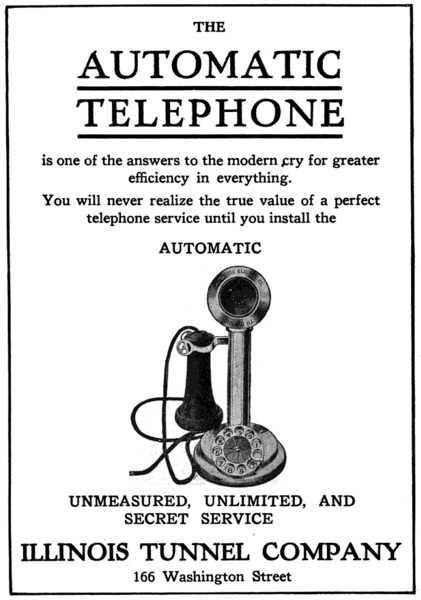
1910 Advertisement for the automatic (dial) telephone service of the Illinois Tunnel Company in Chicago
When I wrote the first edition of The Culture of Collaborationbook in 2006, I summed up the deserialization of work and interaction as the “in-box culture is dead.” The idea was that something called presence would allow us to see who’s available and that we could connect with anybody in the organization via instant messaging. Then—and this is the important point—we could escalate that instant messaging session into a spontaneous voice or video call with the simultaneous capability of collaboratively working on documents, spreadsheets, presentations or in any application. So there was no longer a need to schedule voice and video calls. Through real-time collaboration, we could create far greater value.
Somehow IM took hold in companies but escalation to voice and video calls has seemingly stalled. And use of voice on mobile devices has plummeted. At one time speakerphone quality was a key attribute of devices, but Apple iPhone and Samsung Galaxy marketing barely mention voice.
IM has the advantage over email in that it’s nearly real-time and there’s an expectation of immediate response. So it’s easy to find people and connect with them. The problem is that like email IM and texting are one dimensional. It can be difficult to determine the real meaning and the emotion behind the words. If we talk with each other on a voice call, we can often understand each other better, cut to the chase and resolve issues more quickly than through IM. If the issues are more involved, a video call fits the bill.
Also, people feel less isolated when using real-time voice and video. In fact, there are signs that we are desperate for real connection and interaction that IM and texting can’t deliver. The New York Times recently ran a story on how people are using calls to customer service representatives as therapy sessions. Increasingly, companies are training representatives to show compassion and focus on the emotional needs of the customer rather than rush them off the line.
This phenomenon cuts both ways. Increasingly, customer service representatives are anxious for a real connection. I experienced this first hand when I called a credit card company recently to discuss my airline co-branded card. The representative told me about her background as a former flight attendant and a singer with a band. I also learned that she had a degree in advertising, likes to roller blade and moved from California to Florida. At the end of the call, she arranged a mileage bonus and said “thanks for letting me be me.” We both felt connected in a way that an IM session with the card company could never deliver.
I’m currently writing a new edition of The Culture of Collaboration book and assessing where we’ve gone wrong and how we can get collaboration back on track. When it comes to tools, we’re half way there. Rather than getting stalled with texting and IM (not to mention social media), our challenge is to maximize our ability to find and connect with people. This means turning some of those texting and IM sessions into voice and video calls so that together we can create value.
The in-box culture is dead, but that may be news to the mayor and officials in New York City.
New York’s City Hall apparently never got the message about deserialization. What I mean by deserialization is curbing the in-box or pass-along approach to work and interaction that is critical for collaboration and value creation. But New York Mayor Bill de Blasio has sure received plenty of memos…decision memos, that is.
New York City’s City Hall reportedly embraces the pass-along approach to work and interaction
Before Mayor de Blasio makes many decisions, his staff prepares memos. And before these decision memos reach the Mayor, they reportedly require the signatures of at least eight officials including the first deputy mayor, the law department, the Mayor’s counsel, the budget director, the press secretary, the head of intergovernmental affairs and the deputy mayor with direct responsibility, according to a recent story by J. David Goodman in the New York Times. This is the antiquated pass-along approach.
The Wall Street Journalreports that a memo on flight rules for helicopters took at least nine rounds of revisions. Nine rounds! This is pass-along times nine. And we wonder why citizens complain that government is mired in bureaucracy. The Times story quotes the Mayor’s chief of staff Tom Snyder as saying the Mayor’s decision-making process is “extremely granular, engaged, semi-Socratic.”
Actually, Mayor de Blasio’s approach is anything but Socratic. Socrates believed that the way to the truth was through questioning and dialogue. Socrates rejected writing, because writing meant—quite literally in ancient Athens—that ideas were set in stone or wax and that the process of developing those ideas was dead. Socrates also rejected scripted speeches, because these are essentially the recitation of written words. For organizations making decisions, one form of the truth is accurate information—which is dynamic rather than set in stone. As the situation changes, sometimes hour-to-hour, what can be considered accurate information also shifts.
Using memos or email to make decisions compromises collaboration and disrupts value creation. This approach is a hallmark of command-and-control organizational structure and culture. By the time each department head or official has signed off on the course of action and passed the baton to the next official, the “truth” or facts have often changed. Socrates would roll over. Yet dialogue and questioning without a structure can also pose problems particularly for complex organizations such as New York City government and large, distributed enterprises. So what’s the alternative?
My most recent book, The Bounty Effect: 7 Steps to The Culture of Collaboration, shows how to change the structure of organizations so that they can evolve from command and control to collaborative. And a fundamental element is creating an Open-Access Enterprise which enables the organization for spontaneous dialogue. In the Open-Access Enterprise, everybody has access to everybody else—and that access is immediate.
Using unified communications, we can see who is available and connect instantly. We can bring key stakeholders into collaborative group sessions (CGS) so we can hash out issues in real time, make decisions and create a work product without getting mired in the pass-along approach of memos and meetings. A CGS can occur virtually using unified communications and related tools or the session can happen physically with all participants in the same room.
Mayor De Blasio’s apparent goal of getting broad input into decisions makes sense. Embracing the Socratic method has merit. But the structure and processes of the Mayor’s office appear flawed and are short circuiting the goal. This is typical of many organizations that embrace collaboration as a concept but sabotage collaboration with a command-and-control structure that encourages bureaucracy and reinforces hidden agendas and internal competition. The solution is to adopt a collaborative organizational structure that leaves memos and traditional meetings in the dust. The in-box culture is dead.



 The Culture of Collaboration Blog