the culture of collaboration


  • Fixing General Motors and Curing Veterans Affairs

    General Motors chief executive Mary Barra has vowed to change the company’s culture and has testified

    GM Logo1before Congress that GM has taken steps to increase internal transparency and information sharing. This commitment follows a report exposing that GM discouraged raising or sharing safety concerns. The company commissioned the report, because GM failed to recall thousands of cars with defective ignition switches for eleven years.

    Similar calls for culture change have followed the Veterans Health Administration’s wait-for-care and numbers fudging scandal. President Obama has remarked that VA Image the VA needs a culture change so that “bad news gets surfaced quickly.” Not content to wait for culture change, House and Senate negotiators today announced a $17 billion plan that, among other provisions, provides money to lease clinics so that veterans can get treatment outside the VA’s system.

    Culture change emphasizes the result without a way to get there. It’s like telling a poor person to become rich. Culture change has become a common prescription from leaders, pundits and management gurus. The prescription often fails, because the shift originates with executives without detail, discussion or broad buy-in. Meantime, the organizational structure stays the same.

    The Bounty Effect has hit GM and the VA. As I describe in my new book, The Bounty Effect happens when exigent circumstances compel businesses, government and organizations to change their structures from command-and-control to collaborative. The solution for these organizations is to seize the opportunity The Bounty Effect provides and fundamentally change their structures so that people can spontaneously engage one another, share information and participate in decisions regardless of level, role or region. This will cost far less than $17 billion.

    Many organizations, including GM and the VA, still operate with a structure that has barely changed since the Industrial Age.  This obsolete structure based on command-and-control promotes hierarchy and internal competition plus rewards information hoarding, secrecy, and cutting corners. GM and the VA also share a need to go through channels. This inhibits the participation and information flow critical to Information Age organizations.

    Safety concerns apparently never reached GM’s chief executive, nor did problems with scheduling reporting systems apparently flow to former VA Secretary Eric Shinseki.  And both organizations apparently discouraged people from sharing concerns. VA supervisors often retaliated against workers who raised valid complaints, according to a White House report.

    GM chief executive Mary Barra has said that culture change must be leader-led. Barra has also promoted a program called “speak up for safety” plus three GM “core values.” These are “the customer is our compass, relationships matter, and individual excellence is crucial.” But a leader’s words have modest impact without structural change. Yes, GM has added safety investigators, increased safety data mining, and created a vice president of safety position. Nevertheless, none of these actions will reduce information hoarding and internal competition. None of these actions will change GM’s structure from command-and-control to collaborative. 

    When an organization rewards obsolete behavior, change dies on the vine despite a leader’s mandate. If hoarding and hiding information or failing to act on knowledge results in a raise or a promotion, people are unlikely to share information or take action. Pushing safety issues at GM was seemingly no path to promotion. VA managers reportedly kept patient names off the official waiting list, because bonuses depended on concealing information. Recognition and reward systems in obsolete organizational structures often reinforce bad behavior and the status quo regardless of culture change efforts. The same flawed practices and processes that encourage internal competition and information hoarding lead companies to compromise safety and fudge numbers.

    Changing the VA’s structure will enhance transparency and efficiency while saving money rather than costing the $17 billion Congress is authorizing. Changing GM’s structure will ensure that people across the organization share and act on critical information.  And changing the structure of GM and the VA will accomplish what many leaders and pundits are recommending: culture change.


  • Pope Francis Promotes Collaborative Structure

    The least collaborative organization is changing its structure.

    Which organization? Well, here are some of its characteristics. This global enterprise pays a few people to make decisions while everybody else follows orders. The CEO’s direct reports act like a royal court and compete for face time. Senior leaders often live lavishly and consume conspicuously. Headquarters micromanages satellite offices. Bureaucracy and formality reduce efficiency.  Internal competition runs rampant. The command-and-control organizational structure quashes dissent.

    Sound familiar? This description fits many global corporations and government entities. This particular multinational spent $170 billion in the United States in 2010, according to The Economist. The organization is the Catholic Church and, more specifically, the Roman Curia, the church’s centralized administrative operation.

    Like many corporations, the Catholic Church suffers from an obsolete organizational structure that is compromising value. And like many corporations, reform-minded leaders have tried introducing a new approach. But entrenched interests and a centralized bureaucracy rife with intrigue, fiefdoms, and Machiavellian motivations has frequently derailed change.

    Enter Pope Francis setting the stage for change by wearing a simple white robe and black shoes rather than the regal vestments and ruby shoes of his predecessor. He has washed the feet of inmates and has Pope Francis smallopted to live in a guest quarters rather than the Vatican’s deluxe papal apartments in the Apostolic Palace. There are signs the Pope’s frugal tone is rippling across the Church. In March, the Pope accepted the resignation of Bishop Franz-Peter Tebartz-van Elst of Limburg, Germany who spent the equivalent of $43 million on a new house and office complex.  In April, the Atlanta Archdiocese announced that it would sell Archbishop Wilton Gregory’s $2.2 million mansion.

    Beyond Pope Francis’ rejection of the trappings of office, he is taking steps to adopt a more collaborative structure in the Roman Curia and in the global Catholic Church. The Pope has chosen a “working group” of eight cardinals from outside the Curia to collaborate with him on changing the structure.

    Cardinal Francesco Coccopalmerio heads the Vatican department that writes the church laws that will codify reforms. The Religion News Service quotes Cardinal Coccopalmerio as saying “The big change is the emphasis on collegiality, on collaboration.” Now Pope Francis, Cardinal Cocopalmerio and other new church leaders are focused on breaking down barriers among silos so that information flows around the organization rather than from top to bottom. Cardinal Cocopalmerio has proposed naming a “moderator of the Curia” to identify inefficiencies and cut through red tape.

    Pope Francis participates in meetings without dominating them and embraces broad input. Cardinal Donald Wuerl of Washington, D.C. recently attended one such meeting at the Vatican about appointing new bishops. Typically, popes never attend such meetings. Pope Francis reportedly stayed for three hours. “We’re all sitting around the table, and he comes in and pulls up a chair,” Cardinal Wuerl told Fox News.  At another similar meeting, a senior cardinal asked the Pope what he thought about the topic. “If I told you what I think, you would all agree,” Pope Francis responded according to Cardinal Wuerl. “I want to hear from you what you think.”

    Perhaps most significantly, according to Cardinal Wuerl, the Pope has repeatedly advocated a collaborative process through which “the Holy Spirit can be heard.”  And the Holy Spirit isn’t going to be heard if just one person speaks. “He wants all of us to be speaking with him so at the end of the day he can say this truly was the fruit of the work of the Spirit.”

    Hallelujah. Many corporations in multiple industries including United States government agencies can learn from the Pope’s example. It takes more than window dressing and a desire for change to create value through collaboration.  The only viable approach is changing the organizational structure which, in turn, shifts the culture. My research on collaboration indicates that changing the structure requires seven steps—plan, people, principles, practices, processes, planet and payoff. Pope Francis has demonstrated that making progress through these steps requires that a leader set the stage for change so that others feel comfortable participating.

    In essence, The Bounty Effect has hit the Catholic Church. The Bounty Effect happens when exigent circumstances compel companies, governments and organizations to change their structures from command-and-control to collaborative. For the Catholic Church, exigent circumstances range from sexual abuse scandals to corruption and cronyism at the Vatican. And it’s The Bounty Effect that led to the election of Pope Francis and the structural change now underway.


  • Bankruptcy of Purse–and of Culture

    Can an organization’s culture portend disaster?

    For the answer, we need look no further than some of the most high-profile corporate scandals. Lehman Brothers, Worldcom and Enron— companies that experienced some of the largest bankruptcies in history— used accounting gimmicks which stemmed from bankrupt cultures. Command-and-control, internally-competitive, autocratic, star-oriented organizational cultures breed unethical and—in extreme cases—illegal behavior.

    Now Big Law gives us a new don’t-let-this-happen-to-you poster child for embracing the right culture. Leaders of the once top-tier law firm of Dewey & LeBoeuf overstated revenue and used accounting tricks to hide losses and cash flow shortfalls, according to a 106-count indictment that a New York state grand jury handed up last Thursday. If convicted of the most serious charges, Chairman Steven Davis, Executive Director Stephen DiCarmine and Chief Financial Officer Joel Sanders, each face up to 25 years in prison. Dewey filed for Chapter 11 bankruptcy in May of 2012. The alleged financial shenanigans began as billings dipped and clients evaporated during the depths of the 2008 financial crisis.

    But Dewey’s problems began long before the firm’s leaders allegedly began their deceit, as I describe in my new book, The Bounty Effect: 7 Steps to The Culture of Collaboration®. Formed in 2007 from a merger of two venerable firms, Dewey Ballantine and LeBoeuf, Lamb, Greene & MacRae, the firm reportedly employed three thousand people globally at its height. Dewey’s roots date back a century, but it took roughly five years for the firm to come unglued.

    Among other cultural defects, the newly-merged firm created a two-tier partnership system in which it treated “stars” differently than other “partners.” After the merger, Dewey began recruiting so-called “lateral partners” rather than promoting from within. These partners received multiyear, multimillion-dollar guarantees. Dewey’s secretive culture prevented the firm from sharing this information with all of the partners. While one lateral partner reportedly had a six-million-dollar-a-year guarantee, other partners received four hundred and fifty thousand dollars a year.

    The stars were those who the firm expected would bring in the most business. Dewey considered other partners “service partners,” the ones who wrote briefs and performed or managed the legal heavy lifting. When word of the wide compensation gap spread, the service partners—many of whom had worked for the firm much longer than the newly-recruited “stars”—became resentful. Clearly, star culture had compromised trust and poisoned the organization. And, guess what? Some highly-touted “stars” were unable to live up to their hype, and therefore revenue fell short of what Dewey needed for paying annual compensation commitments to these “stars.”

    The merger occurred right before the financial crisis. By the end of 2008, Dewey had more than $100 million in term debt outstanding and available lines of credits totaling more than $130 million with four banks. The firm’s credit agreements required Dewey to maintain a minimum cash flow. To abide by this covenant, the firm’s leaders and others conspired to misrepresent Dewey’s financial performance, according to the indictment.

    So brazen were the defendants, according to the indictment, that they created a document called the “Master Plan” which outlined fraudulent accounting tricks. Plus they reportedly discussed the alleged fraud in a series of emails. One of these apparently read, “Can you find another clueless auditor for next year?”

    Suppose Dewey had fostered a collaborative rather than command-and-control culture and organizational structure? What if Dewey had shared rather than hoarded information, harnessed broad input into decisions, and encouraged partners to work together both in developing business and producing legal work? The firm may have weathered the financial crisis rather than devolving into apparent unethical and possibly illegal activity.

    Dewey is by no means the only law firm with a two-tier partnership system. Nor is it the only firm that embraces a star-oriented, command-and-control culture. Many law firms and organizations in multiple industries and sectors run the risk of financial implosion, because their cultures are bankrupt. The solution, as I describe in The Bounty Effect, is to change the structure of organizations from Industrial Age command-and-control to Information Age collaborative


  • Rank and Yank or Differentiation?

    Sometimes corporate speak or shop talk migrates from cubicles to the front page. This is exactly what happened to the terms “performance review” and “performance appraisal” last November. That’s when Microsoft eliminated its so-called “stack ranking” of team members.

    Last spring, Microsoft Chairman and co-founder Bill Gates read an advanced copy of The Bounty Effect: 7 Steps to The Culture of Collaboration®. The book shows how to change organizational structures from Industrial Age command-and-control to Information Age collaborative. Regarding performance reviews, The Bounty Effect demonstrates why ranking team members falls short and how a Collaborative Reward System creates greater value than an internally-competitive system. Ranking is essentially grading on a curve, because the organization often pre-determines which percentage of its workforce must fall into categories such as below target, target, above target and significantly above target. And grading on a curve fosters internal competition rather than collaboration. How encouraged are team members to share information and ideas if they must compete with colleagues for rankings? Not very. More likely, people will try to fake collaboration.

    Headlines regarding Microsoft’s shift include “Stack Ranking Falls Outs of Favor” in Computerworld and “Microsoft Kills Its Hated Stack Rankings” in Bloomberg BusinessWeek. Within several days of Microsoft’s elimination of stack ranking, I was on a flight from Taipei to San Francisco reading The Wall Street Journal Asia edition. And I was fascinated to see a condemnation of Microsoft’s shift and a defense of ranking team members from Jack Welch, who once was CEO of a company known for using what Welch calls “differentiation.” That company is General Electric.

    Here’s how Welch describes differentiation: “It’s about building great teams and great companies through consistency, transparency and candor. It’s about aligning performance with the organization’s mission and values. It’s about making sure that all employees know where they stand. Differentiation is nuanced, humane and occasionally complex, and it has been used successfully by companies for decades.”

    In The Culture of Collaboration® book, I describe “differentiation and affirmation.” The process is more commonly called “rank and yank,” a term that Welch considers “media-invented” and “politicized.”  One company that adopted the approach and created a star culture was Enron, which went bankrupt for many reasons.  Star culture is a hallmark of the Industrial Age command-and-control organization. Such organizations pit people against one another and hidden agendas multiply. In contrast, a collaborative organization encourages team members to work in concert towards common goals.

    Welch seems to endorse star culture in describing “feedback and coaching” as one component that makes “differentiation” work. “Your stars know they are loved and rarely leave. Those in the middle 70% know that they are appreciated, and they receive clear guidance about how to improve their performance. And the bottom 10% is never surprised when the conversation sometimes turns, after a year of candid appraisals, to moving on,” according to Welch.

    Further, Welch endorses the “bell-curve” grading aspect of “differentiation.” “We grade children in school, often as young as 9 or 10, and no one calls that cruel. But somehow adults can’t take it? Explain that one to me.” Well, here it goes, Jack. Curve grading is no more helpful to children in school than it is to organizations. Our educational systems, particularly in the United States, too often foster unnecessary competition rather than collaboration. It’s no wonder why corporations have difficulty migrating from command-and-control to collaboration. Part of the reason is that team members competed for grades in school, competed for graduate school admissions while in college, and then competed for limited grant money and fellowships while in graduate school. In particular, law schools often grade first-year students on a curve in part to limit merit scholarship awards. Eliminating curve grading in which a fixed percentage must fail is a major step towards reducing internal competition and curbing the “star culture” that complicates collaboration.

    Ranking team members is part of the broader recognition and reward process. This process typically features performance reviews, which distract organizations and waste an incredible amount of time. The Bounty Effect describes how to replace performance reviews with a far more collaborative approach. Whether we call ranking team members “differentiation” or “rank and yank,” this Industrial Age command-and-control approach has no place in an Information Age collaborative organization.


  • Media Embraces The Bounty Effect’s Structural Change

    There are encouraging signs that the media is recognizing that the structure of organizations must change to enhance collaboration and maximize value. And when the media gets on board, organizations often follow.

    Several media outlets that have featured The Bounty Effect: 7 Steps to The Culture of Collaboration have focused on changing organizational structures from Industrial Age command-and-control to Information Age collaborative. This is crucial, because The Bounty Effect is about seizing opportunities to design and build new organizational structures that exigent circumstances provide. So, reviewers and journalists have clearly understood the central theme of the book.

    Reviewing The Bounty Effect in The Washington Times, James Srodes describes the big picture of why changing organizational structures is necessary. He relates the need for collaborative structures to the changing “hinges of history” in which a decades-long trend suddenly shifts. Srodes mentions a global economic state where little or no growth is the norm and dwindling raw materials and political instabilities among other trends impacting the planet. This insightful review endorses the book’s approach:

    “If you recoil at the notion of folks sitting around a boardroom campfire singing “Kumbaya,” Mr. Rosen offers an ingenious example of the essence of the collaboration strategy. The “Bounty” in his title is in fact the HMS Bounty, famed in Hollywood’s bogus history for its portrayal of a despotic (command-and-control) Captain Bligh.”

    In a question-and-answer article with me entitled “Can Collaboration Be Forced?” in Talent Management magazine, Kellye Whitney also focuses on changing the organizational structure. My answer to a question about what talent leaders can do to change command-and-control structures echoes the “hinges of history” shift in the Washington Times review:

    “In the workplace we should constantly be working to create value. It used to be that companies could make a decent buck by just telling people what to do. A few people were paid to do the thinking and everybody else was paid to carry out orders. But with globalization, increased competition and the boom and bust cycles, companies are realizing that it’s all hands on deck.”

    In another question-and-answer article entitled “The New Way We…Collaborate” in Avaya Innovations magazine, Eric Lai focuses the interview on changing organizational structure and culture. Here’s my response to his question about the role of technology in changing the structure and culture:

    “The Greek philosopher Socrates believed that the way to truth is through dialogue. Socrates rejected writing because it meant—quite literally in Ancient Athens—that ideas were set in stone or wax and that the process of developing those ideas was dead. Email is the modern equivalent of setting ideas in stone. If given the choice, Socrates would have found a lot more truth in using real-time tools rather than email. Email is essentially an updated version of the old memorandum. In command-and-control organizations, people send an email and wait for a response. An email is often a report or a request for a decision. There is no real-time dialogue in email, so Socrates would have found little truth in email.”

    So the media is beginning to join the growing numbers of organizations that have jumped on the structural change bandwagon.


  • World Bank, Microsoft Changing Structure for Collaboration

    More and more organizations are recognizing that obsolete organizational structures are impeding collaboration. I identify this issue and detail solutions in my new book, The Bounty Effect: 7 Steps to The Culture of Collaboration®.

    One of the latest organizations to begin adopting a collaborative structure because of The Bounty Effect is the World Bank. The World Bank has announced that it’s moving away from a command-and-control organizational structure that is compromising value. The World Bank will instead adopt a collaborative structure for greater speed and efficiency. The new structure will enable internal collaboration across functions, groups and regions. Plus the new structure will enhance external collaboration particularly with the private sector.

    World Bank President Jim Yong Kim announced the shift after a survey of ten thousand team members revealed a “culture of fear” and a “terrible environment for collaboration,” according to an October 6, 2013 story by Annie Lowrey in the New York Times. Further, Kim told the New York Times he feared the World Bank’s culture and structure might short-circuit its new goals of eradicating extreme poverty by 2030 and ensuring “inclusive growth.”

    The Bounty Effect for the World Bank is that the organization, which is financed by 188 member countries, faces increasing competition in supporting developing economies from many groups. One of these is the Bill and Melinda Gates Foundation. Incidentally, Bill Gates also chairs the Microsoft board of directors. In July, Microsoft announced it would change its organizational structure to reduce internal competition, curb silos and enhance collaboration. Bill read an advance copy of The Bounty Effect: 7 Steps to The Culture of Collaboration®. The book shows how to change the structure and culture of organizations from Industrial Age command-and-control to Information Age collaborative.

    Microsoft, the World Bank and many organizations suffer from similar shortcomings. While many have embraced collaboration as a concept and have even developed pockets of collaborative activity, the broader organization remains mired in command-and-control.

    Remnants of Industrial Age command-and-control compromise value creation. These remnants include 19th Century vertical organization charts, the need to go through channels, traditional meetings, and recognition and reward systems that reinforce internal competition among many others. The Bounty Effect: 7 Steps to The Culture of Collaboration® identifies these remnants and details how to replace them with infinitely more valuable collaborative building blocks.

    As the World Bank, Microsoft and growing numbers of organizations recognize The Bounty Effect’s impact on them, they can use the opportunity to implement the 7 Steps to The Culture of Collaboration® and ultimately create far greater value.


  • Big Data, Measurement Mania and Collaboration

    The world is drowning in data. The term “Big Data” appears in most technology trend articles in 2013 and reverberates at seemingly every conference regardless of industry. This reminds me of a quote attributed to Mark Twain that I used with my senior picture in the high school yearbook: “Collecting data is much like collecting garbage. You must know in advance what you are going to do with the stuff before you collect it.”

    Now companies and government agencies have an idea what they’re going to do with the data they collect. And a leading use of data is measurement. Measurement mania has spread throughout every function of seemingly every organization from government agencies and universities to public school systems and corporations. Organizations can now measure traits among applicants and team members ranging from emotional intelligence to flexibility. Plus companies can calculate transactional cost-per-hire.

    The relentless drive to measure people can reduce value creation and compromise collaboration. Measurement mania breeds fear and internal competition among team members and encourages leaders to focus on short-term results which create less sustainable value than achieving longer-term objectives. In a numbers-obsessed organization, leaders are more likely to cut corners by booking phantom sales or sacrificing safety in manufacturing plants. With hidden agendas running rampant, collaboration towards common goals becomes impossible.

    Media reports suggest that Zynga, the company that develops online games including FarmVille, has thrived on numbers. “Relentlessly aggregating performance data, from the upper ranks to the cafeteria staff,” is the way Evelyn M. Rusli of the New York Times describes the company in a November 27, 2011 story. According to a November 28, 2011 blog post by Ryan Fleming of Digital Trends, executives nurture “fierce competition both between the groups and within each department.”

    Apparent measurement mania is one of many structural and cultural issues that have plagued Zynga. A September 8, 2010 story in SF Weekly by Peter Jamison indicates that the company’s values are sub-optimal and that rather than focusing on innovation, Zynga has instead pushed team members to appropriate ideas from competitors. If these assessments are accurate, it appears that Zynga would benefit from changing the structure and culture of its organization. Principles is one step that I explain in my new book, The Bounty Effect: 7 Steps to The Culture of Collaboration.

    In perhaps the most sober indication of problems with Zynga’s focus, the company reported second quarter results last Thursday that contained few bragging rights. While the results exceeded analyst expectations, the number of daily active users declined 45 percent in the quarter from the same period last year. In the three months ending June 30, Zynga’s sales fell 31 percent to $231 million. According to the Wall Street Journal, Zynga CEO Don Mattrick indicated that “getting a business back on track isn’t quick, and isn’t easy.” Mattrick recently replaced founder Mark Pincus as CEO.

    While Zynga clearly faces challenges on many fronts, the company’s structure and culture are likely factors in Zynga’s woes. The company is by no means alone in the issues it faces and the possible structure and culture elements. Organizations of all kinds face exigent circumstances ranging from new competitors and disruptive market forces to natural disasters and terrorist attacks. These storms that blow through businesses provide opportunities to change.

    In The Bounty Effect, I discuss how to replace command-and-control remnants including measurement mania and how to adopt collaborative principles, practices and processes among other steps. Creating value through collaboration happens only when organizations change their structures and cultures from Industrial Age command-and-control to Information Age collaborative.


  • Seven Steps to The Culture of Collaboration

    My new book, The Bounty Effect: 7 Steps to The Culture of Collaboration, has received two favorable reviews: one in Publishers Weekly and the other in Library Journal. Both reviews focus on the 7 Steps: Plan, People, Principles, Practices, Processes, Planet and Payoff.

    I’m delighted that both reviewers understood the book’s premise that businesses must abandon obsolete organizational structures designed for the Industrial Age and replace them with infinitely more valuable collaborative structures suitable for the Information Age. Leigh Mihlrad of the National Institutes of Health reviewed The Bounty Effect for Library Journal. “Rosen declares that while the control method might have worked in the Industrial Age, it does not work in today’s Information Age,” according to the review. Mihlrad concludes with the Library Journal's verdict: “For those in positions to bring about organizational change, this book provides many useful examples.”

    The Publishers Weekly review highlights my point that The Bounty Effect is by no means limited to corporations. “Rosen argues that collaboration moves well beyond organizational boundaries, as it applies to neighborhoods, communities, and government,” according to Publishers Weekly.  “Collaboration creates greater value, enhances achievement, and produces sustainable business models; the question then becomes how quickly can an organization free itself from the Industrial Age and operate to its maximum capacity in the Information Age.” The sooner an organization starts the seven steps, the faster it can migrate from command-and-control and maximize value through collaboration


  • Changing Organizational Structures for Collaboration

    My new book entitled The Bounty Effect: 7 Steps to The Culture of Collaboration® is now available. It’s the second book in a series which includes The Culture of Collaboration®: Maximizing Time, Talent and Tools to Create Value in the Global Economy. The Bounty Effect shows how to change the structure of organizations for collaboration.

    Why do organizations need to change their structures? The Industrial Age was command and control. The Information Age is collaboration. Yet Industrial Age structures render collaboration dead on arrival in the Bounty Effect Jacket JPGInformation Age. Remnants of these structures—including organization charts, performance reviews, meetings and mission statements—inhibit organizations from using new collaborative methods and tools that spark innovation. Now we’re at the point where many organizations—from corporations and small businesses to universities and government agencies—have a desire to collaborate.  Some have taken action to instill collaborative culture. But what’s holding back collaboration is obsolete organizational structures, which we must change.

    The Bounty Effect gets its name from the mutiny that occurred on the H.M.S Bounty in 1789. Before the mutiny, Captain William Bligh used a well-worn management technique: command-and-control. The mutiny forced the structure and culture to change as Bligh became a collaborative leader and his loyalists participated in decisions as they struggled for survival aboard a small boat. The mutiny was an exigent circumstance, one that compels immediate action.

    The Bounty Effect happens when exigent circumstances compel businesses, governments and organizations to change their structures from command and control to collaborative. Triggers include disruptive market forces, new competitors, regional slowdowns, natural disasters, terrorist attacks and global downturns.

    The book is about how to seize the opportunity that The Bounty Effect provides and change the organizational structure in seven steps.  My objective in writing the book is to provide a framework for structural change necessary to transform organizations into collaborative enterprises. And The Bounty Effect demonstrates how collaborative enterprises create far more value than command-and-control organizations. Using the framework, people and organizations can determine how to redesign and adopt a collaborative structure that fits. I welcome your input.


  • Multicultural Collaboration Produces Unique Spa

    Bridging cultures, particularly regional cultures, produces a broader perspective that gives collaborators an edge. In disciplines like aerospace engineering, team members trained in one country’s engineering tradition may view a creative challenge differently than their colleagues who were trained in a different country’s system. Drawing from their collective global knowledge, cross-cultural collaborators can spark synergies and create greater value. In The Culture of Collaboration book, I call this the Dynamic Dimension of Cross-Cultural Collaboration.

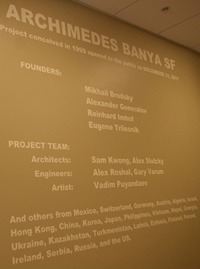
    This dimension is alive and well at Archimedes Banya, a spa complex that opened in San Francisco last New Year’s Eve after twelve years of development and construction. People from twenty different countries collaborated on the project. Managing partner Mikhail Brodsky of Russia had the original idea. Reinhard Imhof of Switzerland led the indoor construction. Architect Sam Kwong of China developed the plans. Other partners are from countries including Korea, Israel, Germany, Japan, and Mexico.

    The concept began when Brodsky, a mathematician, arrived in San Francisco from Moscow in 1989. A lBanya2over of Russian bath complexes or banyas, Brodsky was disappointed to find no such facilities in his adopted city. He longed to start a banya. In the summer of 1998, Brodsky, then a professor at the University of California at Berkeley, applied for a job as chair of the mathematics department at San Francisco State University. SFSU’s rejection sparked Brodsky’s interest in doing something significant in San Francisco while delivering on his banya dream.

    Brodsky, Imhof and two other partners formed a company, and in 1999 bought a lot in India Basin near San Francisco’s former Hunters Point Shipyard. Though in an obscure neighborhood, the lot provided sweeping views of San Francisco Bay. To construct the building, Brodsky and his partners would need to recruit more partners. Like many ethnic groups living in the United States, many Russians do business only within their community. Therefore, logic would dictate engaging Russians to finance, design and build the project. But some Russians who Brodsky approached had difficulty seeing past the many roadblocks to the project ranging from building permits and location to construction costs and customer base. So, Brodsky decided to broaden his reach, involving people from as many countries as possible. The common thread was a passion for the Banya project plus mutual trust and common goals, two of the Ten Cultural Elements of Collaboration I identify in The Culture of Collaboration book.

    In a departure from the command-and-control approach to business in which “stars” grab the credit, Archimedes Banya recognizes multiple contributions in much the same way Adobe Systems includes a Banya Wallcredit role in its software products. When I visited Archimedes Banya recently, the first thing I noticed was a wall near the entrance listing the names of the multicultural collaborators who turned the concept into reality. Also apparent was the amazing art ranging from mosaics depicting bathing traditions to murals and inlaid ceiling tiles. Including art in public bathing facilities is a tradition dating back to the Roman Empire.

    Artist Vadim Puyandaev of Kazakhstan collaborated with Brodsky to evoke the right atmosphere. “I
    wanted very simple, clear images of emotion,” says Brodsky. And the images also reflect action. “In a Russian banya, people move. It’s an active place. It’s not just sitting and sweating.” The complex is geared to socializing and offers facilities ranging from a rooftop sun deck with a San Francisco Bay view to private reception rooms replete with bars and kitchens.

    The Banya offers a spa experience reflecting the cultural melting pot. I checked out two Russian saunas, the Finish dry sauna, the steam room, warm soaking pools, cold plunge and relaxation room. After loosening up in the various saunas, I experienced a Russian venika platza treatment that involved a tall Moldovan fellow clad in a towel and sweat-soaked Banya hat brushing and lashing bunches of Latvian birch leaves on me to increase circulation.

    Following this, I laid on a table as an attendant scrubbed me with an exfoliating soap and then rinsed me with buckets of warm water. Then my muscles were relaxed enough for a massage from a masseuse from the United States. Afterwards, I headed to the café upstairs for pelmini or Russian dumplings, stuffed cabbage, hearty Russian beef soup, fresh-sqeezed juices spiked with kombucha, which is fermented tea and housemade kvass, a non-alcoholic beer made from fermented rye bread.

    An ambitious spa project that began as one person’s vision ultimately reflects the combined vision and execution of multiple people from many cultures. Collaboration involves marrying talents that are worth far more collectively than individually. Brodsky describes himself as a “starter.” But to make the project a reality, he collaborated with Imhof, a “finisher.” Because of the Swiss tradition of quality workmanship, Imhof shared Brodsky’s values of using the best materials and constructing a banya for the long term. The concept of “starters” and “finishers” has broad ramifications. A starter may have an incredible idea, but creating a company that produces substantial value may require collaborating with a finisher.

    As we collaborate, we can create awesome value by engaging and involving people with multiple talents and backrounds and, yes, from multiple cultures. The Dynamic Dimension of Cross-Cultural Collaboration delivers results otherwise unattainable.