Toyota


  • New Expanded and Updated Edition of The Culture of Collaboration® Book

    How has collaboration evolved? What is the current state of collaboration at Toyota, Mayo Clinic, Industrial Light & Magic, Boeing and other companies profiled in the first edition of The Culture of Collaboration® book? What are the keys to long-term value creation through collaboration?

    These are questions I sought to answer as I went back inside collaborative companies to research and write the new, expanded and updated edition of The Culture of Collaboration® book.
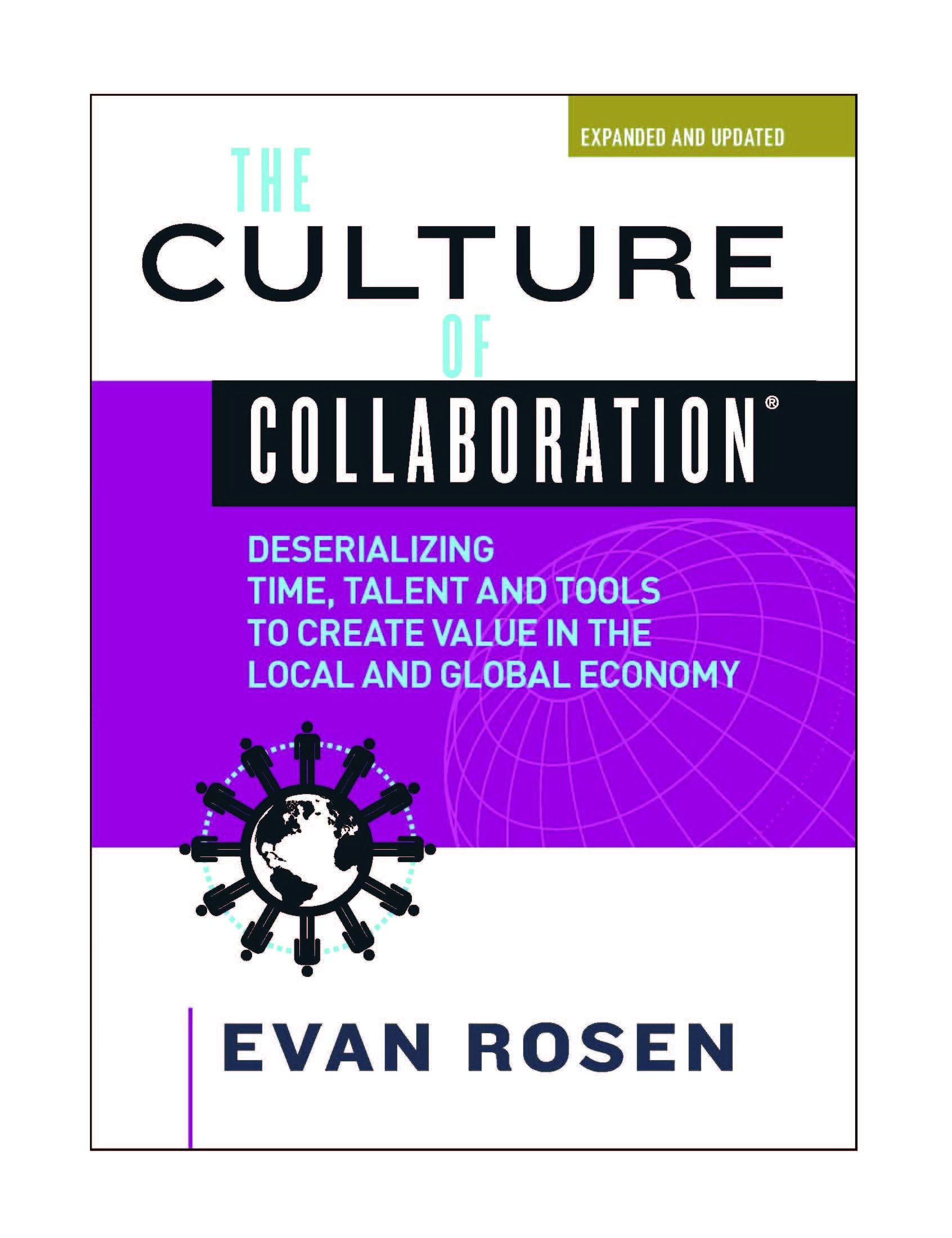
    Jacket with border CofC EU


    The expanded and updated edition has just been released, and I’m proud of the finished work. The 363-page business book includes 54 images and illustrations and a beefy index. By the way, 54 images and illustrations is no easy feat in 2024. Ever wonder why most business books lack pictures? It’s time-consuming to license even a single image from a large organization.

    One thing I’ve learned is that deserialization and collaboration go together like peanut butter and jelly. Deserialization means removing sequences from the lifecycle of products and services. The idea is to collapse outmoded sequential approaches and replace them with spontaneous, real-time processes.

    Deserialization also involves removing sequences from interaction. This means killing what’s left of the in-box culture. In short, deserialization is the key to long-term value creation through collaboration. That’s why the subtitle of the expanded and updated edition of The Culture of Collaboration® is: Deserializing Time, Talent and Tools to create Value in the Local and Global Economy.

    I’ve also learned that despite best efforts, collaboration can stall within highly-collaborative organizations. Paradoxically, collaboration happens in companies in which the dominant culture is command and control. Likewise, internal competition and command and control exist in mostly-collaborative organizations. Many factors, as I explain in the expanded and updated edition, influence both the evolution and regression of The Culture of Collaboration.

    More broadly… as I write in the preface, in some ways we’re less collaborative than we were in the early 2000s. Social media lets us broadcast opinions without refining ideas through real-time interaction. We join groups that make rules for how we should think. Videoconferencing enables interaction at a distance, but too often we’re wasting time in scheduled virtual meetings rather than creating value together spontaneously. While in the same room, we meet rather than collaborate. We leave meetings to work and then schedule follow-up meetings to review work. This serial process zaps value.

    My objective in revisiting this topic is to consider whether we have evolved or veered off track and to provide a new framework for unblocking collaboration and unlocking value.

    Let me know your thoughts about the new, expanded and updated edition of The Culture of Collaboration® book.



  • BMW, Toyota and Collaborating with Competitors

    They compete in the marketplace, but now they’re also collaborating.

    BMW Toyota CollaborationBMW and Toyota have announced they will collaborate in two areas: the companies will share costs and knowledge for electric car battery research, and BMW will supply diesel engines to Toyota. Toyota owns the luxury brand, Lexus, and therefore BMW and Toyota directly compete in the luxury car segment. Both companies have a significant collaboration track record.

    In The Culture of Collaboration book, I describe how BMW and Toyota create value by collaborating internally and with business partners. The preface, which you can read here, reveals how my visit to the BMW design center in Munich some years ago sparked the book.

    So why would two competitors collaborate? Collaborating makes sense within enterprises and with partners, but the marketplace requires pure competition. Right?  Well, that depends.

    Collaborating among competitors makes sense when the collaboration:

    1. Creates value for both parties
    2. Begins with structure and clarity
    3. Involves non-differentiating processes

    Clearly, the BMW/Toyota collaboration nails number one. “We think that this collaboration will allow for development of next-generation batteries to be done faster and to a higher level,” Toyota Executive Vice President Takeshi Uchiyamada said at a news conference. Both companies will share the costs of battery development. 

    Toyota will reportedly use BMW’s 1.6 and 2-liter diesel engines for cars sold in Europe beginning in 2014. This is reportedly the first time Toyota has procured an engine from a competitor. According to a story by Yoshio Takahashi and Kenneth Maxwell in the December 2, 2011 edition of the Wall Street Journal, the collaboration will reduce BMW’s engine production costs per unit by increasing volume. So, value creation is at the heart of this collaboration.

    What about #2, structure and clarity? Based on what I know of BMW and Toyota and their approaches to collaboration, chances are this effort involves much of both. In any collaboration among competitors, both parties must establish boundaries for collaboration at the outset. Most importantly, the competing collaborators must determine use and ownership of existing and jointly-created intellectual property. Far fewer problems arise when business unit people, engineers, marketing folks, lawyers and others from both companies hash out these concerns rather than simply handing off the issues to lawyers to hash out in a vacuum.

    Regarding #3, I’ve found that collaboration among competitors works best when the effort involves eliminating redundancy in non-differentiating processes. These are typically under-the-hood processes that are not part of a company’s market or product perception.  Two companies that each make hot sauce might use the same bottling equipment. Two newspapers in the same market might use the same printing presses. Entire industries participate in consortiums for purchasing, saving each competing company substantial money. These shared, non-differentiating processes are invisible to the customer. 

    Engines are invisible to all but the most die-hard car enthusiasts, so collaborating on this process arguably fits the bill as non-differentiating. Typically, car batteries have nothing to do with the vehicle perception in the marketplace. In the case of electric cars, though, the jury is still out whether the battery is invisible to the consumer. The technology is in its infancy, and therefore the market consists primarily of early adopters. These consumers are more techno-savvy, realize the lithium-ion battery is intrinsic to the product’s technology and performance, and therefore may place a heavier emphasis on the battery in their purchase decisions.

    So, it remains to be seen whether battery research and development is non-differentiating for BMW and Toyota. Nevertheless, if both companies can save substantial money on development and bring vehicles to market sooner and customers perceive and actually get better electric vehicles, this collaboration will prove successful.