Evan Rosen


  • General Motors and the “C” Word

    General Motors CEO Mary Barra is taking aim at the “C” word.

    “I hate the word culture,” Barra is quoted as saying in an article by Joseph B. White in the Mary BarraSeptember 30 edition of the Wall Street Journal. “Culture is really just how we all behave,” according to Barra. The comments are curious in that Barra testified before a Congressional subcommittee last June that she would

    GM CEO Mary Barra outlines new strategic plan  (Image copyright GM)

    not rest until GM’s “deep underlying cultural problems” are resolved. The subcommittee was investigating GM’s failure to recall thousands of cars with defective ignition switches for eleven years.

    It’s myopic to dismiss the word culture. Merriam-Webster Dictionary’s third definition of culture is “a way of thinking, behaving, or working that exists in a place or organization.” GM would benefit from focusing on these issues plus the broader context of the word culture. In his Tusculan Disputations, the ancient Roman orator Cicero introduced the concept of culture as cultivation of the soul as a farmer cultivates crops. Culture has come to represent beliefs and customs of societies. Cultural anthropologists study social structure and customs in populations ranging from villages to corporations.

    Culture is inextricably intertwined with collaboration in that how “we all behave” in Barra’s words determines whether we’re working together towards common goals or working at cross purposes. Ironically, in a July 28, 2014 post, The Culture of Collaboration® blog took General Motors to task for overemphasizing culture change without structural change. Culture change typically delivered as an edict often highlights the desired result without providing a way to get there. This common prescription from leaders, pundits and management gurus often fails, because the shift originates with executives without detail, discussion or broad buy-in. Meantime, the outmoded organizational structure stays the same. To achieve collaborative culture and the payoff that collaboration provides, it’s necessary to change the organizational structure. Then culture change can happen.

    On October 1, GM outlined its new strategic plan that focuses on technology and product advances, growth in China, establishing Cadillac as a separate business unit “headquartered” in New York City and delivering “core operating efficiencies.” Incidentally, the notion of headquarters is a relic of Industrial Age command and control. Nowhere does the plan mention structural change, which the automaker sorely needs. Changing GM’s structure requires overhauling everything from how team members share information across levels, roles and regions to how the company recognizes and rewards people as I detail in my book, The Bounty Effect: 7 Steps to The Culture of Collaboration®.


  • Seven Steps to The Culture of Collaboration

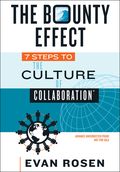
    My new book, The Bounty Effect: 7 Steps to The Culture of Collaboration, has received two favorable reviews: one in Publishers Weekly and the other in Library Journal. Both reviews focus on the 7 Steps: Plan, People, Principles, Practices, Processes, Planet and Payoff.

    I’m delighted that both reviewers understood the book’s premise that businesses must abandon obsolete organizational structures designed for the Industrial Age and replace them with infinitely more valuable collaborative structures suitable for the Information Age. Leigh Mihlrad of the National Institutes of Health reviewed The Bounty Effect for Library Journal. “Rosen declares that while the control method might have worked in the Industrial Age, it does not work in today’s Information Age,” according to the review. Mihlrad concludes with the Library Journal's verdict: “For those in positions to bring about organizational change, this book provides many useful examples.”

    The Publishers Weekly review highlights my point that The Bounty Effect is by no means limited to corporations. “Rosen argues that collaboration moves well beyond organizational boundaries, as it applies to neighborhoods, communities, and government,” according to Publishers Weekly.  “Collaboration creates greater value, enhances achievement, and produces sustainable business models; the question then becomes how quickly can an organization free itself from the Industrial Age and operate to its maximum capacity in the Information Age.” The sooner an organization starts the seven steps, the faster it can migrate from command-and-control and maximize value through collaboration


  • Changing Organizational Structures for Collaboration

    My new book entitled The Bounty Effect: 7 Steps to The Culture of Collaboration® is now available. It’s the second book in a series which includes The Culture of Collaboration®: Maximizing Time, Talent and Tools to Create Value in the Global Economy. The Bounty Effect shows how to change the structure of organizations for collaboration.

    Why do organizations need to change their structures? The Industrial Age was command and control. The Information Age is collaboration. Yet Industrial Age structures render collaboration dead on arrival in the Bounty Effect Jacket JPGInformation Age. Remnants of these structures—including organization charts, performance reviews, meetings and mission statements—inhibit organizations from using new collaborative methods and tools that spark innovation. Now we’re at the point where many organizations—from corporations and small businesses to universities and government agencies—have a desire to collaborate.  Some have taken action to instill collaborative culture. But what’s holding back collaboration is obsolete organizational structures, which we must change.

    The Bounty Effect gets its name from the mutiny that occurred on the H.M.S Bounty in 1789. Before the mutiny, Captain William Bligh used a well-worn management technique: command-and-control. The mutiny forced the structure and culture to change as Bligh became a collaborative leader and his loyalists participated in decisions as they struggled for survival aboard a small boat. The mutiny was an exigent circumstance, one that compels immediate action.

    The Bounty Effect happens when exigent circumstances compel businesses, governments and organizations to change their structures from command and control to collaborative. Triggers include disruptive market forces, new competitors, regional slowdowns, natural disasters, terrorist attacks and global downturns.

    The book is about how to seize the opportunity that The Bounty Effect provides and change the organizational structure in seven steps.  My objective in writing the book is to provide a framework for structural change necessary to transform organizations into collaborative enterprises. And The Bounty Effect demonstrates how collaborative enterprises create far more value than command-and-control organizations. Using the framework, people and organizations can determine how to redesign and adopt a collaborative structure that fits. I welcome your input.